In high-low hoof deviations, the forearm and cannon make up an almost straight vertical line, even with parallel displacement and rotations.
When these foals are suckling or grazing, they bring one leg forward to carry their weight, while the other either bends backward or is lifted to bend at the knee. With one leg carrying far less weight than the other, one steep and one short hoof develops. In the worst cases, they can develop a club foot.
This deviation is caused by tendons, muscles, ligaments and joint surfaces developing to shape a more upright leg. It escalates when the foals are about 3 months old, when they have grown and must reach even farther down to suckle.
Club foot is a condition where the two bottom bones have a broken-forward axis, Hall of Famer Dr. Simon Curtis says. A high-low horse has a straight hoof-pastern axis, no matter its angle. This high hoof is also known as the steep hoof.
The steep hoof typically has a shorter and deeper frog than the other leg. Usually, we find there’s a 5 mm difference in the deepest point of commissures (the groove between the frog and the bar) in the two front legs. Sometimes, growth rings can be seen as broader in the heel than at the toe because of the pressure in the front part of the hoof caused by the steep pastern angle.
The front leg that’s placed forward is carrying most of the weight at the palmar part of the hoof (from the widest part of the hoof and backward). The tendons, muscles, ligaments and joints develop a conformation that ultimately shapes a practically flat hoof on this leg. The frog is typically larger on this hoof because of the coffin bone’s position and the added strain on the frog. This also results in compressed bars that are pushed forward and a longer toe growth.
We do not believe it’s essential to force equality between the two front legs. While the biomechanical issues may easily be solved by therapeutic shoes, trimming to an unnatural shape of the hoof capsule may lead to injury. Also, we have found this is not where the problems reside.
Importance of Hind Legs
We were intrigued by Dr. Ric Redden’s study of the club foot. He found that in horses with club foot, the hind hoof on the same side always had a negative coffin bone angle, while the opposite hind hoof was normal and strong. We’ve made the same systematic finding in our clients’ horses with mismatched feet, not only those with club foot.
The strain on this hind leg is critical and a source of problems for the horse and rider. These horses carry their weight mostly on the same diagonal (low front, negative hind) while grazing and nursing. They develop rotation of the back from strain with a negative axis on the hind leg that’s parallel to the steep front leg. This may be visible by the coronet band being steeper on this hind leg.
When shoeing horses that are high-low, we have discovered a recurring problem — these horses are not sound. Riders feel they are lame, imbalanced and problematic. There are clear differences in movement going different directions on the circle. After evaluation and then shoeing based on our system, they have improved.
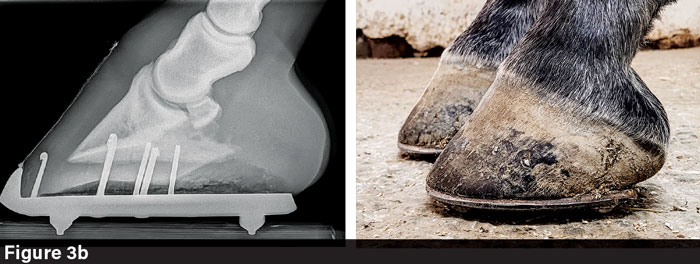
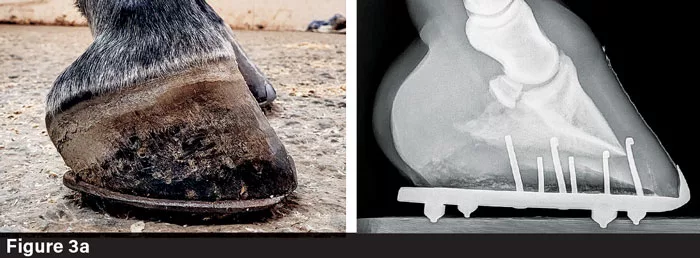
The left front low hoof of the horse. Stig Haga, Dr. Martin Hjelle
High-Low Hoof Care
We trim these horses as any other, removing the growth of the hoof wall and sole horn. As the legs have different hoof-pastern axes, each individual hoof capsule gets different strains and wears, so the growth is unique to each hoof.
We don’t recommend shaping the hooves identically. The joint surfaces, ligaments and tendon junctions are placed as the horse has developed, and each leg should help achieve equilibrium.
To even out the mismatch, we must lessen the resistance in the movement using the breakover point of the shoe. What we have seen is that following our strategy, sometimes the low front hoof improves by itself over time.
Low front. On the flat or low hoof, the toe growth is trimmed, and we wrap up any flares as much as we feel safe to. If the hoof has a flat sole, side clips can lessen some of the load and help build a more concave sole. This low hoof sometimes needs help in the breakover part of the stride. If there is great pressure on the bars, we add a flat pad with a frog piece and impression material. With this type of padding, we often see strong heels with soles developing concavity with patience.
High front. On the high hoof, we usually trim evenly around the whole edge of the wall. If it grows more in the heels and the hoof-pastern axis borders on club foot, we trim the heels to get the zero hoof-pastern axis, but not further. The hoof should land flat against the surface at walk. If the heels are very high/deep, this hoof also needs a pad or a bar shoe to stop the heels sinking into the surface.
Normal hind.The normal hind hoof is trimmed and shod normally.
Negative angle hind. Most attention is given to the hind hoof with a negative axis, which is parallel to the steep front leg. We trim as much as possible from the toe, as it always grows longer than the other. The bars and heels are susceptible to more strain, and the frog usually appears bigger, sometimes worn more medially. This has to do with the hoof carrying more weight on its inside as it’s placed toward the horse’s center. Its hoof always gets a shoe with a wider outside branch (lateral extension) from the widest part of the foot.
Making the extension. This is a simple procedure, during which we fuller the crease to the end of the branch and smooth the outer edge to make it wider. We leave the inside edge of the shoe symmetrical, so the 15-20 mm extension is only on the outside.
When the horse places its inside and carrying leg down, the shoe brakes against the surface, making the horse place the leg farther out. It also has a bit more shoe to support and carry its weight. When this leg is on the outside of the circle, it doesn’t travel as far underneath the horse, allowing it to stabilize its outside and carry more weight on its inside hind leg instead.
Creating an extension that’s too wide or has a corner that’s too sharp seems to put strain on the hock. By doing this, the horse straightens its way of going both ways, in turn helping the rider straighten, and most of the movement issues disappear. Our experience is when there’s a low degree of high-low, the difference may decrease over time. However, if we take away the support on the negatively angled hind leg, they relapse.
We’ve shod more than 100 horses this way the last 3 years. Our contribution is to look at the whole horse and not just the fronts.
Gain more insight by reading “Shoeing Mismatched Horse Hooves” in the July/August 2025 issue of American Farriers Journal