American Farriers Journal
American Farriers Journal is the “hands-on” magazine for professional farriers, equine veterinarians and horse care product and service buyers.
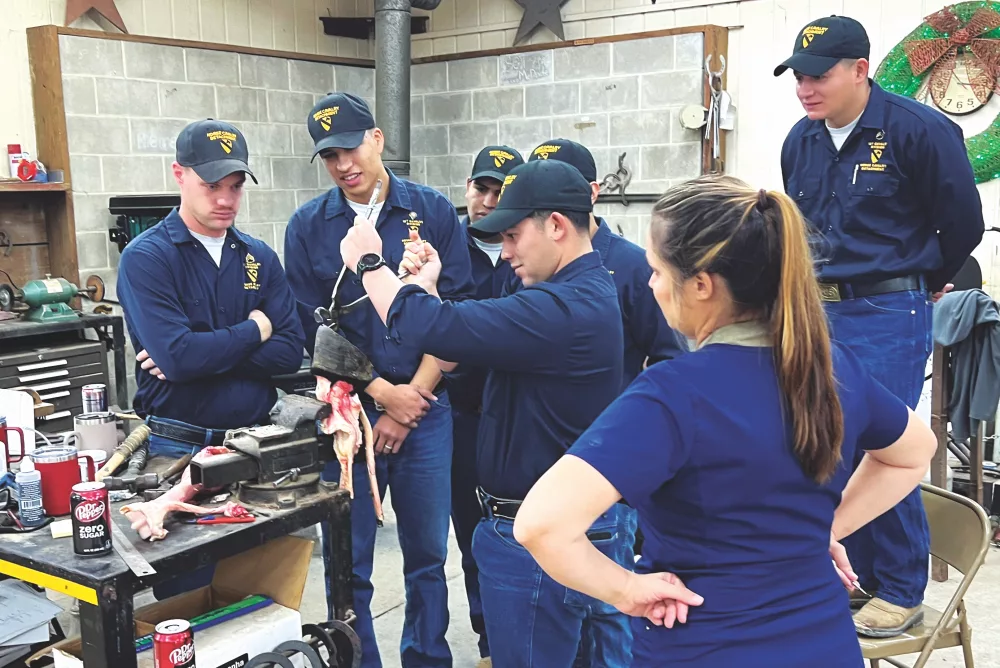
Members of the First Cavalry Horse Detachment at Fort Hood, Texas, dissect a cadaver limb. Image: Chris Gregory
The U.S. Army is pulling back the reins on eliminating its mounted units.
The Military Working Equid (MWE) programs at Fort Hood, Texas; Fort Riley, Kan.; Fort Irwin, Calif.; Fort Huachuca, Ariz.; and Fort Sill, Okla.; were scheduled to end in July 2025 in a cost-saving move. The cuts would have saved about $2 million annually.
The Old Guard caisson units at the Military District of Washington and Joint Base San Antonio, Texas, were not part of the reduction. These units are responsible for funeral services at Arlington National Cemetery in Virginia and Fort Sam Houston National Cemetery in Texas, respectively.
“After careful consideration, the Army has determined that retaining these programs is in the best interests of the force,” says Col. James Fuhriman, assistant deputy for Army health affairs.
Two of the five ceremonial Army units — Fort Hood and Fort Riley — are being preserved. They will cost an estimated $1.2 million a year, says Tony McCormick, an Army spokesman. The horses, mules at donkeys at the remaining three will be put up for adoption and transferred by July 2026.
Farriers and horses are deeply woven into the fabric of U.S. military history, serving significant roles in every major war since 1775, including the invasion of Afghanistan in 2001.
The 1st Cavalry Division Horse Cavalry Detachment at Fort Hood has 40 troopers, 29 horses and four mules. They represent the late 1880s era, armed with Colt revolvers and sabers, and participated in the 2026 Tournament of Roses Parade.
…

American Farriers Journal is the “hands-on” magazine for professional farriers, equine veterinarians and horse care product and service buyers.

American Farriers Journal is the “hands-on” magazine for professional farriers, equine veterinarians and horse care product and service buyers.
Download these helpful knowledge building tools


We are here to support you.
We stock a wide range of high-quality products from trusted brands to ensure durability, performance, and reliability in every job you undertake. Our extensive inventory of horseshoe products and farrier tools means you can find everything you need in one place, saving you time and effort. Your satisfaction is our top priority. We are committed to providing excellent customer service, prompt shipping, and hassle-free returns.
