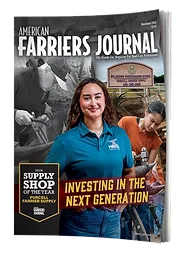
After having back surgery, Hillsborough, N.C., farrier Jeff Denson wanted more balance to his work and family life, so he established working hours of 6 a.m. to 2 p.m. for his practice.
The boogeyman of regulation looms over the farrier profession in the United States. And much like the mythical figure used to scare children, there are various forms of the farriery boogeyman.
Every few years, new concerns over licensing reemerge, leaving many to wonder whether any state or federal agency will register and qualify farriers beyond the race track. None have.
Progress continues in our work to define the professionalization of farriers. A few of us met and discussed many of the processes and permutations of the “Initiative to Professionalize the Practice of Equine Footcare and Farriery” in early March. We’ll meet in late summer, when progress can be assessed and new assignments undertaken.
A record number of footcare professionals invaded Cincinnati, Ohio, for the 13th annual International Hoof-Care Summit for the sole purpose of “Working Together For Healthy Hooves.”
A Friend To Everyone
In early November, I attended the 38th annual clinic at Danny Ward’s shop (“It All Started Because Someone Wanted To Show Off A Shoeing Truck,” Dec. 2015). Like every year, it was well-attended and featured excellent clinicians.
For more than 4 decades, Walt Taylor has favored the licensing of farriers. But for years the founder and long-term president of the American Farrier’s Association (AFA) accepted the wishes of the AFA membership to develop an in-house certification program as an alternative to licensing.
That message came through loud and clear from speakers who voiced opinions on farrier regulation and licensing during the recent open forum sponsored by the American Farrier’s Association
Among roughly 75 AFA members, educators, suppliers and non-members who attended the mid-September “open forum” sponsored by the American Farrier’s Association, nobody spoke in favor of regulating and licensing farriers.
Faced with overwhelming opposition from its members, the American Farrier’s Association cancelled its plan to survey North American farrier schools and dropped any possibility that the organization might push for farrier registration and licensing.
From 1915 to 1981, Illinois was I believe the first of only two or three states to have a licensing requirement for farriers. One of the requirements for a license was having completed a 3-year apprenticeship. Most farriers I spoke with who were affected by the licensing law had nothing good to say about it. They felt that it was unfairly applied and discriminatory. If you were friends with the examiner and/or they needed more farriers at that time, you had a much easier time of passing the test and being licensed than if you were not friends with the examiner or if they did not need more farriers — no matter how good you were.
Oleo Acres Farrier and Blacksmith Supply owner Rob Michel walks viewers through the Littleton, Colo., warehouse. Inventory is organized with the customer in mind. If the product is in stock and easy to find, farriers can spend more time under a horse, which Michel says is more money in your pocket.
At Doc Foal's, we manufacture The Black Pads and The Black Pads PLUS (featuring embedded magnets and copper). Our hybrid pads work seamlessly with your choice of conventional horseshoe, combining metal for structure with polyurethane for exceptional comfort and shock absorption.
Designed as a...
We stock a wide range of high-quality products from trusted brands to ensure durability, performance, and reliability in every job you undertake. Our extensive inventory of horseshoe products and farrier tools means you can find everything you need in one place, saving you time and effort. Your satisfaction is our top priority. We are committed to providing excellent customer service, prompt shipping, and hassle-free returns.
Equilox International Inc. specializes in equine horse hoof adhesives. Developed in 1988 after many trials and extensive research at leading universities and equine centers throughout the U.S., the Equilox Adhesive Hoof Repair System was originally used to treat competitive horses. Now, Equilox Adhesive is used by farriers, equine centers, and horse owners — as well as various zoo and wildlife centers — throughout the world.