Farrier Takeaways
Recording video of the equine athletes’ feet before the start of the show provides a database to familiarize what the horses are wearing so surprises can be avoided.
There has to be a willingness to do your own product research to stay up on what the top international farriers are applying.
Consulting with the team — client, trainer, rider and vet — is critical to the equine athlete’s success.
Including mechanics in both the feet and shoes will make your job easier and benefit the horse.
It would be easy to sit around as a horse show farrier and collect a paycheck while waiting for something to happen. After all, there’s a fair amount of down time, and it would be a nice break after shoeing scores of horses the previous week.
Just don’t expect that from Jason Critton, CJF, TE, and his C-Cross Farrier Services team. Easy isn’t in the Sedalia, Colo., shoer’s vocabulary. Critton views horse shows as opportunities to continue his hoof-care education.
C-Cross Farriers and their associates work 12 weeks of hunter/jumper shows each year at the Colorado Horse Park in Parker, Colo.
“Being at the horse shows and watching horses compete day in and day out has opened my eyes to how much demand is put on them,” Critton says. “We get to see a lot of horses that come from all over the country. I feel like being at the shows gives us greater insight into what’s working and what isn’t in regard to footing, travel and show horse demands.”
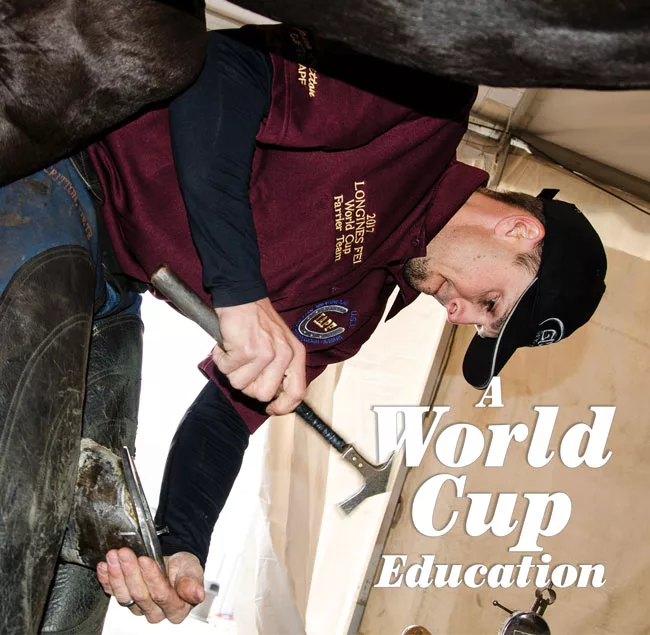
So, when Critton had an opportunity of a lifetime to be the official farrier of the 2017 Longines Fédération Equestre Internationale (FEI) World Cup in Omaha, Neb., he jumped.
“If you ever get an opportunity to work big shows, boy, you have to do it,” he says. “The World Cup only happens once a year, so when you get this caliber of horses all together in the same place, it’s priceless education.”
Critton counts Dodd Stone, a fellow Colorado shoer, among those who inspired him to absorb and learn from observation.
“I learned so much from him,” Critton recalls of his late mentor, who passed away from Parkinson’s disease in 2012. “He was like a father with small children to those horses. He was always watching those horses. He paid close attention to what they were doing, and he picked up on a lot of information when the horses weren’t in the cross-ties.
“He used to say, ‘You have to spend as much time looking up as you do looking down.’”
After Stone’s passing, Critton crossed paths with Wellington, Fla., farrier Mike Wharton at the 2013 International Hoof-Care Summit in Cincinnati, Ohio. The initial meeting didn’t exactly get off on the right foot.
“He wanted to twist my ear off and he’s a big dude,” Critton says with a laugh. “We got into a little tiff right there in front of everybody.”
“I bowed up on him at a roundtable on performance horseshoeing,” recalls Wharton, a CJF with 45 years of experience.
“We were talking about footing and mechanics,” says Critton, a 19-year veteran farrier. “We were probably saying the same thing from two completely different angles.”
As it turns out, though, the two actually see eye-to-eye more often than not when it comes shoeing horses.
PHOTO GALLERY:
2017 Longines FEI World Cup
“When I met Mike, I was doing some stuff that I wasn’t sure whether it was right, wrong or indifferent,” Critton says. “I just felt like my feet were getting better. Mike reaffirmed a lot of what I was doing because he was doing a lot of the same stuff. When we started shoeing together, we didn’t have a conversation about what we were going to do. We just started shoeing horses. It just so happened that we shoe horses very similarly.
“I needed that relationship in my life after Dodd passed away. I needed a mentor who I could just call and visit with — maybe to talk shoeing with, maybe not.”
Wharton is as eager as Critton to take advantage of the learning opportunity that the World Cup affords.
“This is as good as any clinic,” he says. “Who’s giving this clinic?”
“The horses,” Critton replies.
“They’re right there in the arena,” Wharton agrees. “We met a breeder from Switzerland who made a great point. We have the breeder, owner, trainer, rider, massage therapist, veterinarian, farrier, etc. Who is the most important one here? It’s the horse. Without the horse, there’s no need for the rest of us. Sometimes we lose perspective on that. You know, we go into barns and we’ve got 10-head to do. Instead of making it a day and a half, we want to get it all done in a day. So, whom have we short-changed? We put a lot of change in our pocket, but we short-changed that horse somewhere.”
Critton utilized his smartphone throughout the World Cup to document a number of points of importance including hoof problems, shoeing and way of going.
Opening Bell
The education began 4 days before the start of the World Cup when the international horses arrived March 25 at CenturyLink Center. Critton and Jaime Venegas, CJF, greeted them by recording video of all 37 of the equine athletes.
“Just their feet,” Critton says. “We didn’t record anything above the knee or hock. We just wanted to document everything they were wearing so we could familiarize ourselves with what we had to work with. For example, there were several horses with hind suspensory shoes on, so we made note of that.”
Recording video is nothing new for Critton’s hoof-care practice back home.
“We record video of horses daily,” he says. “We’ll jog them for the camera just to have a record. It’s so easy now with smartphones. You can use slow-motion and really get a good picture of what’s going on.”
The shoeing practices, though, are slightly different on the international stage.
My shoeing has to compliment the horse …
“A lot of them are shod in aluminum up front, which is not the norm in the U.S. for a jumper,” Critton says. “A hunter wearing aluminum on the fronts is pretty common, but a Grand Prix jumper in aluminum in the front is a pretty new concept for the U.S., but it was very common amongst these horses.”
Wharton agrees.
“One of the biggest things that I’ll take away from here is re-evaluating all aspects of the horse,” says Wharton, who was present with Critton each day for the FEI soundness jog. “Seeing how these horses track up, seeing what is accepted and what isn’t accepted was very educational. The other big thing is re-evaluating some of the applications because I’ve never seen so many jumping horses with aluminum shoes on before. Our goal is to better understand why each horse is shod the way they are.”
One possibility is the footing.
“That’s a whole afternoon of discussion,” Critton says. “We’re trying to create slide on the front feet during the landing phase, so oftentimes in doing that, we end up with a really wide surface, which aluminum allows. But even that can be a divisive topic. Some top farriers use a shoe with a narrower surface to create slide, while other top farriers believe that a wider section creates more slide. You can’t put on a steel shoe to replicate an aluminum shoe. The weight would be a serious issue. So, they’re getting by with a thick and wide section of material because it’s aluminum. Synthetic footing is a complete game changer. It’s added a whole new element to what we’re trying to do every day.”
It’s not just the application of aluminum shoes to the front feet, it’s also the type.
“It’s a different quality of aluminum,” he says. “What these horses have on isn’t stuff that you find in your shoeing supply houses — maybe a little bit, but it’s not standard.”
Homework Assignment
After spending a week in Omaha, the variety of shoes has intrigued Critton the most.
“More than anything else, I’ve been challenged by the way the European horses are shod,” he says. “It’s not necessarily better or worse, but they’re doing something different than what you typically see in the U.S. It’s been a huge opportunity to pick up a lot of feet in the past several days and see some different styles.
“These are the top jumpers and dressage horses in the world and they are sound. It definitely makes me want to consider the differences and try to figure out what it’s all about and try some different techniques.”
That means doing some homework.
“You have to do your own product research and try things out,” Critton says. “I’ll go home and apply some different shoes and mechanics.”
Like most things, one size doesn’t fit all.
“Just because it works for one farrier doesn’t mean it’s going to work for me, and vise versa,” he says. “There’s no substitute for going home and continuing to do your own research by networking with other farriers who shoe these disciplines and start applying some of what we learned from our experience in Omaha.”
The variety of shoes, particularly those that were applied on the international horses, especially intrigued the farrier team. “It definitely makes me want to figure out what it’s all about and try some different things,” Critton says.
There’s No I In Team
Yet, before applying anything, it’s critical to involve the entire team — client, trainer and veterinarian.
“You have to have that conversation explaining that you want to try this on the horse, here’s why, here’s what I think it’s going to do,” Critton explains. “I want to make sure everybody is involved and agrees to it. After the shoeing cycle, the team decides whether it was a benefit. Did the horse get better, worse or stay the same? What did the feet look like when we came back? It’s critical to re-evaluate and go from there.”
Not only is it important to involve the team, the team must exist.
“Because the demand is so high on today’s show horse, each horse must have a united team behind them,” he says. “It’s the only way I’ll work on a horse. If there’s not a team behind the horse, I’m not interested because you can only be so successful on your own, and there’s going to come a day when you have to have a team. It hasn’t always been that way. I haven’t always had that luxury. Fortunately I’m in a position now where if I foresee the team not working together or seeing eye-to-eye, I generally decline the client.”
Making the team work means having mutual appreciation and respect for each member of the team.
“We’ve got to get past the days of the vet this and the vet that,” Critton says. “The civil war between vets and farriers needs to be a thing of the past. We have to move forward. A lot of that comes from earning the veterinarians’ respect by our willingness to do whatever we can to keep the horse sound. It can be a huge challenge, but well worth the effort. If I hope to be successful in my business, then I need to be a team player. I’m very fortunate to be surrounded by many talented veterinarians who play a pivotal role in the success of the horses that we work on together.”
It starts with building relationships.
If there’s not a team behind the horse, I’m not interested …
“If Jason calls me and says he has so-and-so that needs to be looked at, he knows that I’m going to take care of it and vise versa,” Wharton says. “The client knows that the relationship is solid, so she’s comfortable. Then the vet becomes more comfortable.”
The end result is Critton asking Wharton to join him as part of the FEI World Cup Farriers Team.
“Jason wouldn’t have invited me to be part of this if he didn’t trust me,” Wharton says. “And, I wouldn’t have come if I didn’t think he trusted me. That’s absolutely in the forefront. It doesn’t matter whether you shoe a little different, as long as everybody gets to the same spot. That’s something that can be simply worked out, but you’re not going to get through it if you don’t trust the individual. It’s not going to work.”
When trust is misplaced, expensive consequences can follow. Wharton recalls a moment in time when he asked a fellow farrier to nail up a set of hind shoes after a vet had worked on one of his client’s horses.
“When I got back from vacation, the client called me and said, ‘I think you need to come over here and look at this,’” he says. “She tells me that the shoes were applied to the wrong feet. I never asked him again. You’ve got to know that the farrier is going to take care of business. After all, the horse is the most important thing, but don’t forget, it is your livelihood. Many of us have gained a large account through one horse and also lost an account through one horse.
“Shoeing horses is more than nailing on four shoes. You’ve got to relate better to people, and you’ve got to have a personality that people can get along with.”
That includes developing relationships with the grooms.
“I try to take care of them, for sure,” he says. “At Christmas time, I give them a little something. More than anything else, though, I treat them on the level they deserve to be treated. When I get to the barn, I’m excited to see them. I try to get to know them, become friends with them. I’ll make sure to ask them how their family is doing.”
The grooms can be helpful on a number of levels in your hoof-care work.
“You can ask the owner to perform tasks, but generally, most are only going to see that horse a few times a week,” he says. “Building a good relationship with your grooms and getting them involved with what you’re doing can help you a ton.”
In one case, Critton floated a jammed heel and asked the groom to keep floating it throughout the cycle by using a saw blade. When Critton returned, the damage had grown down.
“The groom did his job,” Wharton says. “We did our job, and the client was very happy.”
Venegas has a particularly good relationship with the grooms at the barns where Critton and his team work.
“They have a ton of respect for Jaime,” he says. “They’re tight. He knows what’s coming down pike because the grooms will tell him. It’s amazing what goes on behind the scenes that the grooms can give you a heads up on. They’re around the barn aisle every day and hear and see what’s going on.”
Shoeing Conundrum
Tending to the feet of performance horses presents a number of challenges. Among them is something of a philosophical question — Should the horse be shod for performance or its time outside of the show ring?
“It’s a hard balance,” Critton says. “A lot of guys believe that we have to shoe them for the 23 hours a day that they’re just standing in a stall. First and foremost, I want to stay out of the horse’s way. This seems easy enough until you start asking that horse to piaffe and passage or jump a 1.5-meter oxer. Then we have quickly gotten in the way again.
“My shoeing has to compliment the horse’s conformation, posture and ability. Unfortunately, there are instances in which the shoes that I apply might hinder the hoof capsule itself. If I decide to add width because I want to get in the middle of a horse’s leg, that might not be the best thing for the hoof capsule due to the extra leverage. But, I might have to sacrifice the hoof capsule sometimes in order to support the limb so the horse can do its job better. I’m OK with that, as long as I’m not causing long-term issues with the limb or hoof itself and the horse is performing better.”
The Fourth Dimension
Many times when taking on a new horse, the shoeing information isn’t included. Critton tries to assess each horse’s posture, as well as conformation.
“Conformation is what the horse is born with, but to me, posture is the result of pain,” he says. “We’re not going to change conformation on an aged horse, but we can influence a change in posture.”
“I like to visualize what the horse will do to its foot if it were to go barefoot. In regard to loading and releasing, whatever the horse is going to do to the foot on its own is what I’m going to try to do to its shoeing. Very rarely do I have a flat shoe on a horse’s foot. Sometimes it’s a grind, but more often than not, I’m using my hammer to provide a rocker or a roll.”
Trimming flat and making shoes flat is an important skill set, but Critton doesn’t believe all horses should be shod flat.
“I think we have to look at shoeing beyond two dimensions,” he says. “I try to see the foot in three dimensions, because I’m not shoeing a block. Instead, I look at the foot more as a round ball.
“When you add a rider, you add a fourth dimension. What I can get away with a talented rider, I can’t get away with a rider who can’t keep the horse together. I’ve had several riders complain that their horse forges. I’ll ask the trainer whether the horse forges when they are on the same horse. ‘No, it doesn’t forge when I’m on there.’ What does that tell you? The horse is going around on its forehand, back’s hollowed out; it’s forging. That fourth dimension is critical. You have to know your riders.”
Harkening back to the topic of building relationships, this is when insight from a rider is invaluable.
“It’s one of the things about working on the few dressage horses that I do, they have good riders,” Critton says. “Man, they are good at telling you what they’re feeling. It can drive you crazy, but it can be so helpful.”
LEARN MORE
Watch video of Jason Critton as he demonstrates some of the mechanics that he typically includes in shoes for equine athletes by visiting at americanfarriers.com/0717
Then they apply the information they gathered from the rider to the shoe and foot.
“You can’t put mechanics in a foot and not put it in the shoe,” Wharton says. “It will be unbalanced. You could end up with excess pressure where you don’t want it. So, they both have to come together. When you put the mechanics into the foot, put mechanics into the shoe. As the horse goes into its shoeing period, it goes longer in balance than it would the other way, because the horse never grows into balance. It always grows out of balance.”
Critton very rarely applies a flat shoe on a horse’s foot. “Whatever the horse is going to do to the foot on its own is what I’m going to try to do to its shoeing,” he says. “I’m not talking about a grind. I’m talking about using my hammer to provide a rocker.”
Making It Simple
The attention to detail and remaining diligent in putting the mechanics in the foot and the shoe is paying off.
“Once I started putting mechanics in the feet, I would say I could go through my whole client book and do very little top dressing,” Critton says. “We used to dress every foot. Now, our feet seem to stay together and distort a lot less. We don’t dress unless I point out something that needs dressing. It might only be one part of one foot on one horse.
“I wasn’t able to accomplish this when I was shoeing everything flat. If you can figure out how to avoid flaring, you’ve conquered a huge obstacle in the distortion issue in your horses’ feet. The best luck that I have had to keep them together with minimal flaring is from the bottom. I have to control the bottom of the foot if I ever want to get the top to do what I want it to do.”
Critton admits that his philosophy is contrary to most beliefs.
“A lot of farriers dress every foot,” he says. “I used to do the same thing. It’s not ignoring the feet. It’s paying enough attention to them to get them to the point in which you don’t have to dress them anymore.”
There also is very little knife work put into Critton’s feet.
“It’s done with the trim, the fit and what you do with the hammer to the shoe,” he says. “I’m not saying we’ve got every one of them dialed in perfectly, but they are getting better and better with more vertical depth, which results in less work. The goal for me is to make the horse as simple to shoe as possible. If you have to do an overhaul every time you shoe them, something’s not right.”
Most of Critton’s horses are on a 5-week shoeing cycle, but those that are in Florida could stand to be shod every 4 weeks. He admits the shorter cycle has a huge influence on limiting distortion.
The horse never grows into balance …
“They just grow foot in the Florida humidity,” he says. “I might have one that I might get done a little earlier if they have a class or something during the summer. For the most part, they have plenty of growth to work with at 5 weeks.”
Before taking on a client, Critton not only explains what they can expect from his shoeing program, but what he expects from them as well.
“The biggest thing is we have a conversation in which I tell them, if we invest in your horse’s feet and I do my job well, it’s going to save you so much money. I was talking with the German World Cup Team’s vet the other day. He told me that if the owners hired the right farrier and didn’t cut corners on costs, they wouldn’t have much need for him. And it’s true. We can help them in so many ways if they just sign up for a good program and keep their horses on a good schedule.”
While Critton and Wharton are enjoying success in their private hoof-care practices, the educational opportunity that comes with working the World Cup is too good to pass up.
“An opportunity to work a horse show like this doesn’t come along every day,” Critton says. “We’re not here because we’re going to make a bunch of money. We’re here for the education of it. It’s a sacrifice for our businesses to come here. It’s a 10-day commitment, which means I will work for 3 weeks straight before and after the World Cup. But, our clients and the vets we work with, and the other farriers we’re connected to will benefit from this, as well. Watching these horses is priceless information to help us keep up with what’s going on in the industry.
“If you’re at home with your head in the sand, the horses are the ones that will suffer. Having the opportunity to stand at the rail, to walk through these barns and pick up these feet, and work on a few horses while we’re here allows us to study what’s going on. These horses are at the top of their game, and their farriers are the best in the world. They got here because they’re sound and performing very well in whatever shoes they’re wearing. You’re going to learn something from that experience.”
The synthetic footing, which consists of fiber and sand, is sticky and provides more traction for the horse. Although the material is the same from one location to another, it reacts differently in a humid climate than it does when it’s utilized in a dry location.
The Horseshoe Is The Challenge, Not The Footing
No matter where a client’s horse competes, a farrier’s job is to take the footing into consideration. It’s no different at the Longines FEI World Cup in Omaha, Neb.
The synthetic footing consists of fiber and sand that’s sticky and increases traction. Although the same material is used throughout the country, it reacts differently from location to location.
“The footing in Florida is different than it is in Colorado,” explains Jason Critton, the head farrier at the World Cup. “The conditions are different. It’s the humidity vs. the dry, arid climate. They have a different effect on the sand and it makes for a completely different substance.”
When shoeing a horse that works on any surface, it’s important to understand how the application will interact. Working the farrier tent at the Colorado Horse Park in Parker, Colo., has been beneficial when it comes to footing, Critton says.
“We see most of the horses that the vets see for foot soreness,” he says. “Over time, you start to see a correlation in styles and shoe selections that don’t compliment a horse working on a synthetic surface.”
Equally important are the types of mechanics that are included in the shoe.
“We didn’t talk much about mechanics before this footing was introduced,” Critton says. “Yeah, we talked about breakover and this and that, but mechanics really came about as a result of this footing. In my experience, if I’m not implementing mechanics into my shoeing and into my feet, my horses are going to suffer because of it.”
While some farriers consider the surface a challenge, Critton and his partner Mike Wharton look at it a different way.
“The challenge isn’t actually in the footing,” Wharton says. “The challenge is on the horseshoe. We’re the ones who have to make the change and be mechanically capable to adapt to that. If you’re not making the adjustment or not willing to put that roll or rocker into it or put an onion heel in a shoe, then you’re the one pulling up short, and that’s the challenge.”
Critton concludes, “We as farriers have to try to be in front of the times as much as we can and be as proactive as we can to keep our horses sound. Otherwise, we put ourselves out of work.”