Takeaways
- Farriers today face significant difficulties finding reliable help, which may stem from a modern shift in how younger generations value time, effort, and immediate rewards compared to the past.
- Traditional “rough” apprenticeships taught aspiring farriers much more than technical skills; they instilled essential personal values, including resilience, humility and pride in their craftsmanship.
- To bridge the gap for today’s aspiring hoof-care professionals, veteran farriers must find constructive, patient ways to pass down the invaluable lessons they learned the hard way.
Why is it so challenging today to find help? This is an issue across the board, not just for farriers but in all industries. Are they afraid, lazy, is it upbringing, do they not want or like a challenge?
This is an issue today for the farriers who struggle with apprentices — to have or not to have has been a question. Why was so much different when I was a young farrier in the 1970s than when my career was at its conclusion? I had many a helper/apprentice, and I was not an easy guy to work for, although I softened a bit as I got older.
Folks in my age group (born in the 1950s or earlier), I would love your thoughts on why our generation worked so hard to learn and did it for free or even paid for it? Education is never wasted. I’m not talking about farrier schools; I’m talking about the time you put in after, when the real learning begins. What happened?
The Way it Was
I worked for free under several different farriers (we called them blacksmiths then). My early career was in the Standardbred industry, along with some hunters. This was a rough bunch of farriers, but they taught me good basic skills like how to trim and balance a foot and forging skills. Most of our shoes were handmade swedged, or, if we were lucky, some McGraw blanks in the straight that were quick to turn. A good part of our shoeing was bar shoes, most of which had plastic pads. Cutting them was a lot of work for a kid. I was in my early teens. Yet, we all did it for free, and, oftentimes, you had to buy the boss lunch.
The materials and tools are a story unto themselves. Our plastic and leather came in big sheets, which were a pain to cut, but you got used to it. There were no pad cutters. You did it with a sharp knife. I loved it when you were mostly done and a slip ruined the pad.
They were just starting to sell pads like we see today. Imagine inventing a pad shaped like a horseshoe; who would have thought? One of the guys I worked for at Dover Downs used an engine block for an anvil and could do a fair job shaping and welding. A big 8-cylinder from a Ford 4 Lightning. New bar shoes and rim pads on the hoof for $50. It was crazy, and that’s why I never stayed in that industry.
“Maybe there are some young hands still willing, if they can find someone patient enough to light the fire…”
Remember, at the time, we all had coal fires in our trucks; you could spot us a mile away with the smokestack sticking out of the top of your truck. I lived on the Main Line right on the railroad tracks. I collected my soft coal when the trains would stop. It was only a few dollars a ton, but who could afford that? We were up early and finished by mid-afternoon or so. Then I would go bail hay with a local farmer for $2 an hour cash. If I were lucky, some poor farmer’s wife would feed me dinner, sometimes as late as 10 or 11 p.m.
When I was not under a horse to supplement my income, I would cut grass, paint houses — whatever to make a buck. I lived during the week at a local Delaware boarding house with guys 15 years my senior. Not all that much fun, truthfully, as I was in my early teens. The best bargain at the time for me was breakfast at a local home where they fed me a huge breakfast for $2. That might have to keep me going most of the day.
It did not take me long to realize that the industry was struggling, and the sport horses closer to where I lived provided a much greater living.
You were killing it at $5 a trim. When I retired, it was $100. Then again, gas was 25 cents a gallon for the good stuff. My truck cost $800 for an F-100 three-speed on the column. My first .22 rifle cost $25 and a year at private college cost me only $5,000. My son’s tuition was closer to $250,000. That’s not a typo.
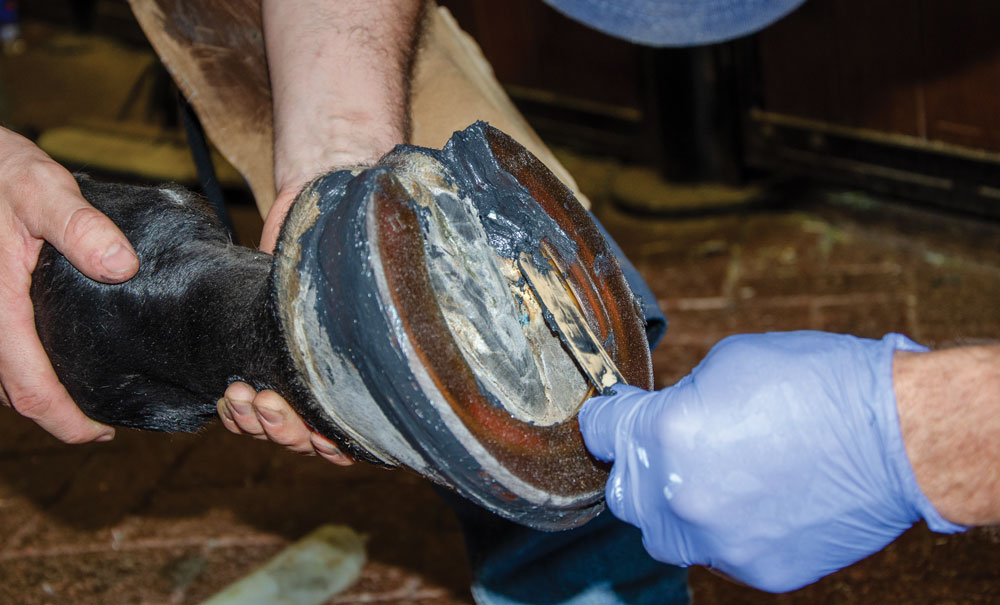
The younger generations might have different values or view time and reward differently. Experienced farriers might need to demonstrate more patience, Steve Teichman writes. Jeff Cota
All this was done without cell phones. No texting, no pictures, no Facebook. How did we do it all without that? When mobile phones came with cameras, I thought, who the heck would need a phone that took a picture? How stupid. Now, my phone is jammed with them. Follow me for more good advice, right? Honestly, I got more done and far less stressed. A few quarters rolling around in the old truck for a pay phone and you were good to go. That’s if you remembered to flip the tape over in your answering machine.
Our supplies came from Amsterdam Farrier Supply, which was run by Joseph Stultzfus in a small building still on the same street corner as today’s shop. Today, it’s a supermarket for farriers. Then, it was small. You could buy five things — coal, bar stock, Capewell nails, rasps and shoes, which were Bakers that came in a dirty, greasy burlap bag or Diamonds. That’s it!
Shift in Values
When I was established enough to have my own apprentices, it was different. Coal fires, for example, meant that one of your helpers was a fireman while the other was under the horses with you. Two 5-gallon buckets of coal a day. It was dirty stuff.
The fireman’s job was cutting bar stock, keeping the fire going and not burning shoes in half. The rhythm was around the fire and the heat; this included your timing under your horses, too. Two-heat shoes from hot-rolled
5/16 x 3/4 inches were made for most horses. There were six nail holes and hammer-finished heels. There were no jump vises or grinders. An extra heat was necessary if you needed two clips.
Learn More
Gain more insight from Steve Teichman by:
- Reading “How Modifications Affect Breakover,” in which Teichman’s research examines the effects of front shoe-surface modifications in the sport horse on the speed of breakover during the walk and trot on artificial and solid surfaces.
- Reading “Better Practices for Making Stud Holes for Sport Horse Shoes,” in which he shares guidelines to help ensure a proper and useable stud hole for your sport horse clients to use.
Access this exclusive content and more at AmericanFarriers.com/1126
So where did all the willing hands go? Perhaps it’s not the fear of hard work, laziness or a different upbringing. Maybe it’s a shift in what people value or how they view time and reward.
One thing is for sure — the old ways taught me more than just skill; they taught grit, humility and pride in craftsmanship. Those long dirty days beside the fire weren’t just about making shoes; they were about becoming someone. Do today’s generations need more of those opportunities? Or maybe we need to find a way to pass down what we learned the hard way.
For those of us who came up the “rough” way, there’s still something worth sharing. And maybe, just maybe, some young hands out there are still willing, if they can find someone patient enough to light the fire.