Takeaways
- California farrier Raleigh Desiato says competition gives farriers the foundational shoeing skills with which to build their career.
- When a farrier’s work is on display for all to see, it also encourages humility and accountability, traits she instills in her helpers.
- Building a network of diverse voices in your horseshoeing circle is important to fill in the gaps where your skill set may not be as strong.
“I wanted to compete more than I wanted to breathe,” says California farrier Raleigh Desiato. “I don’t know where I would be without horseshoeing competitions. They changed my life.”
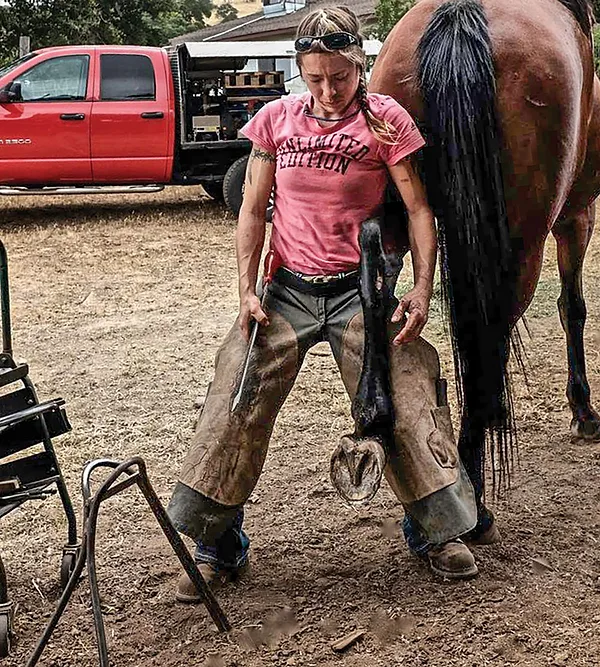
Desiato has been shoeing horses for 26 years and competed heavily for 15 of them, landing a spot on the World Championship Blacksmiths (WCB) team in 2013 and again as an alternate in 2015. In that time, competition taught her valuable lessons about shoeing, humility, the importance of surrounding herself with diverse perspectives and of building a network of trusted farriers to rely on. And they are values she works to pass on to the next generation of horseshoers.
“I don’t specialize in anything. I shoe all kinds of different horses — hunter/jumpers, dressage horses, cow horses, reiners, backyard horses, trail horses. I’m like an ER doctor. I can do any of it. And competition has been a great thing because it’s given me the skills to do anything,” she says.
Staying Knowledgeable & Accountable
Since Desiato started shoeing, she’s noticed that knowledge is now shared much more readily between farriers than before. Whereas information used to be closely guarded, now there are countless shoeing videos on YouTube, Facebook and other social media platforms to learn from. The WCB is also a valuable resource that provides networking and growth opportunities, something that wasn’t easily available to her when she started shoeing.
“Competition is awesome because it gives you a good flat set of skills,” she says. “You learn how to run your tools. You learn how to work your nippers, trim a flat foot. You learn how to forge anything, learn how to fit feet. You have to understand nail fit to keep your shoes tight, and I think that is the most valuable thing because if you can do all of that, then the rest of it is easy to apply.”
In addition, competition forces farriers to put their work on display for everyone to see.
“So, you get really brave about putting your work out there and talking to people. I tell people horseshoeing will change your life if you let it. It’s made me better in every aspect of my life,” Desiato says.
It also encourages humility and accountability.
“You have 50 or 100 other horseshoers going in there picking up the foot and pointing out your mistakes, and it’s also taught me to be OK with that and realize that it’s not an attack,” she says. “When I’m by myself, I get blind to my own mistakes. I tell my helpers to hold me to the fire. I tell them to question me if I’m doing something wrong, and I’ve taught them to see it. They keep me honest, and contests hold me accountable.”
“Competition made me the horseshoer I am today…”
The people you’re with are just as important as the competition itself, Desiato says. The 2013 WCB team was the best she’d ever competed on because of their collective devotion to the team and its success, uplifting their fellow farriers in the process. It’s a mindset she values in her everyday shoeing as well.
“Everybody wanted the team to do well. So, you were held accountable, but it was never personal. You had a space in the team and the contests where you could thrive at the things you were good at and improve the things you were poor at. That was a big deal to me. They held you accountable over lunch, and no one made fun of you for the things you couldn’t do.
“It’s not always easy to work as a team or work with veterinarians or owners, but if you have a good team, even when things aren’t OK, you know they’re going to be OK. Even when catastrophe hits and that horse tears something or founders, you never feel like you’re going to be blamed.”
Skills learned through competition extend beyond the practical, as well. For Desiato, it’s given her a network of people to rely on for shoeing advice. If she’s working on a discipline she encounters less often, she can reach out to a friend she met at a clinic or contest who may see that particular issue much more frequently. And because she has a diverse set of skills gathered from shoeing, competition, riding and networking, she can easily implement any advice she’s given.
“I tell my helpers, ‘You don’t have to know everything. All you have to do is make sure you have the basic skills to do it, and then have friends who will pick up the phone to help.’ If I’m managing a quarter crack, I’ll get on the phone with Scott Lampert. Or, if I have an issue with a hunter/jumper, I’ll call Logan Lovett. I feel really fortunate that I got to participate in the generations behind me. I have found mentors in Jim Keith, Jay Sharp, Bo Tipton, Joe Magistri, Rich Franklin and Kelly Vermeer Vella.”
Part of learning and connecting with other talented horseshoers means putting yourself out there and not being afraid to ask questions, Desiato says. Farriers can learn something from everybody.
“I don’t care if it’s the stupidest question in the world. I don’t care if I ask it in front of all these people, and I don’t care if they feel like I should know more. I don’t know the answer, and I need help,” she says.
This continuous sense of curiosity and knowledge-seeking — whether through contests, clinics or peers — is something she encourages in her helpers to make them better horseshoers.
Teaching the Next Generation
Desiato values diverse opinions in her circle of farriers and advocates the same for others. No one is going to know everything, so it’s important to both connect with people outside your usual group and to be comfortable saying, “I don’t know.”
“Most people really respect the answer,” she says. “And if someone tells you, ‘I don’t know,’ they’re the person to have back again because they’re willing to go find the answer. They care.”
The only way to lessen the amount of times a person says, “I don’t know” is to seek out new voices, new opinions and new experiences. It doesn’t serve you or the horse to pigeonhole yourself into one discipline or type of shoeing, she says.
“I sent my helper Jersey Lambert to work with Joe Magistri,” she says. “Joe shoes cold and has a completely different style of shoeing than me. We have a lot of respect for each other, and he has shod horses for almost 60 years. How do you replace that kind of experience learning from someone so knowledgeable? He shod for Benny Catron. He shoes for Ken Wold. He’s shod for a lot of the top Western horsemen for decades. That says something. I don’t care if he’s out shoeing cold or if we fit feet differently.”
Another reason she encourages diverse perspectives is because no one is perfect, and she acknowledges this within herself so that the next generation of farriers can be better than the previous.
“You don’t have to know everything…”
“My helpers spend so much time with me that I put my stamp on them,” she says. “I get proud when I see things within them that are good that have come from me, but when I see them do something that’s a quality of mine I feel can be improved, it makes me want to do better.”
Desiato feels a deep responsibility to her helpers to make sure they become the best possible horseshoers they can be.
“I try to show them something new or tell them something new every day,” she says. “Sometimes it’s about the metal or the file or the application, but I’ve been lucky to have ridden many different disciplines. So, I’ll say, ‘This is why this topline looks like this. This is why a horse goes that way. Watch these people ride. Why do you think all these horses have neck problems?’ Sometimes we work on those things or we watch them move, and we assess lameness together. Sometimes we see different things, and sometimes they teach me something that they notice.”
Other days, Desiato will let her helpers take the reins — California farriers Matt Millsaps and Jersey Lambert — and guide what they want to learn that day. Most importantly, Desiato doesn’t want them to remain stagnant or lose enthusiasm. If they do, it’s a sign that it’s time to part ways.
“I really believe in the certification process,” she says. “And I feel it’s my responsibility to help them as much as I can. I always match their effort. I tell them, ‘You need to study. We’re in the truck. Let’s study.’ If they want, they can bring their shoes in, and I’ll beat up on their shoes to help them pass their shoeboard. If there’s a goal that they’re working toward, we’ll focus on that. When Matt was working toward his Certified Journeyman Farrier, I’d tell him to give me a Journeyman trim. Then I’d go over a laminated scorecard with a dry-erase marker and score him.”
Once he had that down, Desiato would put the clock on him until he could trim a foot in 5 minutes.
“My helpers have upped the standard of helper I’ll accept at this point. So, I owe them a lot,” Desiato says.
Though Desiato no longer competes, she’s thankful for everything it gave her in life.
“Once you get in the open division, it becomes your lifestyle, and I’m so grateful I did that because it made me the horseshoer I am today,” she says. “Competition has its place. It gives you that set of skills to be able to go anywhere and do anything, and if my helpers have those skills, the rest of it becomes easy. The rest of it is their choice.”