Takeaways
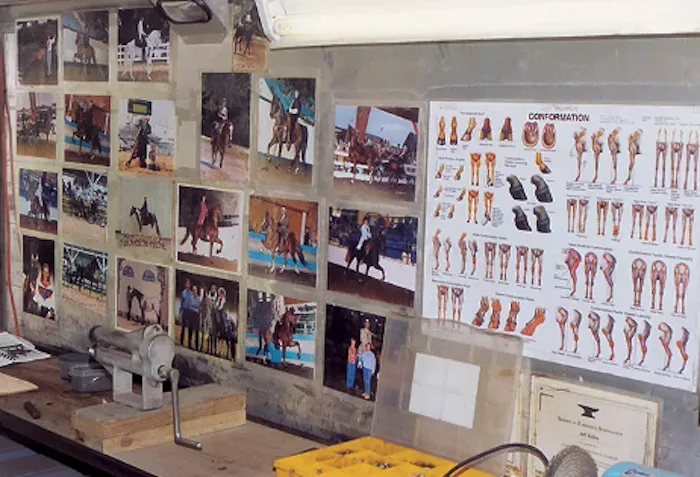
- Charts on equine conformation charts and photos of horses he’s shod hang in the rig for client education.
- Early in the winter, Jeff Ridley contracted to buy $1,000 worth of diesel at a set price.
- The trailer fan is for more than just cross ventilation, as it keeps his safety glasses from fogging up.
- Kyle Ballard’s two-wheeled white trailer isn’t huge, maneuvers easily and takes just seconds to set up.
The two shoeing rigs carefully pulled up to the doors of the Iowa barn are a contrast in styles. One is a spartan, utilitarian trailer, carrying a minimum of shoeing tools. It’s dwarfed by the gooseneck trailer next to it, which is laden with power tools, filled shoe racks, multiple work stations and even a photo bulletin board.
Yet each gets the job done for the farrier who uses it.
Focus On The Basics
The smaller rig belongs to Kyle Ballard. The two-wheeled white trailer isn’t huge, so Ballard maneuvers it easily and it takes him just seconds to set up for shoeing after he’s parked. He opens the back, pulls out his anvil and sets it up on its stand and swings out his mounted propane forge.
Shoe racks, nails and shoeing supplies are stored inside bins where they’re easily accessible. His tools are lined up across the edge of the trailer bed, within easy arm’s reach of his anvil.
Ballard makes relatively little use of power tools at this point in his career. He’s working at developing his shoe-making skills and wants to keep his costs down. A simple shoeing rig helps him do that, while also aiding his shoeing efficiency and presenting a professional image.
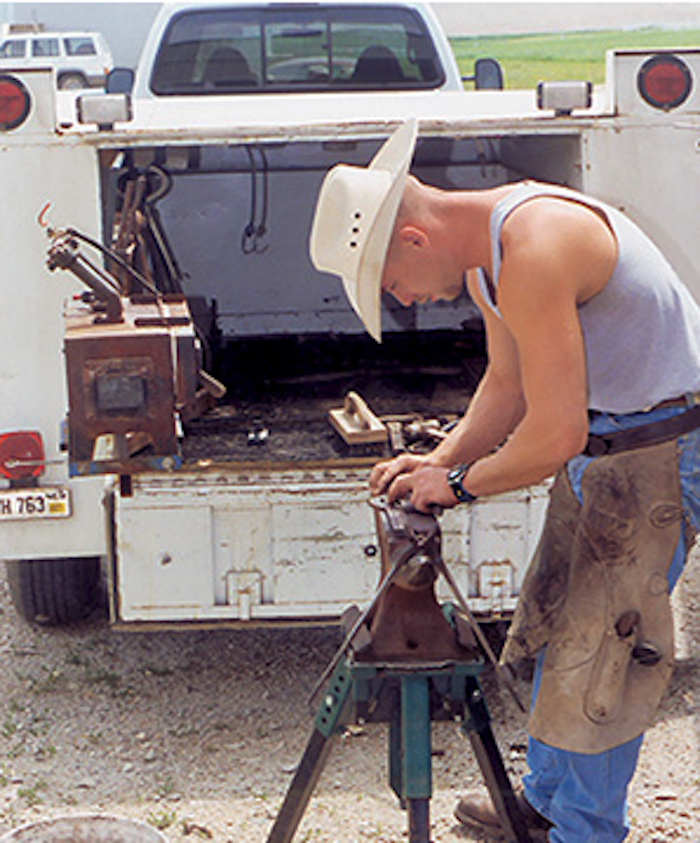
SIMPLE RIG. Kyle Ballard measures a shoe he’s working on at his anvil stand. Ballardʼs shoeing rig covers the basics and can be set up quickly.
Fitting The Job
Jeff Ridley’s rig is far more elaborate, reflecting that his shoeing work tends to be more specialized than Ballard’s at this point in their respective careers. Ridley’s trailer is laid out to enable him to more efficiently assemble the pad and horseshoe shoeing packages that are so important with the long-footed horses that are a big part of his business.
“It works for me,” he says of the rig.
Among other features, Ridley’s rig lets him get out of any inclement weather. His anvil stand is inside the trailer, as is his forge. Along one wall is a shelf where a pad cutter and belt sander are mounted at just the right height for the farrier to work. A drill press is mounted in a corner. Racks for shoes and pads are located below the shelf and along the front wall. Welding equipment is also mounted inside the trailer.
The interior of the trailer is big and roomy enough that it allows Ridley to work at shaping a shoe on the anvil at the same time that Ballard is inside cutting pads. The farriers aren’t in one another’s way and there’s room for both to stand erect, even with Ballard wearing his cowboy hat.
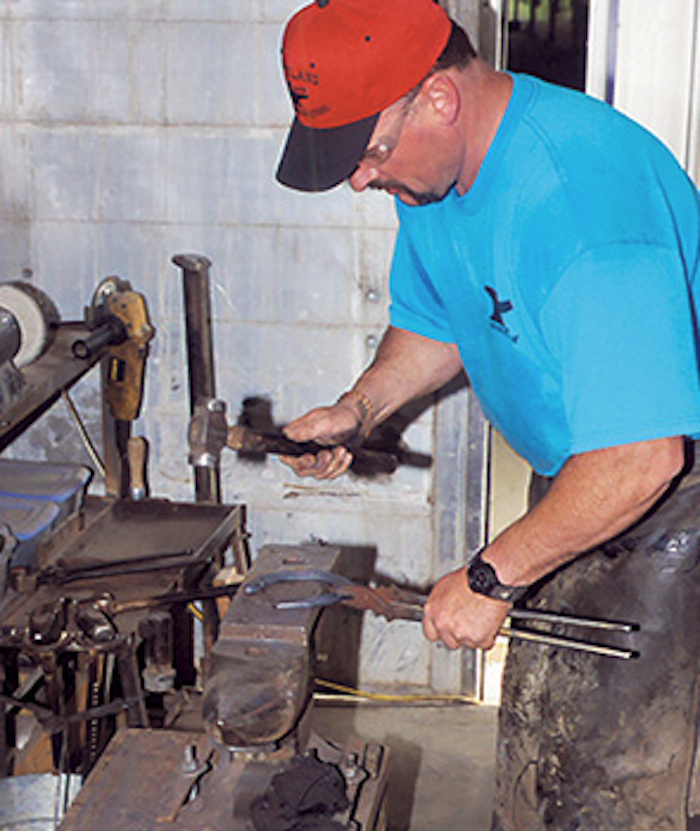
WELL-EQUIPPED RIG. Jeff Ridleyʼs goose-neck trailer shoeing rig is well equipped, ventilated and lighted. Ridleyʼs rig includes power tools that help him prepare shoeing packages more efficiently. Itʼs also roomy enough that he can work inside and be out of possibly inclement weather.
Photo Mementos
On the wall above the shelf, Ridley has hung anatomical charts on equine conformation as well as color photos of various horses he’s shod in the show ring.
“It’s nice to have these,” he says of the photos. “A lot of my clients will have a picture made for me when their horse does well.”
The trailer has a side door on both sides near the front. These can be opened to provide cross ventilation during warm weather. That cross ventilation is helped by an industrial strength ventilation fan mounted at the gooseneck end of the trailer. The fan is for more than just cross ventilation, according to Ridley.
“It really helps to keep your safety glasses from fogging up,” he says.
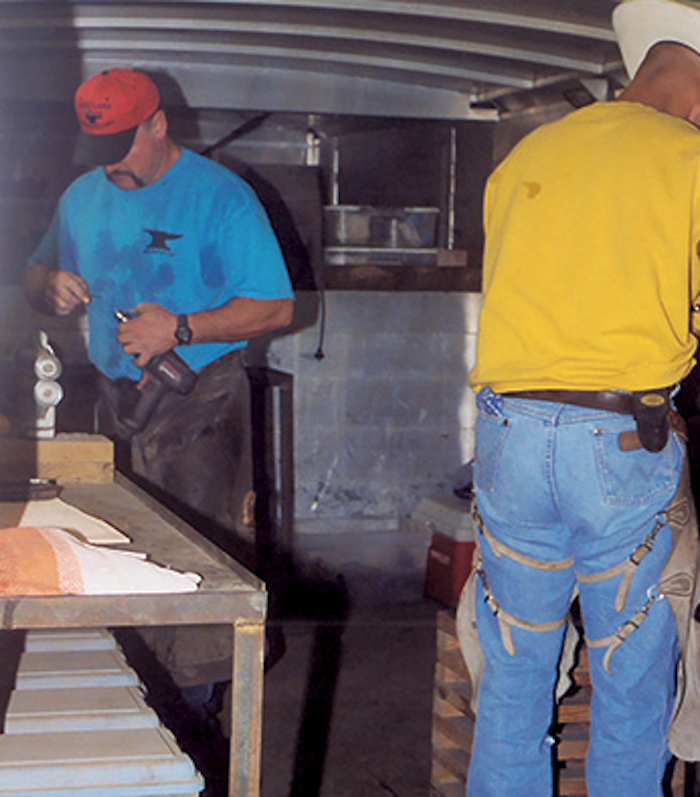
ROOM FOR TWO. Ridleyʼs shoeing rig is large enough that both he and Kyle Ballard can work inside at the same time.
An Approach To Fuel Costs
With diesel fuel prices being somewhat volatile last year, Ridley tried a new approach to buying fuel.
“Early in the winter, I contracted to buy $1,000 worth of diesel at a set price per gallon,” he explains.
He has a fuel storage tank at his home. Several times over the winter months, the company he’s dealing with delivered fuel to the tank. Ridley paid for it on delivery, which enabled him to spread the cost out.
“He makes little use of power tools and is developing his shoe-making skills and keeping costs down……”
Trying this approach is a bit of gamble, of course. If diesel prices had plunged (which they didn’t), he still would have been obligated to buy the fuel at a higher-than-market price. But contracting for the fuel did allow him to budget an accurate cost for his fuel and fix the price he would pay over a volatile pricing period. It’s a method that makes sense under the right circumstances.