 Premium content is for our Digital-only and Premium subscribers. A Print-only subscription doesn't qualify. Please
American Farriers Journal
American Farriers Journal is the “hands-on” magazine for professional farriers, equine veterinarians and horse care product and service buyers.

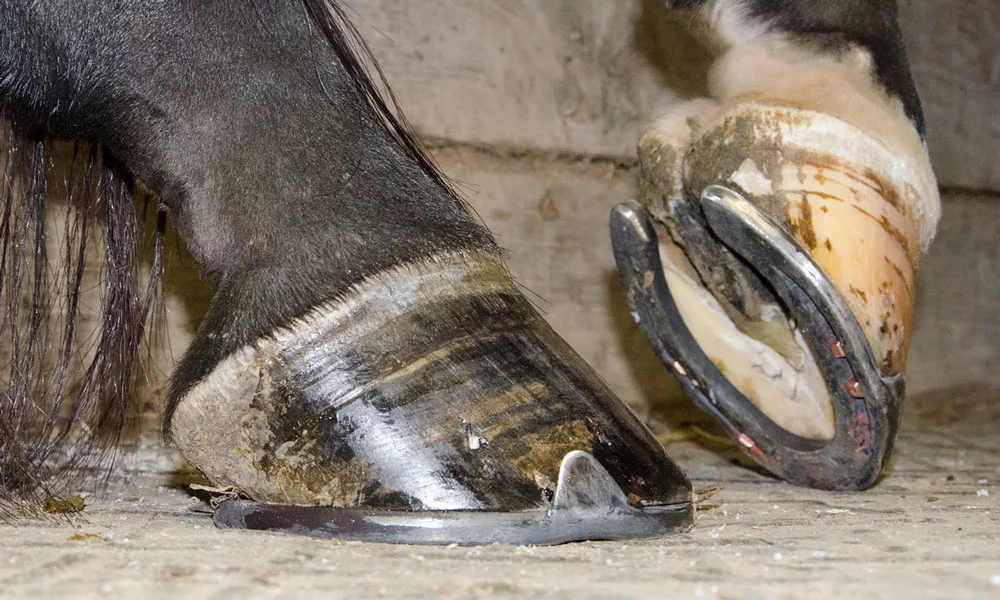
The hind legs provide the majority of the horizontal acceleration and a small amount of lift.
In recent years, published information has been abundant on the length of the toe affecting the normal function of the horse’s limb. In the November 1999 issue of American Farriers Journal, “Strategies For Overcoming Long-Toe, Underrun Heel Concerns” concluded that long toes caused low heels.
The May 2000 issue of The Horse contained an article on the four-point trim, which inferred that long toes cause dished feet.
We must be terribly naive to believe that both of these foot problems, which are extremely different in appearance and hoof mechanics, are caused by excessive toe length.
We’ve been led to believe that “natural” must mean an improvement over past methods of trimming. We’ve also been told that squaring, rocking, rolling or “setting back” the toe improves the horse’s mechanics and hoof function. Easing the breakover must make it easier for the horse to move.
Or does it? What is the difference between the functions of the toe and heels? How do these hoof parts provide different applications of mechanics for the front and hind legs? Do we understand form and function? Maybe not.
The difference between the workload of the front and hind limbs is the most confusing concept. Quite simply, the front legs provide the majority of lift for the body (vertical acceleration) and a small percentage of horizontal acceleration, while the hind legs provide the majority of horizontal acceleration and a small amount of lift.
We have heard and read for years that…

American Farriers Journal is the “hands-on” magazine for professional farriers, equine veterinarians and horse care product and service buyers.

American Farriers Journal is the “hands-on” magazine for professional farriers, equine veterinarians and horse care product and service buyers.
Download these helpful knowledge building tools


We are here to support you.
We stock a wide range of high-quality products from trusted brands to ensure durability, performance, and reliability in every job you undertake. Our extensive inventory of horseshoe products and farrier tools means you can find everything you need in one place, saving you time and effort. Your satisfaction is our top priority. We are committed to providing excellent customer service, prompt shipping, and hassle-free returns.
