The recognition and evaluation of pain is essential for the welfare of horses and management of the patient. Although considerable progress has been made in understanding physiology and treatment of pain in animals, the assessment of pain in horses remains difficult and frequently suboptimal.
Due to their character as flight animals and their high level of compensation, horses are very limited in pain expression. Recognition and evaluation of mild and subtle pain is sometimes difficult and requires professional education and observational skills.
The most reliable and objective way to assess pain in horses is the observation and interpretation of their mimics, gestic and body posture (Dalla Costa, et al. 2014; Dyson 2022; Dyson 2018). Assessment of facial expression changes, as a novel means of pain scoring, offers numerous advantages. The use of the “horse grimace scale” includes observation and evaluation of the ear position, eye expression, muscle tension, mouth and nostril strain.
In the presence of pain, the ears are pointing stiffly backwards. In addition, the eyelid is partially or completely closed, causing a reduced eye size. Moreover, the muscles in the area above the eye cause an increased visibility of the underlying bone surface and the temporal crest bone is clearly visible. In these horses, the chewing muscles are prominently strained, visible as increased tension above the mouth. Therefore, the mouth appears strained and the chin pronounced.
In horses with pain, the nostrils look strained and slightly dilated. The profile of the nose flattens, and the lips elongate. Often, people who handle horses with chronic pain either do not know or recognize these pain signs or they get used to this facial expression and think it belongs to the normal mimics of horses. It’s the professional responsibility of the farrier, who sees the horses at a regular interval, to recognize the pain face and to advise the owner to consult a veterinarian.
Next to facial expressions, further physical signs of pain occur. Usually, horses show a generalized increased muscle tension. In addition, heart rate and breath frequency are higher. Tail swishing or head shaking can be present.
“Pain recognition is part of the farrier’s professional responsibility…”
In cases of moderate to severe pain, sweating and shivering occur. Depending on the source of pain, affected body regions can be hypersensitive. Provocation tests, such as flexion tests of the joints, mechanical stimulation or palpation, are positive and cause an aversive reaction of the horse.
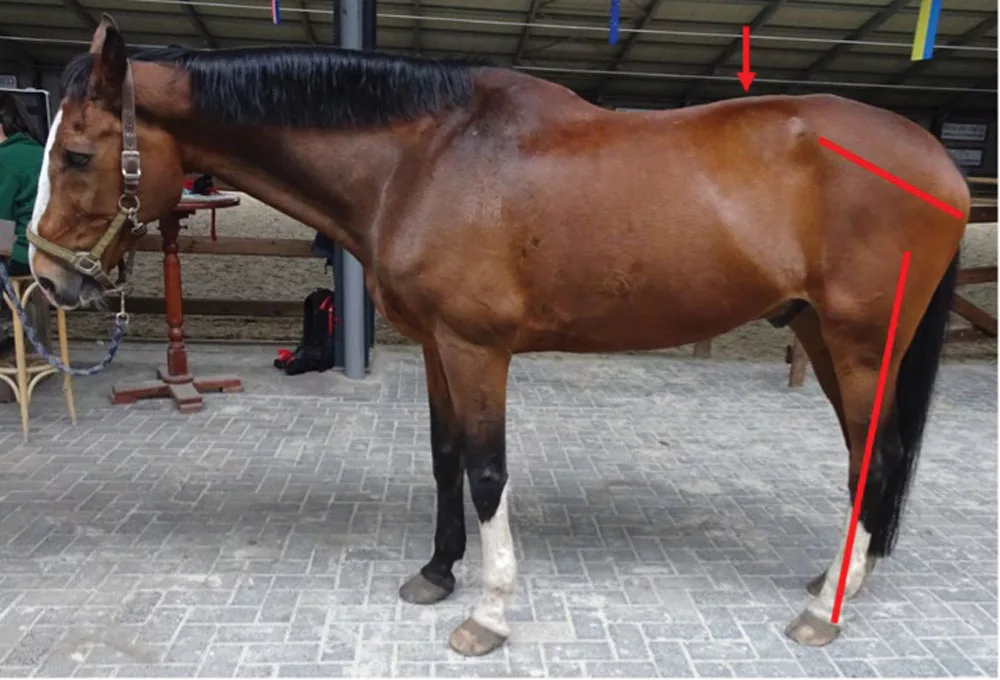
Moreover, even in cases of subtle to moderate pain, horses commonly show a relief posture or shift the weight from one leg to the other (Figure 7). Furthermore, sleeping behavior changes can be observed.
Horses with pain either lie down more frequently or do not lie down for sleeping at all, particularly those in chronic pain. The last situation can result in chronic fatigue and overtiredness. These horses show sudden limb joint breakdowns. It’s crucial to enable lying down for sleeping in horses suffering from pain.
During locomotion, lameness can be present or in less obvious cases, poor gait quality, stiffness, skewness or decreased motivation to move can be signs of pain.
However, next to physical signs of pain, behavioral changes can be observed. In one hand, horses suffering from pain show a reduced interaction with their environment and may exhibit signs of depression. These horses display an atypical posture (stretched neck) and are characterized by their unusual gaze, head and ear fixation (Fureix et al. 2012). They are also more indifferent than sound horses to environmental (tactile and visual) stimuli in their home environment.
On the other hand, horses with pain tend to react (passively or actively) aggressively or unpredictably against humans or other animals (Fureix et al. 2010). This aversive behavior is an attempt to avoid or to escape from pain caused by human handling, such as putting on a saddle, lifting a leg, riding, etc. Usually, horses do not resist human interaction or react aggressively without purpose. Aversive behavior should be taken seriously and the appearance of pain should be excluded as a reason for behavioral changes.
A Farrier’s Role
Pain recognition is part of the farrier’s professional responsibility. The farrier is an equine professional who is educated in physiology and behavioral expressions in horses. In addition, the farrier sees the horses regularly (in contrast to a veterinarian, who typically sees the horse only if it is diseased) and often knows them for several years. He/she knows the individual behavior, posture and gait of the individual horse but is also not as routine-blind as the owner.
Therefore, the farrier might recognize changes earlier or can interpret them with the context of a professional background. This can help to recognize pain at an early stage and to avoid chronic pain development.
The farrier should educate the owner in pain recognition and he/she should advise consulting the veterinarian to clarify the cause of the acute or even chronic pain. It’s a question of animal welfare to ignore the presence of pain.
Moreover, it’s essential for the professional who’s handling horses during trimming and shoeing to recognize the signs of pain. Resistance to lifting a leg, pulling the limb away, kicking, aversive behavior, anxiety or unpredictable reactions are often not “misbehaving” but an expression of pain, particularly if a typically friendly, well-collaborating animal starts to fight against the trimming and shoeing procedure.
If pain is the reason for resistance against trimming and shoeing, the farrier needs to consider it in his/her work. For example, it might be possible to find a more comfortable, less painful position for the horse, such as less height and lateral angle in lifting the leg, using a hoof stand to enable the horse to put load on the lifted leg and using a wall to let the horse lean on. In addition, the farrier can lift and move the limbs slowly to give the horse the chance to adapt or he/she may gently mobilize the limb before fixing the limb for trimming or shoeing.
In mild cases of pain, distraction and positive reinforcement for collaboration can be achieved by providing treats, food or a licking bowl. This might avoid fighting and increased resistance.
If the pain is too great, and lifting one leg is causing significant problems for the horse, the collaboration between the farrier and veterinarian is necessary. The farrier must not force the horse to endure pain during trimming or shoeing. Highly painful, chronic orthopedic disorders, such as laminitis or arthrosis, need pain management by a veterinarian to enable a farrier to work, which is in line with animal welfare.
Learn more in "Pain & the Equine Orthopedic Patient" by Dr. Hagen in the January/February issue of American Farriers Journal.