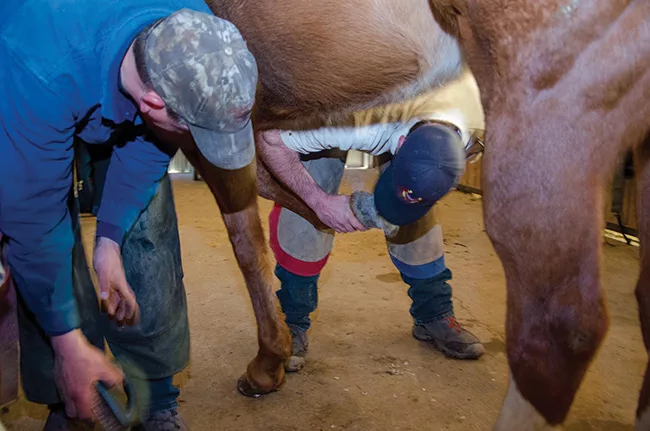
Ramsey, Minn., farrier Mark Thorkildson grew up around horses. During his youth, the work by the farriers who shod his family’s horses didn’t spark Thorkildson’s interest in footcare. It wasn’t necessarily that their work was bad, but these shoers were in-and-out backyard practitioners. Nothing stood out about their work with horses that would catch the eye of a novice.
That interest arrived for Thorkildson when his mother began showing Quarter Horses on the world level. They hauled a horse with foot issues to River Falls, Wis., where Bob Racich had a veterinary and farrier practice. The work performed there to help the horse opened Thorkildson’s eyes to superior hoof care.
“It put things in a different light,” he recalls. “I saw forging shoes and pulling clips — things I hadn’t seen before.”
That craftsmanship, absent in the early footcare Thorkildson witnessed, inspired him to attend the Oklahoma Horseshoeing School in late 1994. He’s been in the industry ever since.
After shoeing school, Thorkildson worked under a few different mentors, with two particularly providing impactful direction. Dave Jacobson exposed him to a high number of horses, spread across various disciplines. Customer service was important for the elder farrier, so Thorkildson gained insight on those better practices.
The other mentor, Bill Qualey, stressed continuing education by attending clinics and conferences. Thorkildson recalls when that mentor took him to the Bluegrass Laminitis Symposium about 20 years ago. That was another eye-opening experience.
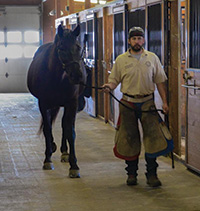
Before and after his work, Thorkildson will watch each horse move. For him, time spent doing that is more valuable than overly finishing the foot.
He invests in his education, and believes you can’t succeed as a shoer unless you make that commitment. He is an American Farrier’s Association Certified Journeyman Farrier (CJF) and earned his associateship in Great Britain’s Worshipful Company of Farriers back in 2010.
The decades-old impact from seeing quality farriery is still evident with Thorkildson. He takes pride in his work, doesn’t cut corners and became a craftsman akin to what he saw in the 1990s. Those elements were on display during this “Shoeing For A Living” day.
7:59 a.m. With snow flurries hitting the Ford F-150’s windshield, it’s a chilly start to the day. The Upper Midwest is in the daily freeze-thaw cycle that adds another variable to consider when shoeing a horse during this season. Thorkildson says this season’s frozen terrain is challenging for keeping the working horses going.
Also joining Thorkildson for the day, and periodically, is Josh Ramsey, also a CJF, who lives in Big Lake, Minn.
We arrive at Kadler Farm, a boarding barn in Otsego, so Thorkildson can address a traction issue with a Thoroughbred mare. This is a horse he shod a couple of weeks ago, but the owner is concerned that the mare is excessively slipping on its way out to the paddock. She’s asked Thorkildson to pull the studs, thinking they are causing the excessive slippage. Considering there is still snow and ice on the ground and the promise of more snow in the forecast, Thorkildson is reluctant to follow that suggestion.
In similar cases, Thorkildson’s go-to fix would be to pull the shoes, but the owner is insistent on keeping them on. They pulled the shoes one winter and the horse came up sore, typical of a thin-footed horse. So instead, Thorkildson pulls the toe nails, replacing them with Vector V-Trax nails in the hinds to improve traction.
After he gets in the hind toe nails, Thorkildson has the owner lead the horse across the grooming area. The change didn’t provide the desired results, as the horse uncomfortably slipped across the floor, never quite trusting its feet.
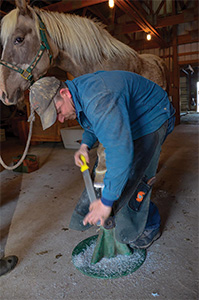
Ramsey, right, rides along with Thorkildson every now and then. The two work well together, allowing each to focus on their strengths as farriers. To be a helper, look for ways to keep the work moving.
The problem isn’t the nails as much as two other contributors. Part of the issue is that the grooming area of the barn is an old garage, so the concrete lacks the coarseness to prevent the slippage. The larger problem is that the horse lacks the confidence with her footing.
“I think that horse slipped and scared herself,” Thorkildson reasons. “You can see how when she would walk in that area, she would extend, but also retract the foot before it hit the ground. So it was sliding as it hit the ground.”
With the horse back in her stall, Thorkildson reviews options with the owner. The new nails will stay in, and they’ll see if the horse can improve with them. The easy decision is that the owner will avoid taking the horse in the grooming area. The barn aisle where the horse is kept has coarser cement, and the mare fared better on that surface. Thorkildson instructs the owner that when the horse is turned out, take it on a different route, avoiding the slippery cement. He’ll see the horse in 3 weeks for its regularly scheduled appointment and reassess the situation then.
8:21 a.m. There is an EHV-1 outbreak going on in Minnesota, with a few cases documented in Wright County — Kadler’s home county. No surprise, this has the attention of the state’s horse industry.
A few clients have cancelled shoeing appointments due to fear of exposure. Thorkildson says other clients have asked him what he’s doing to prevent bringing the virus to their barns should he come in contact with an infected horse at another barn. They are happy to find he is taking measures.
Before loading his tools back on the trailer for the next stop, Thorkildson sprays his clothing, shoeing box and tools with disinfectant. Ramsey has a spray bottle too for when he comes in contact with horses. They’ll each go through the same decontaminating ritual before leaving each barn today, even if the client hasn’t raise the concern.
Of course, the goal of using disinfectant is to prevent spread of the virus. But Thorkildson says there is another benefit. He suggests other farriers take the proactive steps during outbreaks not only for prevention but also because it demonstrates to clients that you are a proactive and serious practitioner who puts their animal’s health first.
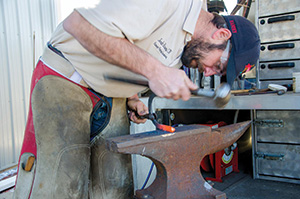
Ramsey says whether you work with concave or any other stock, build the shoe for the foot as you go along. Don’t make a generic shape to fit afterward.
9:17 a.m. During the drive to the next stop, Thorkildson says he didn’t find much of an impact during the economic downturn. Sure, he reasons that he lost a couple of backyard accounts, but not a noticeable impact on his bottom line. Overall, the area’s horse economy is strong, especially around the city.
“This particular area is higher end, with a number of Minneapolis executives living here,” he says.
His practice encompasses the Twin Cities metro area, so the farthest Thorkildson will drive to a barn is about 45 minutes away. He does have a show jumper account in San Diego, Calif., that he sees every 4 weeks. For that trip, Thorkildson will bring his hand tools along, but works with Alpine, Calif., farrier Jason Harmeson so he has use of a rig and anything else that doesn’t fit into a 50-pound checked bag.
“The best part is getting the chance to work with a guy like Jason and learning from him,” says Thorkildson.
Overall, his practice is composed of a diverse mix of horses. Among his clients is the Minneapolis Police Department’s mounted patrol.
He gets most of his tools and supplies at Duggan Farrier Supplies, which is just down the road from his house. The Duggan family also runs the Minnesota School of Horseshoeing, which Thorkildson says was a very instrumental part of his development, even though he didn’t attend the school. He adds that Richard Duggan, who is mostly retired now, was very generous with his insight in helping Thorkildson along as anovice shoer.
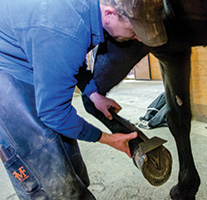
It’s not for every horse, but the T-square is an important part of Thorkildson’s trims. He uses it to check medial-lateral balance on most of his horses.
9:33 a.m. Thorkildson backs his truck and trailer into the barn aisle. Fair Haven Farm is a nice hunter/jumper barn in the southwest suburbs of Minneapolis.
He has pulled the Stonewell Body trailer for 3 years. Prior to that he had a truck body, which he also liked.
“Having a dual purpose vehicle is great,” he says. “This is handy enough, but you may need to plan some things out and back in off the road. You learn quickly what roads not to take.”
The trailer has a good layout, allowing the two farriers to work without too much interference.
Thorkildson likes to switch trucks every 2 years, so using the trailer makes it less complicated to change a new vehicle without having to swap out a truck body.
The trailer is well equipped with power tools, including grinders and two drill presses. The layout isn’t entirely different from what he had on the previous truck body. Before he bought the trailer, he looked at a number of different bodies, but this design still works for him.
9:40 a.m. He keeps most of his horses on a 4- to 6-week schedule, including the ones at this barn. Before Ramsey pulls the front shoes on the first horse, Thorkildson says you should evaluate every horse before working with it.
“You want to get a feel of what’s growing over or what’s not quite right,” he says. “Take a look a them before you pull the shoes to make sure you didn’t miss something at that last shoeing.”
After looking the horse over, Thorkildson will set him up the same way, deciding to use the snow pads one last time — hopefully — this season.
9:51 a.m. With the shoes pulled, Thorkildson takes his rasp to the front right foot and explains his shoeing philosophy.
“I’m trying to be more gentile to the bottom of the foot,” he says. “On these fronts, I’m not going to take much off, just gather the foot up a bit. I take a little off with the burn. I prefer leaving a little more depth on the bottom and am slightly more aggressive shaping the foot. Ideally, I like to have the heels and frogs on the same plane. On these bigger horses, you just want to maintain them.”
As he holds a T-square along the distal limb to the heel, Thorkildson mentions he is a firm believer in using the T-square for checking medial-
lateral balance. It isn’t for every horse, but helps check the accuracy of what he is seeing.
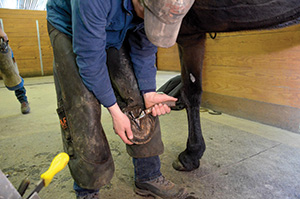
Thorkildson takes a minimalist approach with his trims. He likes to keep his horses on a 4- to 6-week schedule.
Thorkildson notes he can get a reset out of these shoes, as Ramsey has them at the anvil. With the work level of this horse, combined with the pristine footing in the arena, Thorkildson finds he can get two, sometimes three resets.
11:02 a.m. Ramsey finishes the hind feet. The next horse is a mare with a ringbone issue. Whether they work on one horse or have two in the cross-ties at the same time, Thorkildson and Ramsey have a good balance to their work. Ramsey pulls the front shoes and cleans the feet. While he takes the shoes back to the rig, Thorkildson trims the horse’s feet.
11:31 a.m. Having trimmed the feet, Thorkildson is shoeing the fronts. In between steps, Ramsey pulls the hinds.
For the most part, Thorkildson likes to set up his large horses the same way during winter, using Mustad P13 studs in the heels, along with Mustad’s Maxi No-Snow pads on the fronts and hinds. He’ll also use snow pads by Castle Plastics.
His preference is impression material, although he uses a wide variety of packing. Once Thorkildson applies the mixed impression material and copper sulfate to the foot, he likes to set a couple of tack nails, pick up the opposite foot to have the horse bear weight and let the material settle.
He is cautious with traction and doesn’t use Borium because most of his horses aren’t working hard enough that it is required. He finds these studs give the right amount of traction.
For winter shoeing, Thorkildson recommends carrying a variety of snow pads. “You’ll run into various foot shapes where it is hard to make them conform. You might have a pointed toe front, it might be hard to make some snow pads work, but they work well with a round toe. You might want to try a different brand or even a hind pattern. You can’t get away with only carrying one type.”
12:06 p.m. A gelding is in the cross-ties across from the mare. Ramsey will finish her feet while Thorkildson moves across the aisle and starts working with him. She’ll stay in the cross-ties though, as the other horse is better behaved with his pasture buddy around. Thorkildson handles about 15 horses here, and tries to do around four while at the barn each day.
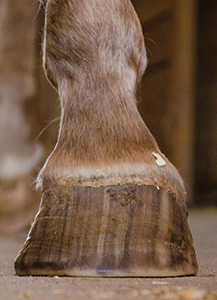
Figure 1.
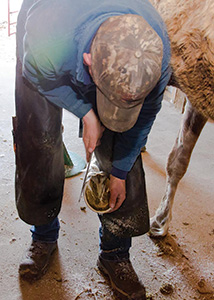
Figure 2.
12:34 p.m. Thorkildson nails on the shoe and snow pad. The Minnesota farrier says he isn’t big on finishing the foot with sand blocking or adding hoof coatings. For one, his clients don’t demand it; but if they did he would be happy to do so. The most important reason not to for Thorkildson, however, is that he would rather devote that extra time reexamining his work before moving on to the next horse instead of cosmetics that don’t benefit the hoof care.
12:56 p.m. The final horse to do today at Fair Haven is a gelding that does not stand well for the farrier. Safety is a concern, and this is just a trim. The horse has been sedated previously for footcare.
Fortunately one of the barn’s staff has a good rapport with this gelding and he stands well for her. Thorkildson just takes his rasp to slightly trim the hooves, occasionally giving the horse a break.
Had the horse handler not been present and sedation wasn’t an option, Thorkildson says he wouldn’t hesitate to skip the horse. Like so many other farriers, it was a mistake of his youth to force his way through working with ill-behaved horses. The issue goes beyond his safety.
“By muscling through it and knocking some foot off, no one really benefits,” he says. “Sure, you trimmed the horse and made $50, but you aren’t happy with the work you’ve done and the horse could have had better work done if you had the time.”
He finds that the best way to move beyond the point of working with bad horses is for a farrier to develop the confidence that the problem rests with the horse, and to professionally tell the owner that the situation isn’t good. You have to look out for yourself.
1:06 p.m. Before we leave the barn, Thorkildson writes up an invoice and gives it to the barn owner. For most of his accounts, he expects payment on the day of service. When necessary, he still bills a few clients, such as the city of Minneapolis for the police horses.
For barns with several horses, his preference is to get through a set number and bill for the complete count. He has begun taking credit cards, initially being turned off by the interest fees, but now recognizes the value of immediate collection.
2:36 p.m. After lunch, we arrive at the barn of Hailey Sheldon, who’s an accomplished barrel racer. Thorkildson says it is a blessing to have a good rider as a client.
“Not all of her horses will be set up the same,” he says. “We’ll watch videos and watch them run. That’s where it is so helpful for the team approach of having someone who really knows her animal.”
Other than different shoes and a tighter fit, his approach with these horses is consistent with what he did at the last barn: a very minimalist trim.
“I tend to not let anything really hang out on them,” he says. “I’m here every 4 weeks, so you can get by without a lot of steel hanging out.
“One weekend she might be in Kansas, and then next in the Dakotas. I just never know where she might be riding at or if there are other farriers around, so the fit is pretty tight.”
2:43 p.m. With the shoes off, Thorkildson trims the feet of the barrel horse. Although apparent throughout the day, the good workflow between Thorkildson and Ramsey is especially recognizable during the work with this barrel horse.
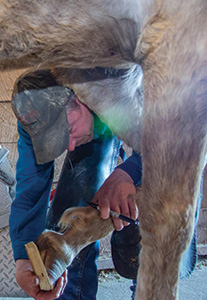
Figure 3.
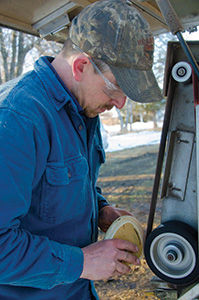
Figure 4.
Thorkildson advises that when you work with a helper, especially one of Ramsey’s caliber, you must recognize their strengths and passions for the work. Allow the helper to handle those duties.
“It’s my responsibility and strength to do the trimming and shoeing, so we can fill the gaps in between,” Thorkildson says. “You also have to be willing to speak your mind and also be receptive to that.”
Ramsey adds that when you are the one helping, you need to be aware of what the lead farrier wants you to do, especially in respect to what the client is OK with.
“You need to keep things moving and figure out what you can do to help,” he says. “Always think about what is coming up in the process. Are pads going to be needed? Then get them and the packing ready. Don’t wait to be told what to do.”
Thorkildson is going to tap into Ramsey’s strength and passion today by having him build shoes for this barrel racer from concave stock. Ramsey likes shoe building and is a competitor with the World Championship Blacksmiths. Although with a newborn daughter, his time dedicated to practice and competing is spoken for at home.
Ramsey measures the length of stock he needs, cuts the concave and heats it in the forge. When building a shoe on site for a horse, Ramsey warns to remember each detail.
“Get your foot trimmed and have the measurements figured out,” he says. “Have a steady system so that when you are making the shoe, you’re in a sense, trimming the foot at the same time.
“When you are building a shoe, build it for that foot right away. Don’t turn some generic shape that you think a shoe should look like and then have to try to fit it to the foot after that. Make the shoe look like the foot from the get-go. If it is offset by 1/16 inch, do that right away so you know the shoe will fall in place right away.”
2:51 p.m. Ramsey likes working with concave for its versatility in use and flexibility when making the shoe.
Thorkildson trims the feet while the shoes are built. Ramsey draws quarter clips on what will be the front fore shoe. For working with concave, Ramsey says keep an eye out for when it twists on you.
“The minute it starts to twist, just flatten it back out,” he says. “Once the stock gets a bit of twist in it, it is tough to get it evened out.”
Ramsey says some farriers may not want to build shoes because more time is spent making a shoe than adjusting a keg shoe. However, the money is made in the resets. He finds that he can get more resets out of shoes he’s made than with keg shoes, especially with concave.
Thorkildson makes about 15% of his shoes. The percentage used to be much higher, and he wants to return to a higher number of handmades. For now, between work and family life, there isn’t the time.
“It’s tough because you fall into a rut where you take on too much work and get really busy,” he says. “You have to find that balance between your family and putting the right amount of time into your practice.”
3:07 p.m. Thorkildson gets out a second horse, pulls the shoes and trims the feet. It is a conservative trim again, and he’ll put the horse back into the stall before Ramsey has both shoes finished.
Thorkildson nails on the front shoes after Ramsey pulls the hinds. Thorkildson is happy with the forge work by Ramsey and only needs a slight adjustment for a good fit.
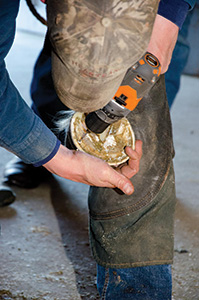
Figure 5.
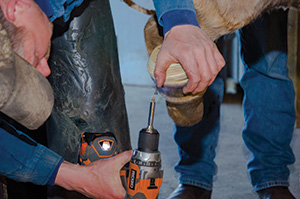
Figure 6.
4:37 p.m. Thorkildson will use St. Croix Eventers with this gelding. He nails on the right front, clinches and uses a gouge, which he modified from a woodworking tool. This horse goes well with the shoes, so there is no need to build some for him.
“Keg shoes on the market are so good these days,” says Thorkildson. “But there is a time and a place for them. Building them yourself isn’t necessary, but gives you more options and a better fit.”
5:40 p.m. With both horses done at Sheldon’s there is one more stop for the day. As we pull into the owner’s drive, Kevin Voller, a veterinarian from Anoka Equine Veterinary Services, greets us. Thorkildson has a good relationship with the clinic, and often works with them on cases.
The vet has called the farrier in for a laminitic backyard horse. Thorkildson’s not the primary farrier for the horse, and has no interest in taking on the account permanently — the other farrier just wasn’t interested in tackling this therapeutic case.
5:49 p.m. Voller reviews the radiographs with Thorkildson. With the state of rotation of P3 in the left fore foot, the farrier will opt for wooden clogs, which he has successfully used in nearly 50 laminitis cases.
He was introduced to the therapy first at a clinic featuring retired Cornell University farrier instructor and current Farrier Product Distribution clinician Mike Wildenstein. He then learned more about using them from equine vets Steve O’Grady of Marshall, Va., and Tracy Turner, also from the same Anoka practice as Voller.
Like the first stop of the day, this owner has a demand that limits shoeing options. In this case, Thorkildson can’t use nails, as the mare won’t tolerate the concussion of nailing. There are other options that could work, and Thorkildson is happy to oblige an owner’s request as long as the available options follow reason. He advises explaining to the owner what the alternative measure and steps are.
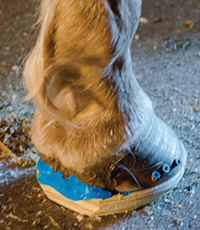
Figure 7.
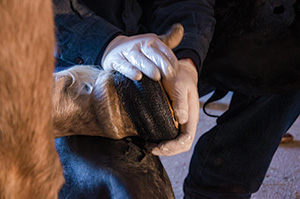
Figure 8.
6:01 p.m. Because the horse is particularly sore in the left front (Figure 1), Thorkildson will begin with that foot. He refers to his trimmings today as “minimalist” in nature. If that is the case, this is even more so. Starting on the left front, he slightly backs up and slightly rasps the foot (Figure 2).
“Could I be more aggressive?” he asks. “Yes, but it is a sore horse, I’m adding mechanics into the package, so I made the conscious decision to not rasp that toe back to being straight and weaken the foot.”
6:09 p.m. Thorkildson carries premade sizes 0 to 2 blocks in his trailer. These are made using two pieces of plywood, glued together and finished with narrow crown staples. He trims them to the basic outline of a Natural Balance shoe. He’ll then bevel with the band saw and sander, and finish at the horse.
He finds the appropriate sizes and measures both clogs to the front hooves, marking the outlines with a Sharpie (Figure 3). He likes to leave about a 1/8-inch rim outside the foot toward the back half and fit for length to the origin of growth in the heels.
“I’m aiming to have that horse facilitate breakover directly underneath P3 and preserve enough sole mass as possible,” he says. “You’re not setting this horse up to do a cross-country course. A lot of time, what we’re doing is trying to save lives.”
With the desired shape for each clog, Thorkildson applies impression material to the foot. Like the jumper earlier today, he likes to let the impression material set. He uses two screws to hold the clog in place (Figure 6), allowing the impression material to set.6:19 p.m. While Thorkildson shapes the clogs (Figure 4), Ramsey brushes and rasps the hinds. After getting the fit he needs, he drills the holes for the clog screws through the hoof (Figure 5).
“I’ve had really good success with the impression material,” he says. “I can control exactly where it is going.”
Once that is done, he drills in four more screws (Figure 7). Sometimes there won’t be enough wall, but as long as he can get a couple for stability, the casting tape will do the work. He then uses 2-inch casting tape around the foot (Figure 8).
“Keep the tape low and stay away from the soft structures of the foot,” he says. “Use cold water so the tape doesn’t set too quickly.”
He’ll let the tape dry before moving to the next foot (Figure 9). With the left foot completed, he will perform the same procedure for the right.
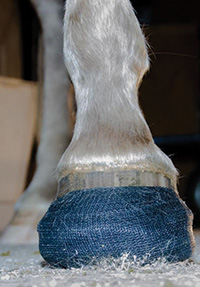
Figure 9.
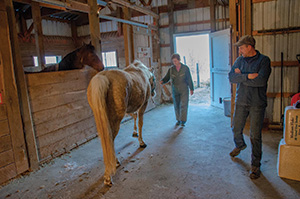
Figure 10.
“So many times, these horses are in pain,” he says. Thorkildson suggests if a horse is in significant pain do one foot completely before moving to the other.”
6:34 p.m. Thorkildson watches the horse walk (Figure 10), noticing a slight improvement from earlier this evening. He’ll return at least once more at 6 weeks.
“This case worked out about as well as you can hope,” he says. “We had radiographs, the vet was present and we were able to discuss options. It was better having that plan set before the horse is even out there.”
7:07 p.m. Thorkildson parks his rig in the driveway. As we unload the gear, he jokes, “I hope you weren’t too bored today.”
Bored? No. This day had a little bit of everything: shoe building, different disciplines, footcare problem solving and a therapeutic case to place the wooden cherry on top. More importantly, two farriers showcased quality hoof care.
Thorkildson has come a long way since he was awestruck by someone building shoes for a Quarter Horse. Now he is the one who’s doing high level work to help horses. I think if that teenager could see himself “Shoeing For A Living” on this April day, he’d be just as impressed as that day some 20 years ago.