 Premium content is for our Digital-only and Premium subscribers. A Print-only subscription doesn't qualify. Please

American Farriers Journal
American Farriers Journal is the “hands-on” magazine for professional farriers, equine veterinarians and horse care product and service buyers.

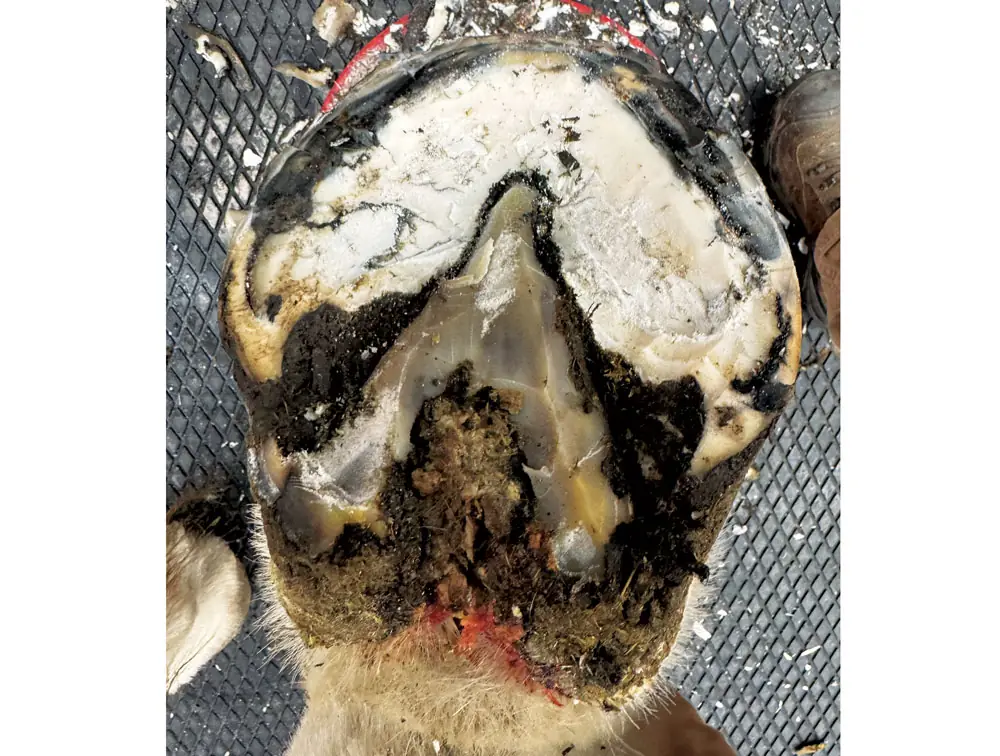
Poor conformation, leading to improper foot function, allows bacteria to invade sensitive tissues, which leads to thrush. Steve Kraus
Humans have intervened in horses’ hoof care for thousands of years. Over time, we’ve seen shifts in breeds, how horses are used, and why people own them.
Historically, we know the horse has played a major role in transportation, war, agriculture and the development of nations. It’s clear that caring for horses’ health, including their feet, is of primary importance.
Understanding the hoof care of horses living in specific areas of the world has varied. Most horses lived and stayed in the areas where they were born. Consequently, their hoof type was in harmony with their environment or they did not last. At some point, horses traveled on ships to new continents or traversed long distances for conquering armies. There’s no doubt they encountered hoof problems when different weather and ground conditions were their new environment.
The Romans developed heavier breeds and paved roads to help them conquer different parts of the world. They realized that durable hoof protection enabled them to move soldiers and materials farther and more efficiently; hence they developed the nailed-on metal horseshoe. It also seems that Genghis…

American Farriers Journal is the “hands-on” magazine for professional farriers, equine veterinarians and horse care product and service buyers.

American Farriers Journal is the “hands-on” magazine for professional farriers, equine veterinarians and horse care product and service buyers.
Download these helpful knowledge building tools


We are here to support you.
We stock a wide range of high-quality products from trusted brands to ensure durability, performance, and reliability in every job you undertake. Our extensive inventory of horseshoe products and farrier tools means you can find everything you need in one place, saving you time and effort. Your satisfaction is our top priority. We are committed to providing excellent customer service, prompt shipping, and hassle-free returns.
