
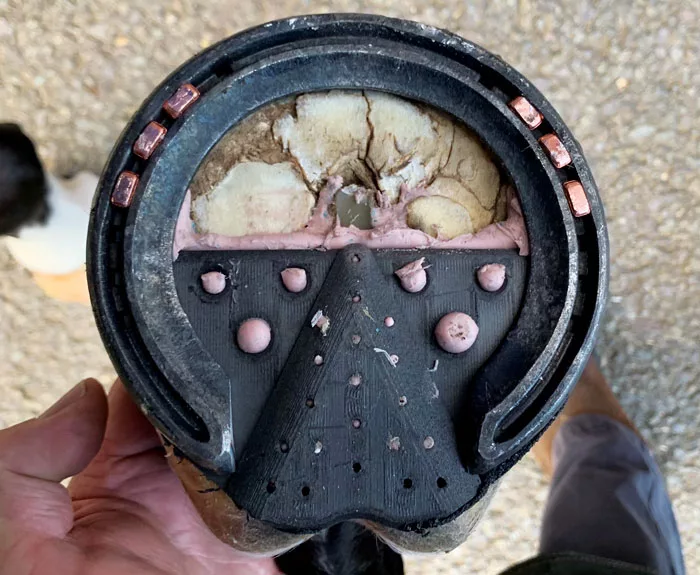
It’s 2025. We now have imaging technology, pressure plates, infrared thermography and even 3D-printed pads and shoes. Yet, here you are, still relying on a rasp and hoof testers like they’re magic wands. Technology is great. It’s a tool, not a crutch. There’s a reason I love diagnostics, but I don’t treat them as the unquestionable truth. Use these tools to guide your thinking, but never let them think for you.
Pressure mapping might show you where a horse is putting stress, but it won’t tell you why. Thermal imaging will show you hot spots, but it won’t explain why those spots are there in the first place. These tools are designed to provide data, not answers. It’s up to you to interpret them and, more importantly, to see the gaps in the data that technology can’t fill.
Slapping every possible gimmick onto a problem doesn’t make you a genius or a trailblazer. At best, it makes you look like a lunatic. At worst, it makes you a complete fool. Just because you have the tools doesn’t mean you should use them all. Understanding the why and the when is a lot more crucial than just knowing the how.
If you’re throwing the same trick at every horse you see — impression material, glue, whatever — then congrats, you may have sold out, following a formula instead of thinking. Sure, they’re useful tools, but if they’re your go-to for everything, it’s time to ask yourself a hard question: When did you stop thinking and just start slapping on Band-Aids? Use your brain, or you’ll miss the real problem hiding behind that lazy routine.
If you’re treating every horse — or every limb — the same way, you’re screwing up. There are no cookie-cutter cases, and if you’re using a one-size-fits-all approach, you’re doing more harm than good. The body is complex, so stop pretending every problem has the same answer.
You need to acknowledge that you have the right to switch up your opinions and your methods. As you stumble through the mess of learning, you’ll inevitably evolve while your skill set expands. Just don’t expect perfection. Strive for it — don’t expect it.
Get Comfortable with the Unknown
If you’re not comfortable with uncertainty, you’re in the wrong profession. Horses are frustratingly unpredictable. Let me be blunt: They’re complete idiots, hell-bent on self-destruction — more like a toddler hopped up on sugar, running full speed with zero regard for their own survival and a knife in their hands. They also can’t tell you what hurts, and often, what you see first is just the tip of the proverbial iceberg. But here’s the thing, being unsure doesn’t mean you’re incompetent. It means you’re aware that hoof problems are often multifaceted. It means you’re willing to say, “I don’t know,” and then actually do something about it.
The truth is, no matter how experienced you are, no matter how many cases you’ve seen, there’s always a chance you’ll be surprised. In fact, count on it. And that’s fine — embrace the surprise. Because when you step outside of the rigid structures you’ve built in your head, that’s where the innovation happens.
Gain more insight from Nicholas Denson by reading "Thinking Outside the Box in Farriery" in the January/February 2025 issue of American Farriers journal.