Optimum should be the goal, so hoof length and angle correspond to the horse’s preferred gait stride and frequency. It seems odd that we would obligate the horse’s distal limb to possibly inefficient mechanics, more than we would tape our hand on the wrong spot on the hammer shaft. We understand the consequences of not holding the hammer correctly, so why do we ignore being mechanically efficient in our practice of farriery?
Finding Optimum
While there are multiple optimums, we’ll focus on the application and loading levers on the sagittal plane on the hoof base (Figures 2a & 2b).
These measured lengths are easily gathered and provide a clear mechanical perspective of how the hoof and distal limb is operating. That information also provides a means to compare one contralateral leg with another, front or back and on a diagonal if required. These lengths are also important as they are the levers in “setting” the toe back and “easing breakover” and assist in gaining a perspective of the fetlock function.
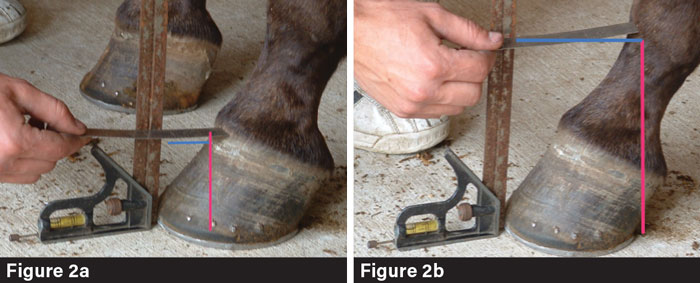
Mark the hoof and fetlock center at the coronary band and the metacarpophalangeal joint respectively on the cranial aspect. When the horse is on a flat surface, place a square at the center of the toe and measure to the mark on the coronary band. When measuring the fetlock, lift on the contralateral leg, move the ruler to the marked fetlock point. It’s critical that the pastern is not broken back and both legs are not standing on the ground during measurement. Randy Luikart
How do we gather and utilize information that assists us in finding the elusive optimum? First, mark the hoof and fetlock center at the coronary band and the metacarpophalangeal joint respectively on the cranial aspect. Grab a square. Stand the horse on a flat surface. Place the square at the center of the toe and measure to the mark on the coronary band. Write down that length.
To measure the fetlock, lift the contralateral leg. On the leg you are measuring, ensure the pastern is not broken back (straight or slightly broken forward is acceptable) and move the ruler to the marked fetlock point. Do not take the measurement with both legs standing on the ground. This measurement is mimicking dynamic midstance. Write down the information after you take the measurement.
Looking at Figure 3, which represents a sagittal view of the distal limb, line AB is the distance you measured at the toe. Line AD is the distance you measured at the fetlock. Unless you are a math wizard, a calculator comes in handy here. Divide line AB by line AD, multiply by 100 and you get the percentage of the toe lever (AB) (propulsion) to the support lever (AD). This percentage should be larger than 40%.
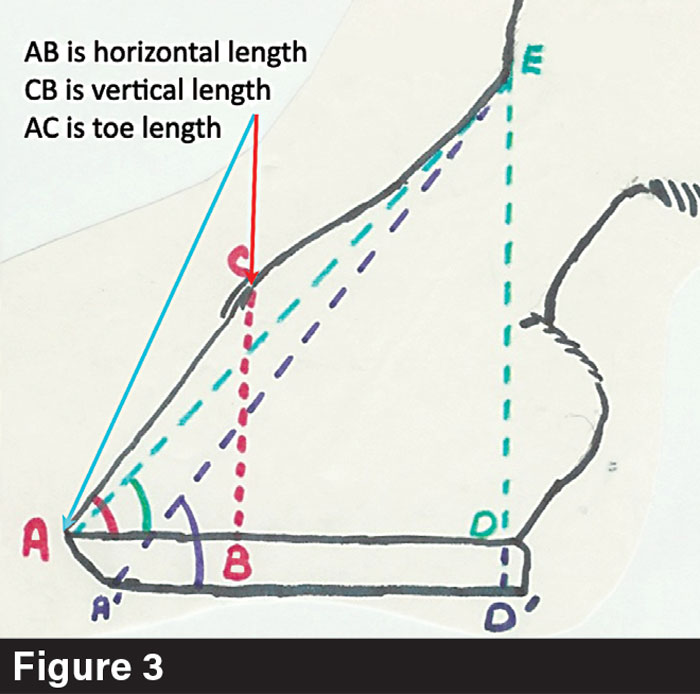
Line AB is the distance you measured at the toe. Line AD is the distance you measured at the fetlock. Divide line AB by line AD, multiply by 100 for the percentage of toe lever (AB) (propulsion) to the support lever (AD). Randy Luikart
Owner-desired performance requirements often dictate a different optimum for that performance. Thoroughbred racehorses might fall below 40%. Flat knee hunters may be close to 40%, plus or minus, while jumpers might be slightly above 40%. Long-footed horses approach 45-48%.
Optimum length of line AB should never exceed 50% in any performance style. Good record keeping and farrier practices allow you to shoe the performance horse for optimum so the hoof can grow “into” optimum balance during the shoeing period. By the methods of shoeing and prescribed shoeing from the equine community, we are instructed to shorten line AB and set the shoe back even more, which also shortens AB and decreases the percentage of AB/AD.
Doing that decreases the toe’s surface area and subsequently increases PSI of that hoof region. Unfortunately, that shoeing technique doesn’t decrease the forces generated by the horse from its required performance.
Growing into Optimum
My assertions that the distal limb (hoof and pastern/fetlock) should be operating in optimum mechanics. Simply mean the loading mechanics equals the application mechanics. That would be nice; however, the hoof base is growing, altering the hoof’s influence on the distal limb from the shoeing. This method allows you to shoe the horse so it grows into optimum. But what exactly is that perspective of optimum/equilibrium?
Allow me to use a metaphor for explanation. Let us assume you are at a clinic or a farrier supply shop, and you see an interesting hammer you would like to try. The first thing you do is pick it up and swing it. Your body quickly “feels” if the placement of your hand on the shaft is correct for the weight of the hammer or the length of the shaft, and you automatically adjust the position.
Logically, a heavier hammer requires you to “choke up” on the shaft, while the lighter hammer allows you to extend the shaft. Your body is oncoceptively feeling those mechanical influences of weight, angle and length and adjusting the hand’s position for you to “feel” the optimum use of the hammer.
Gain more insight by reading "Optimum Distal Limb Mechanics are Just a Few Measurements Away" in the July/August 2025 issue of American Farriers Journal