Farrier Takeaways

  • When addressing a resection used in the treatment of white line disease, consider a solution that will minimize the environmental exposure.
  • Understand the forces influencing the hoof and weigh the benefits and negatives for maintaining a horse post-resection when determining the method.
  • Modern materials and various metals can contribute to creative solutions for stabilizing the hoof.

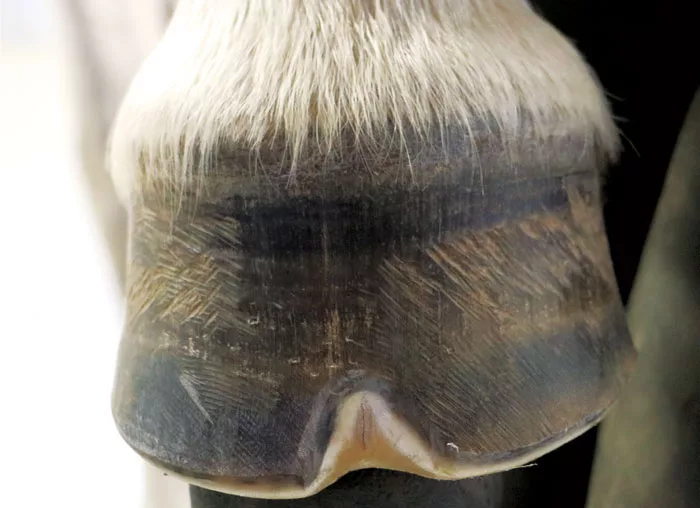
Many disease pathologies that affect the equine hoof require intervention from a veterinarian and farrier team. In addition, a resection of hoof wall portions may be necessary. Among the conditions that typically require partial to complete hoof wall resection are: full thickness hoof wall cracks/fractures, surgical removal of keratomas, hoof wall avulsions and white line disease. To limit secondary complications and increase comfort of the horse, various techniques can be utilized by the veterinarian and farrier team to stabilize the hoof wall and the distal phalanx within the hoof capsule.1,2,3 

The equine hoof shape is an inverted, incomplete truncated cone. In addition to this shape/orientation, the hoof wall decreases in thickness from the toe to the heel that results in expansion of the hoof capsule heels, both medially and laterally, as well as bending of the dorsal hoof wall ventrally when the limb is loaded and the distal phalanx descends within the hoof.4 This hoof mechanism results in various parts of the hoof having one or more forces (compression, tension, bend) acting on it based on the morphology of the hoof.5 These forces also impact defects, cracks and areas of hoof wall resection. For those located on the dorsal portion of the hoof wall, compressive and bending forces act on the proximal portion of the hoof wall, while bending and tensile forces act on the distal portion. For defects, cracks and areas of hoof wall resection located palmar/plantar to the widest point of the hoof, bending and tensile forces act upon them proximally and distally. 

To minimize these forces, externally the hoof wall can be stabilized utilizing hoof casts, plating techniques utilizing metal bands and/or composites of polymethyl-methacrylate (PMMA) adhesivesa and various fabrics, patching/filling with PMMA adhesives or urethane adhesives, and the use of horseshoes with strategically placed clips or horseshoes with toe/quarter caps/rims. To attempt stabilization of the distal phalanx/bony column within the hoof capsule, various forms of frog and/or sole support are utilized, including heart bars, heel plates and pads with various hoof packing materials. The aim of this article is to describe some of the techniques used to externally stabilize the equine hoof wall when significant hoof wall resections are required, including the benefits and some of the possible negative consequences associated with them. 

Addressing Varied Resections 

Smaller areas of resection for the treatment of incomplete hoof wall cracks/fractures, avulsions or white line disease (Figure 1) do not require external stabilization and are often resolved with trimming alone. The benefits for maintaining these horses barefoot are numerous from reduced cost to the owner, avoiding the negative consequences associated with horseshoes and allowing for daily cleaning and topical treatment. The potential negative consequences are lameness as a result of an insufficiently stable hoof capsule, exposure to the environment and microbes, possible avulsion of the remaining hoof wall and crack formation circumferentially to the area of resection. 

Hoofwall-Burns-Fig-1.jpg

Moderately sized areas of resection can often be stabilized externally using strategically placed clips on the medial and lateral sides of the defect (Figure 2). The benefit to stabilizing the area of resection with a shoe and clips is that it allows for daily cleaning and topical treatment. Some of the potential negative consequences are the same as maintaining the horse barefoot as previously outlined, in addition to the potential negative consequences associated with horseshoes including shoe loss, alteration of the hoof mechanism, increased forces and/or vibration to the hoof and distal limb. 

Hoofwall-Burns-Fig-2.jpg

Larger or more complicated areas of resection, such as those resulting from complete hoof wall cracks/fractures, surgical removal of keratomas, avulsions and white line disease, require external stabilization of the hoof capsule to maintain comfort for the horse. The compressive forces that occur on the dorsal hoof wall exceed the compressive yield strength for composites made of PMMA and repair fabrics.6 Therefore, for complete, full thickness hoof wall cracks/fractures at the toe or dorsal aspect of the hoof wall, the authors’ preferred method is to utilize a technique that incorporates either brass, aluminum or steel, which all have compressive, tensile and bend mechanical properties greater than that of hoof wall.7,8,9 The benefit to utilizing aluminum is that it can easily and reliably be attached to the hoof wall with a PMMA adhesive (Figure 3). The benefit to utilizing steel is that it has greater compressive mechanical properties than aluminum and brass however it must be attached to the hoof wall utilizing screws (Figure 4).7 The benefit to utilizing brass is that its compressive mechanical properties are less than aluminum, reducing the risk of restricting the hoof wall at a pathological level. However it must be attached utilizing screws (Figure 5).7 To reduce the risks associated with attaching the metal bands with screws, the hoof wall can be reinforced/increased in thickness with multiple layers of fabric such as Cobrasoxb, Poly-Vectran (polyester-Vectran)b or fiberglass saturated and bonded to the hoof wall with a PMMA adhesive (Figures 4 and 5). In some cases, the defect is plated and left open to allow for daily treatment but the foot must be bandaged to keep the area clean (Figure 4). Complete hoof wall resections exposing areas of the dermis should only be stabilized utilizing a plating technique. It is important that these areas are left open to allow access for treatment, kept clean with a bandage when not being treated and ensure that they do not come into contact with PMMA adhesives (Figure 4)

Hoofwall-Burns-Fig-3.jpg
Hoofwall-Burns-Fig-4.jpg
Hoofwall-Burns-Fig-5.jpg

Areas of resection palmar/plantar to the widest point of the hoof are frequently left open for daily treatment without issue. As previously noted, the forces that act on this portion of the hoof are primarily tension and bend. When stabilization of this portion of hoof wall is required, the authors’ preferred method is to utilize a common plating technique that involves saturating several layers of Poly-Vectran with a PMMA adhesive and applying it across the defect leaving the proximal and distal portion of the resection open to allow for daily cleaning and topical treatment (Figure 6). The tensile and bend mechanical properties of a composite made of Poly-Vectran and a PMMA adhesive are stronger than that of hoof wall, thus a metal plate is not required.

Hoofwall-Burns-Fig-6.jpg

Addressing White Line Disease

Often hoof wall resections for the treatment of white line disease are left open or stabilized with the same plating techniques as previously described. This is to allow exposure to UV light and air, along with daily topical treatment to reduce the risk of creating an anaerobic environment that will exacerbate the disease pathology. However, due to environmental conditions and/or poor owner compliance, when left open, the area of resection often becomes packed with dirt, debris and microbes, typically worsening the disease or at minimum impeding improvement (Figure 7)

Hoofwall-Burns-Fig-7.jpg

To resolve this issue, the podiatry service at the Virginia Maryland College of Veterinary Medicine has developed a technique that stabilizes the area of resection and prevents exposure to the environment to minimize the risk of exacerbating the white line disease process and/or causing an abscess. After the area of resection is debrided (without contacting the stratum internum and/or dermis), the remaining epidermal tissue is treated topically with an antiseptic and astringent substance (7% tincture of iodine) (Figure 8)

Hoofwall-Burns-Fig-8.jpg

Next, the area is packed with a silicone impression material (Figure 9). Then two layers of Poly-Vectran are cut to size to cover the resected area and extend beyond all borders proximally, dorsally and palmarly/plantarly. The hoof wall is then prepared to accept the adhesive by removing all dirt and debris, and drying the hoof. The double layer of Poly-Vectran is saturated with a PMMA adhesive  and applied to the hoof over the silicone impression material. 

Hoofwall-Burns-Fig-9.jpg
Hoofwall-Burns-Fig-10.jpg

After the PMMA adhesive is cured, the silicone impression material can be removed leaving a composite shell on the outside (Figure 10) and a void on the solar surface (Figure 11). This method keeps the adhesive away from resection and allows the area to be packed with an antiseptic packing material comprised of oakumc, Venice turpentined and copper sulfate crystalse (Figure 12) before being covered with a shoe and pad (Figure 13)

Hoofwall-Burns-Fig-11.jpg
Hoofwall-Burns-Fig-12.jpg
Hoofwall-Burns-Fig-13.jpg

This technique has successfully resulted in stabilization of the hoof capsule and treating white line disease, while minimizing exposure to the environment and allowing for the hoof wall resection to be replaced by new growth free from separation (Figure 14).  

Hoofwall-Burns-Fig-14.jpg

Images courtesy of: Dr. Scott Pleasant, Jake Hall and Travis Burns.


Manufacturer’s Information

a. Equilox International, 110 NE 2nd St., Pine Island, MN 55963

b. Sound Horse Technologies Inc., P.O. Box 689, Unionville, PA 19375

c. Jamestown Distributors, 17 Peckham Dr., Bristol, RI, 02809

d. Hawthorne Products, Inc. North N., 16828 IN-167, Dunkirk, IN 47336

e. Zep, 3330 Cumberland Blvd., Ste. 700, Atlanta, GA 30339

References

  1. O’Grady, SE. “How to Manage a Quarter Crack.” AAEP Proceedings, vol. 56, 2010, pp. 141-147.
  2. Pardoe, CH and AM Wilson. “In Vitro Mechanical Properties of Different Equine Hoof Wall Crack Fixation Techniques.” Equine Veterinary Education, vol. 31, no. 6, 1999, pp. 506-509., 10.1111/j.2042-3306.1999.tb03859.
  3. Pollitt, CC. “Chapter 1, 2.” The Illustrated Horse’s Foot: A Comprehensive Guide, Elsevier, 2016.
  4. Pleasant, R.S., O’Grady, S.E. and McKinlay, I., 2012. Farriery for hoof wall defects: quarter cracks and toe cracks. Veterinary Clinics: Equine Practice, 28(2), pp. 393-406.
  5. Wilson, AM and CH Pardoe. “Equine Hoof Cracks: Mechanical Considerations and Repair Techniques.” Equine Veterinary Education, vol. 10, no. 4, 1998, pp. 52-56, doi:10.1111/j.2042-3292.1998.tb01782.
  6. Burns, TD. “Mechanical Evaluation of Composites Used to Treat Hoof Wall Cracks/Fractures.” March 2020. American Farrier’s Association Annual Convention. Chattanooga, Tenn. 
  7. Khlystov, N., Lizardo, D., Matsushita, K. and Zheng, J., 2013. Uniaxial tension and compression testing of materials. Lab report.
  8. Douglas, J.E., Mittal, C., Thomason, J.J. and Jofriet, J.C., 1996. “The modulus of elasticity of equine hoof wall: implications for the mechanical function of the hoof.” Journal of Experimental Biology, 199(8), pp.1829-1836.
  9. Leach, D.H. and Zoerb, G.C., 1983. “Mechanical properties of equine hoof wall tissue.” American Journal of Veterinary Research, 44(11), pp.2190-2194.