Third in a Series
In this series, we will examine different shoeing applications and various alternatives for achieving the same desired outcome. In this installment, we explore the Z-bar shoe.
The Z-bar is a versatile shoe that can be used when it’s necessary to relieve weight-bearing in the heel quarter or the heel as a result of an injury or insult. It can be used to float sore, sheared and lacerated heels. It can aid the healing of quarter cracks by allowing the hairline to drop. It’s also beneficial for shoeing hoof avulsions; abscesses; corns and infected or fractured bars.
It’s important to exercise caution, though. The Z-bar isn’t ideal for all situations in which a heel needs flotation.
Laura was called in to work on a horse that presented with slight navicular changes and a prolific heel shear. After consulting radiographs, the veterinarian advised us to unload the affected side. Laura applied a Z-bar and inset Vettec Equi-Pak with passive pressure to the frog to accommodate the navicular bone.
Farrier Takeaways
- The Z-bar is beneficial when weight-bearing relief is necessary for the heel quarter or heel as a result of a hoof crack, sheared heel, avulsion, abscess, corn or fractured bar.
- Although the shoe is versatile, there is a time and a place for it. Caution should be exercised in cases involving sheared heels.
- The effects of the Z-bar can be achieved whether you are a beginner — by using pads or plates — or a seasoned farrier — by welding or handmaking the application.
About 2 weeks after applying the shoeing package, the horse owner informed Laura that the horse’s lameness had worsened. Upon examination, the heel had dropped nicely; however, the horse was sore through that area. The lameness wasn’t entirely unexpected, so the veterinarian and Laura gave him the rest of the cycle.
When Laura returned for the next cycle, she didn’t float the heel and applied a caudal wide-web bar shoe and inset pour-in pad. His level of lameness remained the same for the duration of that cycle.
After trying several types of shoes and balances, the lameness persisted. The cause could not be determined after radiographic and ultrasound images were captured. It was determined that the horse likely had some scar tissue or adhesions in the sheared heel. When the heel was unloaded, we theorized that it tore, creating the lameness. We determined that the best course of action was to have the client turnout the horse barefoot for 6 months. Lo and behold, the foot corrected itself.
Laura continues to provide hoof care for this horse in regular shoes. She balances the shear but doesn’t float it. The horse remains sound and happy.
LEARN MORE
Gain more insight on alternative shoeing techniques by:
- Reading “What are Your Options for Achieving the Benefits of a Sidebone Shoe?”
- Watching a video demonstration of Pat Broadus welding a heel extension.
Access this content by visiting americanfarriers.com/0721
As a result of this case, Laura advises extreme caution when applying Z-bars on sheared heels. In general, she avoids it, but will lightly float the affected heel for a few cycles and apply a bar shoe or heart bar when the horse has no navicular changes. She also will load the sole lightly at times with the use of a pour-in pad. Depending on the foot, Laura typically uses a rolled toe to alleviate stress on the jammed heel.
Key Factors
In this series, we detail different shoeing applications and various options for how to achieve the same desired outcome. Each application presents a different journey that is influenced by a set of variables — skill set or education, price, availability and environment.
Skill set or education.
Each farrier has a particular set of skills. One who has been providing hoof care for 40 years will have significantly more experience and knowledge than a colleague who is fresh out of farrier school. We have created a rating system, if you will, that categorizes the skill set or education level that is required to properly create and apply a specific technique. It is as follows:

Price. While skill set and education varies from farrier to farrier, horse owners also are different. Each has a specific tolerance for how much they are willing to spend on a given hoof-care modality.
As such, we have created another rating system that distinguishes its affordability across the modalities. It is as follows:

Availability. Regardless of your skill level, you might find that some materials aren’t immediately available for you to properly build the application, whether it’s because you don’t typically carry the inventory on your farrier rig or trailer, your supplies are depleted or your local supply shop is out of stock. These situations call for us to rely on our creativity with what we have on hand.
Environment. In all shoeing applications, we must consider whether it’s appropriate for the horse, what it does for a living, where it performs its job, where it lives and its environmental climate.
In this installment, we will explore the Z-bar shoe, why it’s used and options for achieving the results that it offers.
A great deal of education, experience and time are invested when hand forging a Z-bar such as this one. However, when the investment pays off, it takes little time and money to produce this shoe.
Handmade
It’s always interesting to see what farriers around the world are doing and the different kinds of therapeutic applications that are used for racehorses vs. lameness cases for backyard horses. It certainly opens your eyes to the options available. Shelbyville, Ky., farrier Pat Broadus shoes racehorses across the South and he forge-welded the beautiful shoes in Figures 1a-1b.
A great deal of education and time investment is required to get to the point when these shoes can be hand-forged and applied to a horse’s foot. However, once the appropriate skills are acquired, your efficiency improves accordingly. As such, Broadus can make one of these shoes in about 10 minutes. Another benefit to forging shoes is that you’re saving money since your costs are limited to bar stock, propane, flux, elbow grease and time.
Pads and Plates
As described in the May/June 2021 issue of American Farriers Journal, mushroom pads and aluminum spider plates are incredibly versatile and can be beneficial in a number of therapeutic cases. While “The Many Options for Creating Frog Support” covers the use of both for providing hoof stability and frog support, they also can be effective when the capsule requires relief from weight-bearing.
Similar to using the spider plate to create frog support, it can be easily modified by removing the desired side and rivet it onto the shoe. The foot can be packed with dental impression material or a pour-in pad.
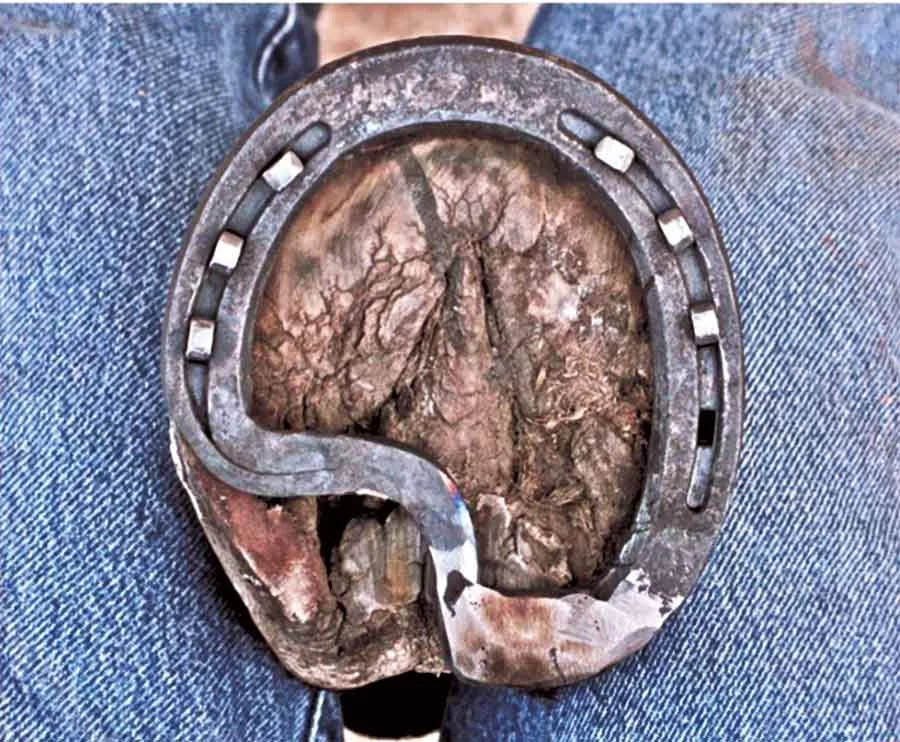
A traditional Z-bar shoe relieves weight-bearing in the injured heel quarter or heel.
Although not a Z-bar, the mushroom shoe is an alternative when it’s necessary to unload both heel quarters and/or heels.
Welded Z-bar
Forge and jump welding a Z-bar is certainly not an application for beginner farriers. It requires a greater experience level than utilizing mushroom pads and aluminum spider plates.
As alluded to earlier, the shoe is versatile and is only limited by your imagination and skill level. While the traditional Z-bar (Figure 2) relieves weight-bearing in the heel quarter or heels, a mushroom shoe (Figure 3) can relieve both the medial and lateral sides.
A horse with a suspected keratoma was brought to Steve Kraus, the head farrier and senior lecturer at Cornell University’s College of Veterinary Medicine, who devised a creative shoeing solution.
“When we opened it up,” says the International Horseshoeing Hall of Fame member, “it turned out to likely be from an injury abscess that was affecting the coffin bone.”
The horse required a shoeing package that would provide security for the foot, as well as the ability to treat the insult (Figure 4a).
“I wanted to provide as much stabilization of the coffin bone as possible,” Kraus says. “I would have used a spider plate insert, except that would have blocked the wound area. A hospital plate was necessary to cover the opening, but also provide access to treat it.”
An infected foot (Figure 4a) required stabilization after surgery at Cornell University Equine Hospital. Steve Kraus jump-welded a Z-bar into a shoe (Figure 4b) and incorporated a hospital plate (Figure 4c) later for access to the wound.
To achieve this, he jump-welded a Z-bar into the shoe (Figures 4b-4c), then incorporated a hospital plate (Figure 4c).
One particular application that Laura used required both a greater skill set and a bigger budget than a pad and spider plate. She was presented with a horse that was in extraordinary pain. He couldn’t walk to Laura and the owners were considering putting him down.
The foot was severely run forward with his heels in the quarters. He was essentially walking on his heel bulbs and the edge of the wedge. He was experiencing abscesses predominantly in the medial heel, but in the lateral, as well (Figure 5a).
Starting with a Grand Circuit Open Performance Wedge Roller, part of the shoe was removed and used to weld a Z-bar on the lateral branch and the widest part of the medial side (Figure 5b). The medial heel was floated and Vettec Equi-Pak was applied (Figures 5c-d).
It took about three or four shoeing cycles to begin seeing blood flow in the sole and the coronary band due to being out of balance and run forward. He eventually progressed to a heart bar and then to an ACR 330 Full Rolling Shoe. The horse made excellent progress and was back to showing and jumping a meter while staying sound within a year. The horse has since been sold and remains sound while performing as a lesson horse in New Jersey.
A horse’s foot that was severely run forward was experiencing abscesses predominantly in the medial heel (Figure 5a). A Grand Circuit Open Performance Wedge Roller was modified with a Z-bar to float the medial heel (Figure 5b). Vettec Equi-Pak (Figure 5c) was applied to lightly load the sole (Figure 5d).
Weld-in Inserts
There are a couple of options on the market for weld-in inserts — Werkman offers the Ortho-Kit and Synergi Farrier Products has its aluminum combo inserts. Both are efficient and allow you the creativity to achieve not just Z-bar, but other types of support or bars, as well. They can be modified with a cutter that you keep in your truck. If you opt for the Synergy inserts, you’ll also need the Synergi-Sticks to weld them.