Since the 1970s, the cost of post secondary education has outpaced inflation. There are a number of reasons for this, and no indication that this trend will change in the coming years. This cost has led to escalating student debt assumed by graduates.
Researchers Study Hoof Management in New Zealand Sport Horses
One-third of New Zealand sport horse owners had a farrier perform therapeutic work during the previous year, according to a Massey University-based study that was published in the November 2016 issue of the Journal of Equine Veterinary Science.
There’s an old saying that time heals all wounds. It is overstated, but it certainly applies to equine athletes. Although not true in every case, many horses recover from a myriad of foot and lower limb problems if given ample time off from training and competition so they can recover. That’s a wonderful thought, but a luxury few track shoers enjoy.
Georgetown, Ky., farrier Steve Norman knows that reality all too well. For more than 45 years, he’s handled footcare for Thoroughbreds on the track and at farms. He’s built a practice to where he now primarily works for larger barns and farms.
When Burney Chapman reintroduced the heart bar, it revolutionized equine hoof-care. Countless horses have survived the scourge of laminitis and founder as a result of the work put forth by the late Lubbock, Texas, shoer.
When experienced farriers check the wear on horseshoes they’ve just removed from a horse, it isn’t just to see whether they can reset them. They’re also looking for valuable information. Four veteran farriers took time to share some of what they’ve gleaned from studying the wear patterns on horseshoes over their careers.
Over the past 28 years of my shoeing career, clients, veterinarians and other farriers have asked three common questions about hoof angle.
What is the ideal hoof angle?
What angle do you like the front hooves?
What angle do you try to achieve for hind hooves, etc.?
The Steward clog or wooden shoe is well known for its use in laminitis treatment, but it also has proven to be a beneficial system for rehabilitation in a variety of hoof and leg conditions of equids. Farriers must address five entities to alter the 3D planar direction of hoof balance and load (to enhance hoof rehabilitation) —all of which can easily be accomplished using the roller motion Steward clog:
What’s the best hoof-care tip you received this year?
December 5, 2016
A: I had been trimming an off-the-track Thoroughbred with flat feet and progress was slow. His feet wanted to “pancake” and he had thin soles.
Once his teeth were floated, his hooves improved dramatically. Now it seems with each trim his feet get more upright and stronger. The mouth is the first step in digestion and helps in nutrient absorption, which invariably benefits the feet.
Is the practice of grooving beneficial when managing a quarter crack?
Conventional wisdom seems to indicate that it does. However, Bedminster, N.J., farrier Bob Pethick had doubts. So when a client, who happened to be a veterinarian, bought a Quarter Horse with a bleeding quarter crack and a displaced heel quarter on the front foot, the Hall Of Fame farrier was presented with an opportunity to experiment.
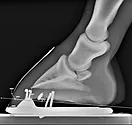
As footcare professionals know, the angle formed by the bony column of the phalanges with the hoof wall is referred to as the hoof-pastern axis (HPA), and is considered ideal when the dorsal surface of the hoof is parallel to the alignment of the digital bones (Figure 1).1
Hall Of Famer Dave Duckett stresses to attendees at the Northeast Association of Equine Practitioners meeting to focus on the science that gives practitioners a common language to work from
There are noteworthy figures in farriery who are closely associated with significant developments. Whether it is a tool, forging technique or creative application, these people left a mark on the industry. But among these, only one name is universally recognized by farriers in association with external reference points of the foot.
Attention is often paid to forging temperatures, hammer blows and anvils, and rightly so. There are other aspects of forging that are equally important, yet don’t get as much consideration.
“A lot of people have problems because they’re just all over the place,” Sacramento, Calif., farrier John Williams told attendees at a late summer forging clinic at The Horseshoe Barn. “They’re just spread out all over their anvil. They throw their stock up there, any old place, and then they just take their hammer to the stock.”
One of the more common hind end problems that vets and farriers see is associated with negative plantar angles. This issue can present itself as a subtle limitation in performance to outright lameness.
They’re everywhere. Every time you turn around, someone’s nose is in a smartphone. In fact, you probably have a holder or two who do little but text, check social media or surf the Internet the entire time you’re under the horse.
When you have a good client, you look forward to getting to that barn. They respect your investment in developing skill and knowledge, appreciate your work with their horses and — although it isn’t about the money — they pay on time, without commentary on the price.
As the public comment period for the proposed amendments to the Horse Protection Act (HPA) came to an end Oct. 26, nearly 200 influential people banded together to urge action from the United States Department of Agriculture (USDA).
The information, ideas and opinions expressed are those of the author and do not necessarily represent those of the United States Department of Agriculture.
Researchers studied the specific lamellar pathology associated with laminitis caused by equine Cushing’s disease, also called pituitary pars intermedia dysfunction (PPID). Hooves of 26 horses and ponies were collected following euthanasia or processing for slaughter and divided into those with signs of PPID and laminitis, those with PPID and no clinical signs of laminitis and controls with no clinical signs of PPID or laminitis. Hoof tissues were examined microscopically and circulating insulin, cortisol and glucose were measured.
There’s an old saying that time heals all wounds. It is overstated, but it certainly applies to equine athletes. Although not true in every case, many horses recover from a myriad of foot and lower limb problems if given ample time off from training and competition so they can recover. That’s a wonderful thought, but a luxury few track shoers enjoy.
Georgetown, Ky., farrier Steve Norman knows that reality all too well. For more than 45 years, he’s handled footcare for Thoroughbreds on the track and at farms. He’s built a practice to where he now primarily works for larger barns and farms.
Is the practice of grooving beneficial when managing a quarter crack?
Conventional wisdom seems to indicate that it does. However, Bedminster, N.J., farrier Bob Pethick had doubts. So when a client, who happened to be a veterinarian, bought a Quarter Horse with a bleeding quarter crack and a displaced heel quarter on the front foot, the Hall Of Fame farrier was presented with an opportunity to experiment.
The Steward clog or wooden shoe is well known for its use in laminitis treatment, but it also has proven to be a beneficial system for rehabilitation in a variety of hoof and leg conditions of equids. Farriers must address five entities to alter the 3D planar direction of hoof balance and load (to enhance hoof rehabilitation) —all of which can easily be accomplished using the roller motion Steward clog:
Now view magazine-like digital flipbooks on your desktop and tablet. Starting in 2015 issues, included for FREE with your Digital or Premium subscription, view the magazine on your laptop, tablet, and mobile device. You need to be logged in to view.
Oleo Acres Farrier and Blacksmith Supply owner Rob Michel walks viewers through the Littleton, Colo., warehouse. Inventory is organized with the customer in mind. If the product is in stock and easy to find, farriers can spend more time under a horse, which Michel says is more money in your pocket.
At Doc Foal's, we manufacture The Black Pads and The Black Pads PLUS (featuring embedded magnets and copper). Our hybrid pads work seamlessly with your choice of conventional horseshoe, combining metal for structure with polyurethane for exceptional comfort and shock absorption.
Designed as a...
We stock a wide range of high-quality products from trusted brands to ensure durability, performance, and reliability in every job you undertake. Our extensive inventory of horseshoe products and farrier tools means you can find everything you need in one place, saving you time and effort. Your satisfaction is our top priority. We are committed to providing excellent customer service, prompt shipping, and hassle-free returns.
Equilox International Inc. specializes in equine horse hoof adhesives. Developed in 1988 after many trials and extensive research at leading universities and equine centers throughout the U.S., the Equilox Adhesive Hoof Repair System was originally used to treat competitive horses. Now, Equilox Adhesive is used by farriers, equine centers, and horse owners — as well as various zoo and wildlife centers — throughout the world.