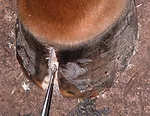
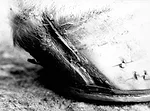
Farriers may find themselves dealing with at least three distinct types of coronary band injuries. They include irritation and damage to the coronary band and sandcracks.
“For something so small, equivalent in size to our little finger, the navicular bone can render a 1,000 pound, finely-tuned equine athlete into a pasture pet — permanently,” explains Dallas O.
The flexor tendons of the front limb of a horse are a common site of injury. Often, lacerations will damage the superficial digital flexor tendon, deep digital flexor tendon and even the suspensory ligament.
Horses that have unbalanced hooves, coronary band damage or interference injuries are all susceptible to hoof cracks. Damage to the laminae from abscess tracts will predispose a hoof to crack. Hooves that are not trimmed or shod regularly can crack from the added stress of long hooves. In an adult horse, limb deformities or shoeing to attempt to change a limb deformity aggressively can crack hooves.
Oleo Acres Farrier and Blacksmith Supply owner Rob Michel walks viewers through the Littleton, Colo., warehouse. Inventory is organized with the customer in mind. If the product is in stock and easy to find, farriers can spend more time under a horse, which Michel says is more money in your pocket.
At Doc Foal's, we manufacture The Black Pads and The Black Pads PLUS (featuring embedded magnets and copper). Our hybrid pads work seamlessly with your choice of conventional horseshoe, combining metal for structure with polyurethane for exceptional comfort and shock absorption.
Designed as a...
We stock a wide range of high-quality products from trusted brands to ensure durability, performance, and reliability in every job you undertake. Our extensive inventory of horseshoe products and farrier tools means you can find everything you need in one place, saving you time and effort. Your satisfaction is our top priority. We are committed to providing excellent customer service, prompt shipping, and hassle-free returns.
Equilox International Inc. specializes in equine horse hoof adhesives. Developed in 1988 after many trials and extensive research at leading universities and equine centers throughout the U.S., the Equilox Adhesive Hoof Repair System was originally used to treat competitive horses. Now, Equilox Adhesive is used by farriers, equine centers, and horse owners — as well as various zoo and wildlife centers — throughout the world.