Farriers have a tendency to live and work in a cave. The “going-it-alone” mentality may cause you to forget the clients, other farriers, veterinarians and trainers that make up your business or help it run smoothly. Not only should you make it a point to strengthen these critical relationships, you should make it a top priority.
Here’s the bottom line: no matter how determined, hardworking and talented you may be, you simply can’t be a successful farrier all by yourself. Never forget that teamwork is critical for your success.
Defining Good Clients
If you are selling a service to clients, then you are selling a relationship.
Doug Butler delivers the best advice on maintaining professionalism with your clients. I will add a few thoughts on this subject:
- You are a representative of this industry for the client. Never bad mouth or gossip about farriers, vets or other owners. Doing so puts you in a bad light and can place you in uncomfortable situations. Do the best work you can, even when no one is watching.
- Address what the client wants. Your clients are interested in themselves and what they perceive as the needs of their horses, not you and your accomplishments within the industry.
- Turn your negatives into positives. Since you don’t have many clients you will have time. Translate that time into superior service.
At this point in your career, you may be more concerned about finding new clients than evaluating the ones you have, but it is a necessary step for developing a business. Likewise, you need to grade their horses.
Every individual will have different criteria for this process. For instance, what may be considered an unacceptable working environment to one farrier may be tolerable for another.
Here is a quick grading system for evaluating clients:
“A” Clients. These are likely to be rare in your early career. They have horses ready as you back the rig up to the barn. They will pay on time and quality hoof care is a premium to these people.
“B” Clients. These people may slip periodically with payment or in maintaining their horses, but are still concerned with quality hoof care. You may have to deal with a single issue, like poor work conditions.
“C” Clients. These owners keep their horses in poor quality fields so their feet get stuck and pull off shoes. The horse is never ready for you upon arrival. Receiving payment can be a struggle.
For grading your horses:
“A” Horses. These horses stand quietly for trimmings and shoeings. There are no lameness issues and they have good feet.
“B” Horses. A typical “B” horse stands, but not perfectly. It may have bad hocks, so shoeing behind can be a physical chore. This may be a horse that has bad feet.
“C” Horses. These will be uncooperative or have such terrible feet that it is difficult to keep shoes on them. These are horses that require extra work or attention. It rarely pays off financially to work with these horses. They can habitually loose shoes.
“D” Horses. These are ill-mannered and dangerous horses. If at all possible, walk away. Your health and safety is more important.
Interacting With Your Fellow Farriers
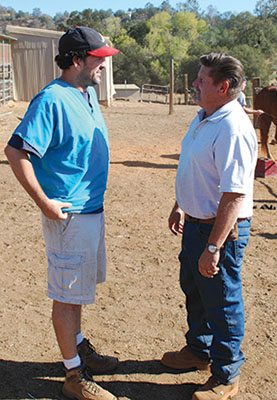
A solid working relationship with a veterinarian is the sign of a good farrier. Bob Smith (right) discusses shoeing procedures with Michael Russell, DVM, of the Grace Foundation in California.
The greatest educational resource in our industry is other farriers. Every farrier, regardless of his or her success, knows other farriers who have obtained a higher status in the horseshoeing world. It may be in their shoeing for a specific discipline, financial success, morality and ethics, forge work and so on.
A successful farrier establishes relationships with mentors in and out of the horseshoeing world.
Earlier in this guide, mentors are discussed. Here are other thoughts on developing a solid business relationship with a mentor:
- Take charge of your mentoring. Seek out mentors because they won’t seek you.
- Beware of choosing mentors only for the power they wield. It’s better to spend time with an individual contributor who possesses a great deal of wisdom than a big name who does not have time to truly work with you.
- Find a mentor is looking to improve you and your skills. Don’t get one who is just looking for free labor or a subordinate that “worships” him or her.
- Build you own mentoring network. When you attend clinics, seminars or clinics, do not spend all your time visiting and talking with those farriers you know well. For instance, the International Hoof-Care Summit is an opportunity to meet hundreds of farriers from around the world. Introduce yourself, hand out business cards and get as many business cards as you can.
- Treat your mentor relationship with care. Don’t take it for granted or abuse it by asking for inappropriate favors or information. Do not forget the occasional “thank you” or acknowledgement of the assistance they are providing.
You will often interact with associates — two or more people in which each of you has an equal status and independence. However, there also is an implicit or informal obligation to each other. Respect is at the heart of building this type of relationships
- Respect the right to differ. Avoid an attitude of “My way is the right way, so therefore, all other ways are wrong.” When differences occur and they are viewed this way, a power struggle ensues. A good business relationship can turn bad, quickly.
- Be mindful of differing values. This concept can be a little difficult. While other people’s values need to be respected, conflicting values can be so different as to prevent this type of relationship from forming without major conflicts. It is important that you identify your values and know what is acceptable in others before entering into this business relationship.
- Be in it for the long haul. These relationships develop into deep personal relationships over the years, so nurture them by maintaining contact.
You will have to deal with competition from other farriers. This is a relationship that can get negative and non-productive if not handled in a professional manner.
- Anyone shoeing horses for a living deserves your respect. Do not talk poorly about your competition to other farriers, customers, vets, trainers or anyone else. There is room enough out there for lots of different shoeing styles and theories.
- Refuse to evaluate your competition’s work. When customers ask you to evaluate another farrier’s work, tell them that you don’t evaluate competitors’ work. If they would like you to shoe or trim their horse, then they can evaluate the differences.
- Take the high road. You can make a competitor an associate by making him or her a friend. Reach your hand out, smile and be polite every time you see a competitor and you can thaw an icy relationship.
Working With Veterinarians
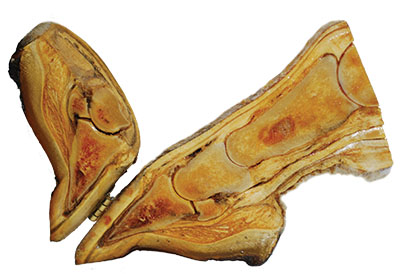
Acknowledge your clients’ concerns and properly communicate with them. Visual aids may help you explain foreign concepts to your clients. For example, using a hinged hoof specimen could help clients understand equine hoof anatomy.
For many farriers the veterinarian-farrier relationship is a sign of success. Most new farriers proudly relive that first veterinarian recommendation as a rite of passage.
In almost every state, the veterinarian medical practice acts are pretty specific. If a veterinarian is involved, he or she is in charge. If you are given a “shoeing prescription,” your options are to follow it or don’t shoe the horse.
To maintain a good working relationship with a veterinarian, you must be proactive and prepared to make the relationship work. In the end, it’s really up to you.
- Realize you have the same goal. The farrier and the veterinarian are both attempting to do the same thing: make a living in the horse world. We are not adversaries so don’t start a power struggle.
- Never question or argue with the vet in front of anyone. If you disagree with the veterinarian’s finding then make an appointment to speak with him or her. Be prepared to state your case with specific information. Always return the vet’s phone calls or e-mails immediately.
- Acknowledge any referrals that the vet makes. Send a card thanking the veterinarian for his or her confidence in your business. Everyone likes to know they are appreciated.
- You see the horse more frequently than the vet. Farriers see the horse every 6 to 8 weeks. The veterinarian may only see the horse once every 2 or 3 years. Don’t hold the veterinarian’s feet to the fire if he or she makes a decision based upon a very poor history from the owner.
- Keep the veterinarian in the loop. Once you have a working relationship with a vet, you will be able to modify his or her shoeing recommendations as things change with the horse. Send a short letter on your business stationary stating the name of the horse, its owner, address and any other information required to identify that animal. In as few words as possible, explain the changes you have made and why. The vet may not see this horse for another year and this will keep him or her informed of the its progress.
Working With Trainers
The horse trainer is responsible for training and conditioning the horse, the equipment used, the stabling environment, feeding and turnout. The trainer can also act as an agent and interact with others who work with the horse.
Working with trainers requires a professional farrier with communication skills. The trainer sees and works with the horse, and sometimes the horse owner, on a daily basis. The farrier sees the horse every 6 to 8 weeks. A good farrier will rely upon the trainer to give detailed history about movement or lameness issues that can help in deciding how to set up the foot and type of shoeing.
- Talk to the trainer. Make the effort to check in with the trainer in your barns and ask if there is anything that you need to be aware of for the shoeing or trimming of the horses you are scheduled to work on that day. Be sure to stop by at the end of the day with any information about any horse under the trainer’s care. I prefer to write a note on stationary with my name and contact information.
- Listen to the trainer. Let the trainer air any concerns or issues he or she may have about the horses you are going to be working on without interrupting or becoming defensive or argumentative. Both of you should be working in the best interest of the horse and its owner.
- Be proactive. Discuss shoeing changes and recommendations to the trainer before there is a problem. Include the trainer in the decision-making, as that is the person who deals with the owner over the long term.
- Deliver acknowledgement. Make sure to acknowledge the accomplishments of the horse while it is under the trainer. Everyone likes to know that others think they are doing a good job.
Bring a nice bottle of wine or something to say thank you to the trainer for working with you and being the liaison between you and the owner — particularly with a difficult owner.
In spite of you best efforts, conflicts between farriers and trainers are common and very quickly boil down to a power struggle, unfortunately with the horse owner caught in the middle. It is up to us, the farriers, to make this relationship work. If everything fails then it is best to leave the account before your reputation takes a hit.
My experiences have been that aggressive trainers are either insecure and/or have an abrasive personality. There are some things that you should do when dealing with this type of trainer.
- First and foremost, don’t take their behavior personally. Some trainers behave in a difficult manner habitually and their attitude is not directed specifically towards you alone — they treat everyone poorly. If a trainer’s tone and actions are beyond your ability or desire to cope, then politely tell him or her that you require a professional working relationship with trainers so that the horse can benefit from everyone’s expertise. Inform the trainer that he or she has obviously lost confidence in your abilities and therefore a new farrier might be a better solution for the owner and horse.
- Don’t try to fight with them. Fighting may only complicate matters further and can pave the way for a bigger argument. Allow the trainer to run out of steam. If you argue with ignorant people, those folks passing by can’t tell which one is which.
- Don’t try to win the argument. Do not approach the argument with the mindset of winning it and proving the other person wrong. You may prove the trainer wrong, but that is unlikely to change his or her behavior.
Instead of trying to win, try to work towards a reasonable solution which will be in the best interests of everyone concerned. Remember your goal is simply to assertively express your own opinion, not try and win a battle of right and wrong.
- Leave professionally. When you have had enough you must remain composed and professional. Do not bad mouth the trainer to the owner. Just tell the owner that the relationship with the trainer is not working out and that, in the interest of the horse, you would advise that he or she find another farrier, or perhaps the farrier that the trainer recommends. Be calm, professional and polite. Tell the owner your door is always open if he or she needs your services again.
Business relationships are not stuffy, dry second cousins to our personal relationships. Both require us to be genuine and understand those that we deal with on a daily basis. Just remember that business relationship building boils down to the fact that it is you the other person buys, not your shoeing.