 Premium content is for our Digital-only and Premium subscribers. A Print-only subscription doesn't qualify. Please
American Farriers Journal
American Farriers Journal is the “hands-on” magazine for professional farriers, equine veterinarians and horse care product and service buyers.

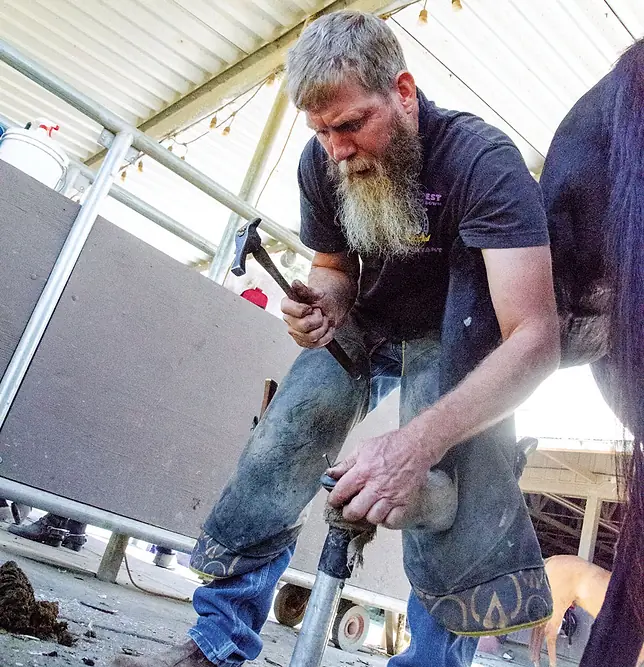
Petaluma, Calif., farrier Sam Durham relies on his understanding of anatomy and conformation to dictate the best trim and shoeing for each horse. Maclaren Krueger
In sunny northern California, farrier Sam Durham and his team members Mike Cinquini, Cole Durham and Lauren Wright shoe 600-head of horses. Among those 600, Durham and his crew average very few, if any, foundered horses, a handful in bar shoes and another handful patched after issues, such as white line disease resections. Durham also typically applies a lot of pads due to the frequent wet to dry cycles in the region, which can be brutal on the foot. Part of Durham’s success in healthy hooves is because of his focus on mechanics — the interconnectedness of the foot with structures higher in the limb — and the attention to the horse’s unique work and conformation.
“There’s a geometric proportional measurement for all things, and it’s specific to each horse,” Durham says. “We met Hall of Fame farrier Simon Curtis, and he was documenting hoof measurements for his research, so we adopted the same model. An average coffin bone is 21/2 inches long from the front end of the extensor process to the tip of it. Then you need a dermal and epidermal layer. So, you add another inch of material from the bottom of the bone down. Depending on the size of the horse, the hoof should be 31/2 inches long, and that’s geometrically proportional for that animal.
“That’s why we measure our feet, so we make sure we’re staying inside that parameter. It’s easy to teach, and eventually you don’t have to measure as much anymore because you…

American Farriers Journal is the “hands-on” magazine for professional farriers, equine veterinarians and horse care product and service buyers.

American Farriers Journal is the “hands-on” magazine for professional farriers, equine veterinarians and horse care product and service buyers.
Download these helpful knowledge building tools


We are here to support you.
We stock a wide range of high-quality products from trusted brands to ensure durability, performance, and reliability in every job you undertake. Our extensive inventory of horseshoe products and farrier tools means you can find everything you need in one place, saving you time and effort. Your satisfaction is our top priority. We are committed to providing excellent customer service, prompt shipping, and hassle-free returns.
