 Premium content is for our Digital-only and Premium subscribers. A Print-only subscription doesn't qualify. Please

American Farriers Journal
American Farriers Journal is the “hands-on” magazine for professional farriers, equine veterinarians and horse care product and service buyers.

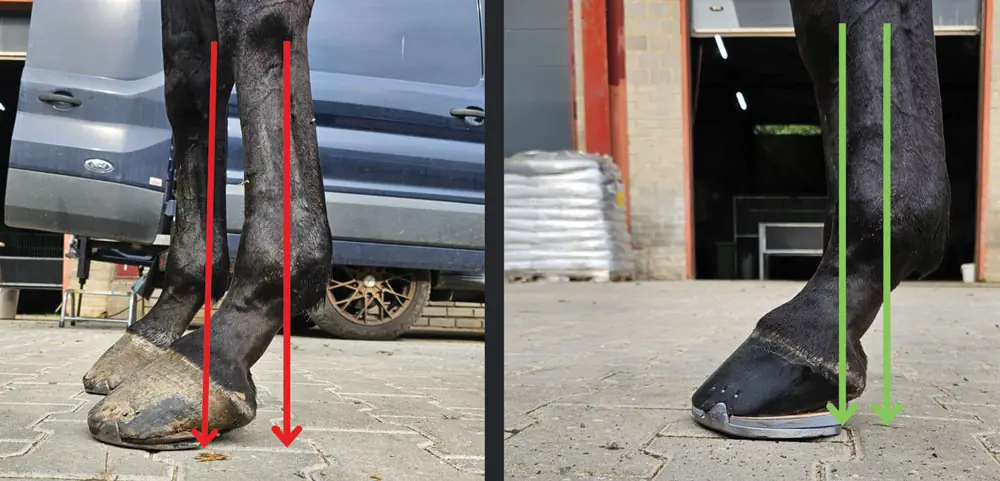
Before shoeing (left), underrun heels showing a longer lever with a farther last point of contact. After shoeing (right), showing a shorter lever and closer last point of contact by lifting the heel with a wedge. Maarten van Hal
Understanding an underrun heel is the first step to successful management. If left untreated, Dutch farrier Maarten van Hal explains at the 2026 International Hoof-Care Summit that the hoof capsule will eventually split. This is due to a difference in growth direction of the tubulars in the back half of the foot in contrast to the front half of the foot.
“We have to remember that the solid structures — the bony structures — are in the front part of the foot. In the back part of the foot, we have the cartilage and the digital cushion. So, why do underrun heels happen here? It’s because there is more movement in the transition between the bony structures to the more flexible structures. So, we could define underrun heels as a problem. It’s not a conformation; it’s more of a pathology. It’s something that, in the future, will give this horse more trouble than it should have.”
As the…

American Farriers Journal is the “hands-on” magazine for professional farriers, equine veterinarians and horse care product and service buyers.

American Farriers Journal is the “hands-on” magazine for professional farriers, equine veterinarians and horse care product and service buyers.
Download these helpful knowledge building tools


We are here to support you.
We stock a wide range of high-quality products from trusted brands to ensure durability, performance, and reliability in every job you undertake. Our extensive inventory of horseshoe products and farrier tools means you can find everything you need in one place, saving you time and effort. Your satisfaction is our top priority. We are committed to providing excellent customer service, prompt shipping, and hassle-free returns.
