Takeaways
- Standard forging hammers and hoof knives usually have handles that are larger than necessary, but they can easily be customized.
- Tool handles can be quickly modified to accommodate high horse nails.
- Hand-making your own tools allows you to customize them to perfectly suit your specific needs.
There is no shortage of farrier tools produced domestically and abroad. Custom-made hammers and hoof knives are prevalent, along with the numerous horseshoes on the market. Nippers of all sizes and hammers of different weights are purchased by tool-hungry farriers. With all these options, is it necessary to customize any of these tools? Certainly, it is. In fact, some of those expensive tools are just standard tools with a tweak of a handle or other easy modification.
Let’s start with hammers. Mass-produced forging hammers usually have more handle length and circumference than needed, so they should be customized to your hand. If you are not sure how long the handle should be, saw off short increments until the balance feels right. While you’re at it, take a horse rasp and reduce some of the handle thickness until it feels right. Some farriers like the sides of the handle flatter for more stability. These same adjustments can also be done to your driving hammer. You’ll notice the expensive, more custom tools have done that already.
If you look at some of the expensive hoof knives, the fancy handles are a big part of the cost. The mass-produced hoof knives usually have more handle size than needed. So, again, a little grinding in the appropriate places provides better ergonomics. For instance, grinding the area where your thumb presses provides a firmer grip.
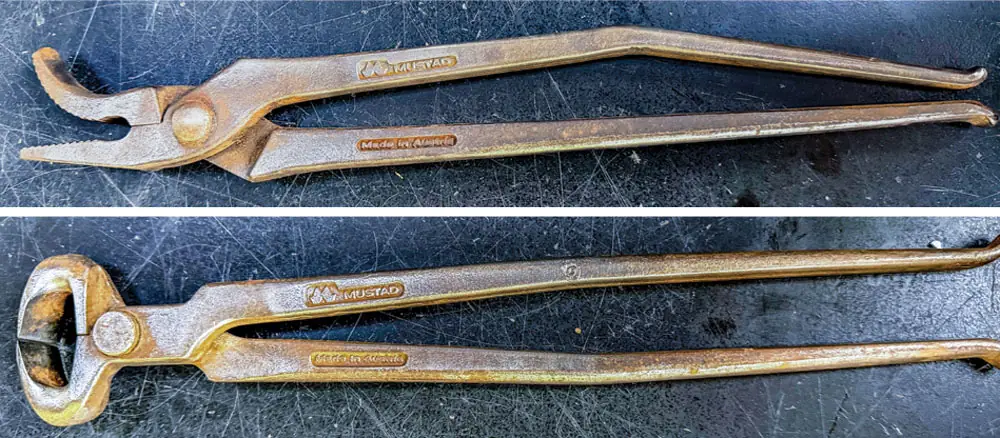
If the handles of your clinchers are too far apart for high nails, you can easily put a small bend one-third from the end of the upper handle (Figure 1a). Just heat the area with an oxyacetylene torch, make the bend and let it cool without quenching. Similar to the clincher modification, you can do the same thing to your nippers on both handles (Figure 1b).
An off-the-shelf clinch block is a clumsy tool. If you want to do a fun forging project, try making one like in Figure 2. Take some 1-inch round stock, split off enough material to make a loop that fits over your hand as pictured and square up the end.
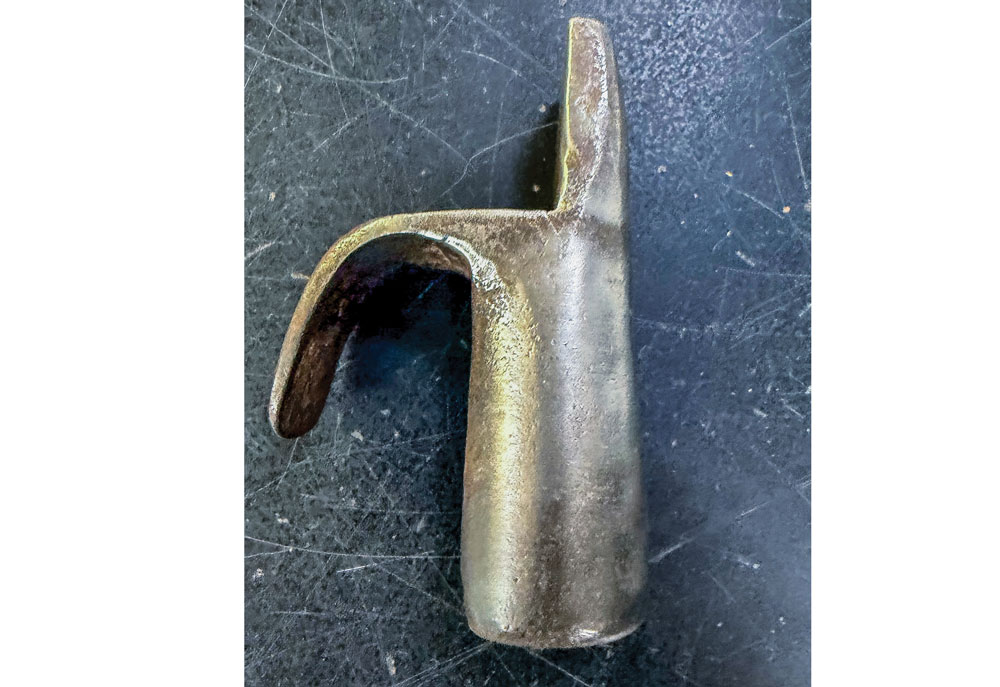
FIGURE 2: Try making a clinch block for a fun forging project. Split off enough material from 1-inch round stock to make a loop that fits over your hand and square up the end. Steve Kraus
Making Pritchels & Punches
You can buy a nice pritchel or bob punch, or, you can order a length of ⅝-inch or ¾-inch H-13 tool steel. Now, you can forge your own pritchels and punches to any length you desire. You must only work this tool steel at higher incandescent temperatures to avoid causing flaws. At the end of forging, heat the working end one more time and let it air cool. H-13 is an air-cooled, self-
tempering steel and is extremely tough and heat-resistant. It’s also known as hot work steel.
After cooling to room temperature, you can fine grind to the exact shape and taper desired. Do not overheat the end when grinding. Never quench H-13 in water, but sticking the working end in wax will cool and lubricate it when punching nail holes. If the striking end is not heated, it will stay soft and “mushroom” uniformly over time but not chip. You can also buy H-13 in larger round or square sizes to produce head stamps and fullers. There is a certain satisfaction to producing your own tools.
LEARN MORE
Gain more tool insights by:
- Reading “The Evolution of Horseshoes & Tools in 1 Farrier’s Career,” in which Steve Kraus explains how hoof-care professionals propel the industry forward with innovation.
- Watching “How to Make Golden Ratio Calipers for Farriery,” in which Kraus shares his process.
- Watching “Horseshoe Nails,” as Kraus discusses why you should consider the various nails you can use for different circumstances.
Access this exclusive content and more by visiting AmericanFarriers.com/1126
There have been some nice hand-forged tongs on the market, as well. Many manufacturers started making their own tongs, and, once they dialed in the process, they made more for sale. There are some good videos for making tongs, and it’s also a satisfying project to produce your own. Again, when you are in control of the process, it becomes easy to produce handle lengths or jaw configurations that suit your way of working.
Finally, when you are about to remove a horseshoe from a foot, packed up with dirt, you might like to have a pulloff tool with a hoof pick on the end of one of the handles. That’s easily forged in a few heats and should be air-cooled.
Making tools your own or making your own tools is a way of putting your needs into the tools that are in your hands every day. This will not only produce a more efficient workflow by increasing your dexterity while using these tools but also provide satisfaction in your work.