
Takeaways
- A few less miles to the gallon with gas is a small price to pay for a lower initial cost and a lower fuel receipt at the pump.
- Unfortunately, when fuel goes up in price, so does everything else.
- My diesel gets 18 miles mpg with a shoeing trailer and 24 mpg without it compared to the gas truck I used to drive that only got 10 mpg.
Whether it’s diesel, gas, propane or waste vegetable oil, there’s no consensus among horseshoers as to the best fuel for their trucks.
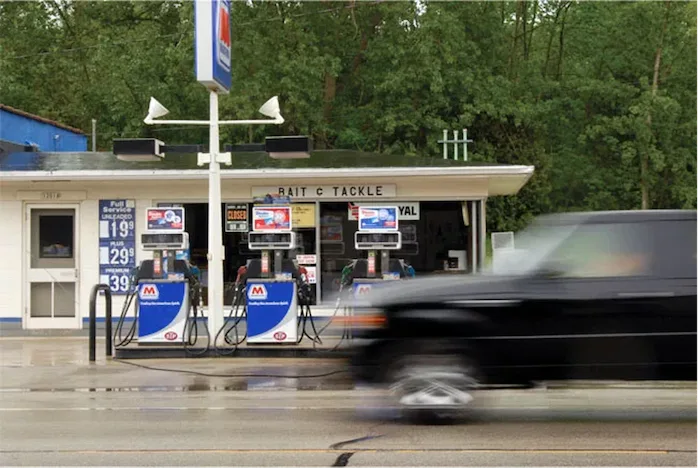
Fuel prices are so volatile that this station draws attention to the situation by refusing to post the dollar figures for gas and diesel prices.
With diesel now costing more than gas, many farriers are convinced that a gas-powered rig is the best way to go. Yet there are still some distinct advantages for driving a diesel-powered truck.
A recent survey of American Farriers Journal e-mail list users showed no consensus as to which fuel is most popular among shoers. While shoers are very concerned about the impact of rising fuel prices, there are many shoers in both the gas and diesel camps — plus a few farriers burning propane and even waste vegetable oil to power their rigs.
A number of shoers believe the long-term benefits of owning a diesel truck outweigh the short-term benefits of cheaper gas. With diesels designed to haul the heavier loads found in many shoeing rigs, some shoers maintain there’s also less maintenance costs and longer engine life.
Yet others aren’t so sure now that diesel costs more per gallon than gas.
New Rig Decisions
If you’re thinking about buying a new rig, Brian Hull says you should look at the better mileage and pulling power you can get from a diesel engine. Yet the farrier from Grand Valley, Ontario, recognizes that operating costs are usually higher.
“As more people buy diesels, there’s a trend toward higher diesel prices at the pumps, which is why rigs with gasoline engines normally have lower operating costs,” he says.
Yet Mike Poe of West Virginia has decided that his next rig will be gas. “A few less miles to the gallon is a small price to pay for a lower initial cost and a lower fuel receipt at the pump,” he says. Roger James of Rhinelander, Wis., agrees that the additional price of a diesel engine combined with rising fuel prices has him questioning whether diesel is the most economical way to go.
Diesel has more power and increased fuel efficiency by 25%...
Glen Henderson purchased a GMC diesel 3500 just before diesel prices outgained gas, but would not buy another diesel rig today.
“My truck with a custom body runs 9,960 pounds fully loaded,” says the Blairsville, Ga., shoer. “I live in the Appalachian Mountains and cross the Appalachian Trail divide two or three times a day over steep, winding roads. I only get 16 miles per gallon, so $100 diesel fill-ups are no fun.”
Dave Kidd moved away from diesel to a gas rig 3 years ago. ”The fuel savings alone paid for the truck in 2 years,” says the Beldenville, Wis., shoer. “I also went from a 3/4 ton to a 1/2 ton because I lightened my load.”
Know Your Costs
Doug Clark prefers gas since a diesel engine can run an extra $4,000 to $6,000. “I can put a lot of gas in the truck before I can come close to the cost of a diesel engine,” says the London, Ontario, shoer. “With regular maintenance, today’s gas engines offer excellent mileage and a longer life than in the past.”
When Martin Kenny replaced his diesel truck in 2004, he switched to gas. “Diesel was still cheaper than gas then, but the oil changes on my diesel truck were $85 while those for my gas truck are only $29,” says the Carthage, N.C., shoer. “That $36 monthly difference alone made purchasing diesel fuel less profitable as the savings was eaten up in oil-change costs. Adding in the extra cost of the diesel engine, you’re behind the 8-ball right out of the box.”
Kenny says that years ago, the fact that gas engines only lasted about 150,000 miles offset the additional cost of a diesel truck. Yet today, he says you can expect to get 250,000 to 300,000 miles from a gas engine.
“Now that diesel costs more than gas, there’s no way it makes sense for me to go with diesel,” he says. “When I went to gas, several clients said I would regret it. Now, they’re rethinking their diesels.”
Despite the higher cost, James Brown still thinks diesel is a better overall engine in terms of durability even stacked up against today’s much more efficient gas engines.
“But the added cost of a diesel engine and the higher fuel price these days just doesn’t seem to make it the best overall choice in terms of value,” says the Chester, S.C., shoer.
Several years ago, Shane Westman justified a move to diesel because of increased fuel efficiency and what looked then like cheaper fuel. “Diesel fuel today is at least 20% more expensive, so the 15% difference in mileage doesn’t matter,” says the Burlington, Wash., shoer.
Josh Robison recently sold his 3/4-ton diesel truck and went back to using his 1/2-ton gas pickup. “They both got the same mileage,” says the Newark, Ohio, shoer. “In the long run, the diesel was more expensive to repair and maintain. I only haul about 1,000 pounds of weight, and the diesel was simply overkill.”
Think Small
Robert Di Grappa is looking at buying a smaller truck, such as a Ford Ranger or Toyota to trim fuel costs. However, the Wilson, Wyo., farrier isn’t going to cut shoeing prices as he gets more efficient.
“Unfortunately, when fuel goes up, so does everything else in our world,” he says. “If horse owners can’t afford to keep as many horses because of the cost of upkeep, they should downsize.”
Since 2001, J.D. Pepper has driven a Toyota Tacoma that gets 19 to 21 miles per gallon (mpg) when fully stocked. “I’ve always run my full-service shoeing business as though times may get tough and here they are,” says the Leslie, Mich., farrier. “Few farriers shoe out of a small truck, but I’ve been doing it for 7 years with great success. Sometimes farriers think they need all the whistles and bells on their truck, but it’s time to get practical.”
Georgia Bentley sees no need for a diesel rig. She shoes out of her car around Nashwauk, Minn. Linda Cowles parked her Dodge 3500 diesel truck and the Santa Rosa, Calif., farrier now drives a Chrysler PT Cruiser 5-speed that gets 29 mpg when fully loaded.
For customers who only need trims for their draft horses, Bruce Mathews of Hyde Park, Vt., saves even more on fuel costs by riding his motorcycle to the barn.
Several years ago, Dean Moshier was shoeing out of a car to reduce travel expenses. The Ostrander, Ohio, farrier recently purchased a 2006 Ford F-350 diesel and added a Purdybilt body. “It gets 17.5 mpg, and even with an 80 cents per gallon difference, diesel comes out ahead,” he says.
“My future plans are to keep this rig in Florida, and keep the car in Ohio — especially now that most clients are used to me showing up in a car to do their horses.”
Scott McKendrick has driven a diesel pickup for many years, but recently looked into downgrading to a smaller gas truck. “The trouble was the low trade-in value for the diesel compared to the economy of the smaller truck,” says the Trenton, Utah, shoer. “I currently get over 20 mpg in my diesel truck equipped with a booster and even smaller gas trucks can’t do that, so the difference in fuel price didn’t yet seem to warrant the change.”
Alternative Fuel Choices
John Trafton continues to run a 1981 Chevy P-30 step van on propane, even with 639,000 miles on the 27-year-old rig. “The most I have paid per gallon for propane has been $2.92,” says the Brunswick, Maine, farrier.
Jay Noone runs a diesel truck that runs on waste vegetable oil along with a hydrogen booster. “I first set up the hydrogen booster on my hay truck, which is a 1997 GMC 5500, with a Cat 3116 diesel engine, about 2 years ago,” he says. “I was able to boost my mileage from 6 to 10.5 mpg. The truck has a lot more power and no more black smoke when working under a heavy load.”
He also has a 1994 Ford F-350 with a power stroke diesel running on waste vegetable oil. Adding a hydrogen booster boosted efficiency from 15 to 23 mpg. He expects even better mileage by adding a second and third hydrogen booster.
“Google HHO gas or Brown’s gas,” he says. “This is old technology and it works well.” (Go to www.hhowater4
gas.com for details on using hydrogen boosters to improve the mileage on your shoeing rig.)
Jim Attebery used to drive a Dodge diesel, but switched to gas. The Goldendale, Wash., shoer, says he won’t switch back to diesel power — at least not until restaurant waste cooking oil gets cheaper.
Why Gas Is Best
When he purchased his last truck, Esco Buff went with gas. “I purchase gas engines due to the ease of obtaining gas, fewer winter problems in the Northeast and less overall hassles, even when diesel was selling for far less then gas,” says the Webster, N.Y., farrier.
Karen Trebitz is sticking with her fully paid gasoline-powered shoeing van. “It is a travesty that the cars in Europe are so much more fuel efficient than here in the U.S.,” says the Poconos, Pa., shoer. Government data indicates less than 5% of the cars on the road in the U.S. run on diesel compared to 55% in Western Europe.
John Conroy isn’t convinced that the additional cost of a diesel engine and better fuel mileage pays off over a 5-year period. “Gas engines still come up less expensive,” he says. “This is based on diesel being 62 cents per gallon more expensive than gas in my area. Unless I was convinced that I needed extra power and torque, gas makes more sense for me.”
With gas costing less than diesel since Christine Abramo started shoeing 5 years ago, the Chickasha, Okla., shoer won’t be switching away from a gas vehicle. Although Debi Gurdock is convinced both fuels cost about the same to run, the Home, Pa., farrier believes a diesel rig is more expensive to own and maintain.
Larry Daley of Larry’s Horseshoeing and Trimming in Calvert, Texas, has driven over 225,000 miles on each of his last three gas-powered trucks. On the other hand, Sanbornton, N.H., shoer Denise is trading a 1999 Ford F-250 diesel 4x4 and buying a 6-cylinder Chevrolet S-10 4x4 to improve fuel economy and reduce vehicle upkeep.
Bruce Mathews switched from a 6-cylinder pickup to a 5.4 V 8 Ford F150 without finding any difference in mileage. “The 6-cylinder was working harder with the heaver load of draft horse shoes and equipment that I carry,” he says. “I get 18 mpg with gas and I’m happy with that.”
Mikel Crees has always preferred gas-powered trucks. “A gas engine is less noxious, not as noisy and usually more reasonably priced,” says the Hamilton, Ohio, shoer.
Why Diesel Is Best
Six months after Jim Goode bought a diesel truck in 2004, diesel prices went up. “Although I hate paying more for diesel, I get better mileage, and you can’t beat the pulling power of a turbo diesel,” says the Norco, Calif., farrier. “A diesel engine also lasts about twice as long.”
Even with higher fuel prices, Mike Olson of White, S.D., maintains his diesel truck is more economical. So does Bo Terry of Amherst, Va., who says diesel offers better fuel economy and horsepower with the large amount of shoes and supplies that he carries.
Denise Lynn finds her diesel truck gets better fuel mileage more than it compensates for the fuel price differences. “My diesel gets 18 miles mpg with a shoeing trailer and 24 mpg without it,” says the Hondo, Texas, shoer. “The gas truck I used to drive only got 10 mpg no matter what I did.”
Joepaul Meyers has driven Ford diesels for 20 years. Diesel engine longevity and improved mileage is a plus, says the shoer from McAlester, Okla. He tries to drive each of his trucks over 500,000 miles and has had few major engine problems. “Sooner or later, gas and diesel will be about the same price again and the gas burners won’t last as long,” he says.
Brendan Short’s father has driven a diesel pickup since they first became available. “We’ve had Dodge trucks and the Cummins diesel has been troubling free,” says the Langhon, N.H., shoer. “My shoeing truck gets 18 mpg consistently, it will pull whatever you hook onto and the diesel engines last forever. The longevity of the diesel engine makes it worth paying a little more for fuel, but I can’t complain because it runs more efficiently.”
While the cost of diesel fuel is certainly higher, Steve Eastman gets an extra 7 mpg with a diesel rig. “I don’t drive fast and try to leave enough time in between horses to let me reduce my speed,” says the Kenwood, Calif., shoer.
Mark Rikard switched from gas to diesel 2 years ago and is still glad he made the move. Not only does the Birmingham, Ala., shoer’s truck have more power, but he’s increased fuel efficiency by 25%.
When Both Fuels Make Sense
Pat Burton utilizes four vehicles in his multi-farrier practice. “A Ford F-350 diesel with a Stonewell Body is utilized at stops that require the majority of our shoeing and specialty work,” says the Burleson, Texas, shoer. “A pair of half-ton Chevrolet gas trucks handles the majority of our trimming clients and smaller accounts. We also have a mobile shop trailer that is used as needed and for horse events. Our goal is to utilize the most efficient rig for the task at hand.”
Brian Kinzie uses a gas truck for shoeing and a diesel truck for pulling a horse trailer. ”They both get about the same mileage, and even though gas is still lower priced, I don’t see a big reason to switch,” he says. “I stay with a plain Jane shoeing truck to keep my costs down. I’ve used smaller trucks in the past, but found they all get about the same mileage.”
Derek Grimwood hasn’t changed his views on the fuel options for larger rigs. “Diesel gets better mileage and gas costs less. In either case, fuel cost is a very volatile issue,” says the Chapel Hill, Tenn., shoer.
With high fuel prices, Cody Holden isn’t convinced that either gas or diesel is better. Even though the Pine Grove, Pa., farrier drives a gas-guzzler, he believes a diesel engine’s longer life is hard to beat.