A reliable, well-planned farrier rig is a costly, yet necessary investment.
It stores your tools, equipment and supplies. It’s a rolling billboard that promotes your business. Simply put, it’s your office, and it needs to serve your needs efficiently to maximize your income potential.
While the price tag is considerable, you have a number of options from which to choose. If you plan to trim horses, a compact car and a minimal set of tools will do the trick. Like most new farriers, if you have a modest client list, a truck bed cap or tonneau — a waterproof metal cover for your truck bed — might fulfill your needs. If you use your vehicle for purposes other than farriery, a trailer might be your best choice. Or, if you are fortunate enough to have a healthy client list, your practice might demand a full-size pickup with a customized body.
With so many choices, here are some questions to ask yourself before committing to such a large investment.
1. Where Do I Start?
Although researching farrier rigs isn’t as easy as comparing reviews for pickups, resources are abundant. Ask around. Pick the brains of established farriers or your shoeing school instructors. Those who are established in the trade often have owned multiple rigs during their careers and can offer advice on what has and hasn’t worked for them.
Of course, rig manufacturers and farrier supply companies are good resources to mine information.
“Farriers are pretty much looking for two things: efficiency and cost effectiveness,” says Lou Sposito of Stonewell Bodies in Genoa, N.Y. “We achieve that by listening to the customer, trying to understand what their business requires and coming up with innovative solutions to their specific applications.”
2. What Do I Really Need?
It’s easy to get caught up in the idea of the “dream rig” that’s fully stocked with top-of-the-line tools, inverters and stereo systems. However, it’s best to keep the bigger picture in mind.
“We have farriers come in here all the time and say, ‘I want this and I want that,’ ” Sposito says. “You don’t need to buy an inverter when you’re going to shoe one horse a month in a pasture.”
Instead, focus on the necessities and start with a budget.
“Based on the budget you come up with,” says Brent Chidsey, founder of Bay Horse Innovations in Cynthiana, Ky., “try to focus on the things that are most practical, meaning forges, grinders and storage, as opposed to microwaves, coffee makers, inverters and those sorts of things.”
Your location, clientele and lifestyle play a vital role in your rig choice.
“You need to know your clientele before deciding whether you are going to need a bigger rig, smaller rig, a cap on your truck or a trailer,” explains Oak Park, Ill., farrier Jeremey Fox. “You have to figure out what’s going to best suit where you’re traveling and what you’re doing.”
If you live in a climate that encounters snow, a four-wheel drive truck might be the best choice. However, if you’re working in a rural setting, a trailer might suit your needs.
“What are your needs at this point in your life…”
“It all comes down to your lifestyle,” Chidsey says. “You have to ask yourself, what are your needs at this point in your life?”
If you already have a truck, your choices certainly aren’t limited.
“A cap is definitely a beautiful starter if you just want to get a nice rig set up,” says Neal Purdy, owner of Finger Lakes Custom Manufacturing in Homer, Ga. “It’s all in what you can afford. I understand these are big purchases, but they don’t have to be. They can be functional and affordable. The extras that would be nice to have, but don’t really need, can come with time.”
A similar choice is a tonneau cover, which costs about half of a traditional unit.
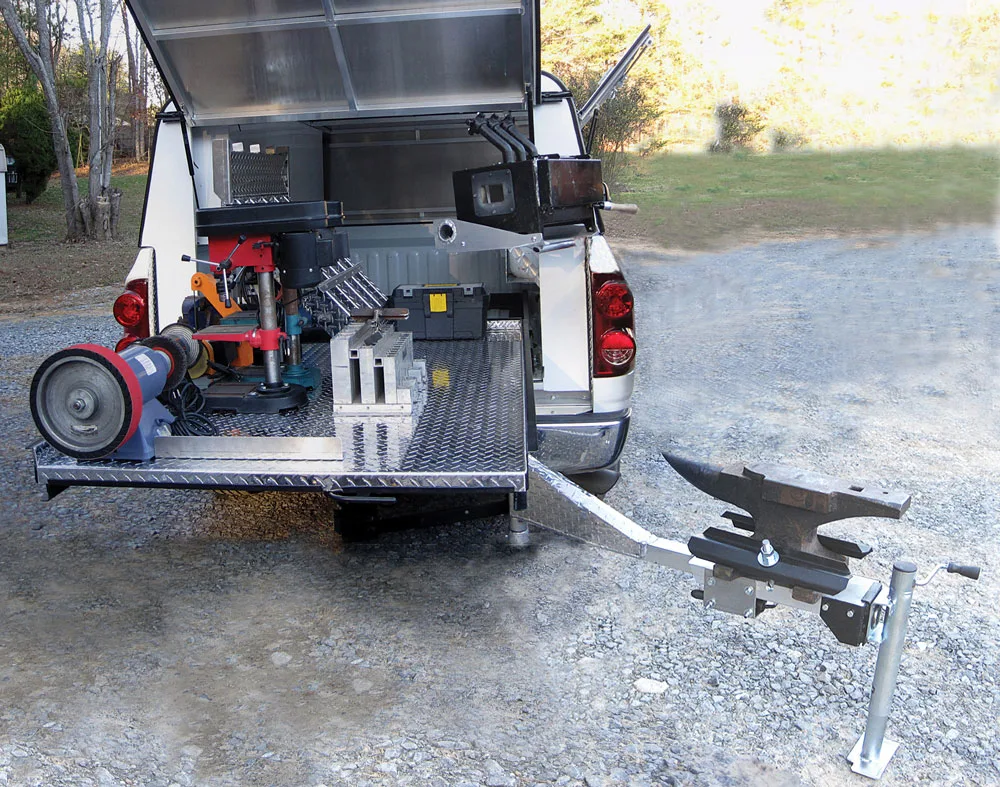
“A tonneau cover with an anvil swing-out is a very efficient unit for a farrier who goes home every night,” suggests John Halko of Georgia Farrier Supply in Jasper, Ga. “Your fuel efficiency is probably 20% better than with a full truck body.”
A trailer is yet another option.
“The industry has changed, and trailers are the way to go,” Purdy says. “Not everyone is a trailer person, but you can unhook them and you can have your truck and leave your job at home.”
Roger Newman of SomerSong Forge Horseshoeing Trailers adds that trailer jackknifing and U-turns are inherent problems of the trade. Gooseneck trailers can provide a better ride and improved gas mileage over bumper-pull trailers, in addition to allowing a greater turning radius.
“Farriers can be determined to get their rigs closer to the horse,” he says. “It happens more in California, where so many people live on cul-de-sacs that require tight turns, but not so much in Texas, where you’re driving up a straightaway on a large ranch.
“Tandem axles don’t like U-turns because the torque is tremendous. When you spin it around on concrete, you’re putting an ungodly amount of pressure on the spindles.”
3. How Can My Choice Improve My Efficiency?
A rig should provide a farrier with a smooth and fluid center of operation that maximizes efficiency. Any wasted movement costs you time and money.
“It’s all about organization and a smooth workflow, as far as setup goes,” Purdy says. “These things are like snowflakes — there are no two alike. We really involve the person in the setup and how they like to see it flow. We’ll throw suggestions in there, whether they take them is up to the customer.”
One example in which a swing-out tool can improve efficiency is the aforementioned anvil.
“An anvil swing-out doesn’t cost you anything,” Halko says. “The average farrier can shoe eight horses a day. If a farrier charges $100 a horse, that’s $800 a day. But with an anvil swing-out, a farrier can do nine horses a day. So after a week, the anvil swing-out is paid for. It puts $100 in your pocket after the first week, every day for as long as you shoe horses. That’s about the energy it gains you for the average full-time farrier. That’s the dollars and cents of it.”
Focusing on the necessities of your practice often increases efficiency.
“After a farrier has been in the business for a while, they realize they really don’t need all of this stuff, and you see them begin to downsize,” says Chidsey, who started as a farrier over 2 decades ago in Ithaca, N.Y. “The most common thing I hear when a farrier changes rigs is, ‘I cleaned out my rig, and I found stuff that I haven’t used in 5 years.’ ”
4. How Can My Choice Save Fuel Costs?
With fuel prices higher than a year ago, it may be more cost effective to purchase a smaller rig. As of June 2026, the average price of gasoline is $3.83 and the average price of diesel $4.67, according to the U.S. Energy Information Administration. Even when prices were lower, many manufacturers saw farriers move to smaller rigs.
“There’s a lot of attention being given to fuel efficiency,” Sposito says. “We’ve seen rigs that have gone from large, dually rigs to the introduction of Sprinter and Transit vans, as well as an upswing in trailer sales.”
If cost efficiency is your top priority, there are two options to consider.
“If you break it down, a cap is going to be the most efficient, just simply because of weight,” Fox says. “A cap and a body are going to be similar because when a body is put on, the bed of the pickup comes off. I’ve found that a trailer knocks off 2-3 miles a gallon for most vehicles.”
The materials used to build the rigs also play a role in saving fuel.
“If the customer just really wants a dually, the best thing we can do is keep the rig light, keep it aerodynamic and manage the amount of content for weight reduction, usability and space,” Sposito explains. “Trailers are very light and can be unhitched from the vehicle when a farrier’s not working.”
5. How Do I Pay For A Rig?
Unless you’re starting your practice with a lot of cash on hand, more than likely you’ll have to secure a loan or a lease. A new farrier will find that there are advantages and disadvantages to both options.
Loan. Often, your best option is attaining a loan from your local bank or credit union — but be prepared to do some work.
While traditional lending institutions often offer loans with lower interest rates, they also have relatively little experience with farrier rigs.
“They’re not familiar with them,” Halko explains. “They’ll lend $50,000 for a car, but they’re reluctant to lend $20,000 for a shoeing rig because they don’t know what it is. They would rather turn it down than approve it because they’re not sure how to handle it.”
Purdy has found that banks are more likely to lend money for specific rigs than others.
“Banks are less apt to finance a truck body because it’s a big ordeal to get the body off the truck if it’s repossessed,” he says. “It’s easier to finance a trailer. Generally, it’s really easy. We work with the banks all the time to make this as easy as possible.”
Here are some recommendations to help smooth the path toward securing a loan:
- Schedule an appointment with a key leader of the lending institution. “Sometimes talking with a loan officer doesn’t work well,” he says. “But, if you can talk to the vice president or president of the bank, and explain your situation, then they see this as a work item. This is something that can make them some money.”
- Walk the bank officer through the manufacturer’s website, explain what a rig is and how it’s critical to your business. The full process of obtaining a loan often will take a couple of weeks.
“Educate the banker, put as much money down as you can possibly afford, and if you do some homework and work with the bank, you’ll usually get the loan,” Halko says. “If you walk into a bank cold, especially a small town bank, it can be a little difficult to borrow money.”
If you still receive a cool reception, some manufacturers can recommend lending institutions that are familiar with the horseshoeing trade and more open to lending to farriers.
Lease. Leasing a farrier rig probably is the easiest and less time-consuming option. However, interest rates generally are higher than a traditional bank loan.
“Usually you’ll have an answer within 36 hours from the leasing companies,” he says. “There’s instant gratification there.”
Many young people venturing into farriery have yet to build a credit history. Leasing often provides an option that otherwise wouldn’t be available.
“Sometimes,” Halko says, “leasing is the easiest way for people who don’t have credit to get a nice unit.”
No matter which option you choose, you can recoup the amount you pay in interest when tax season rolls around.
“The interest that one pays is deductible against your income,” he says, “but you have to show some income to deduct something.”