 Premium content is for our Digital-only and Premium subscribers. A Print-only subscription doesn't qualify. Please
American Farriers Journal
American Farriers Journal is the “hands-on” magazine for professional farriers, equine veterinarians and horse care product and service buyers.

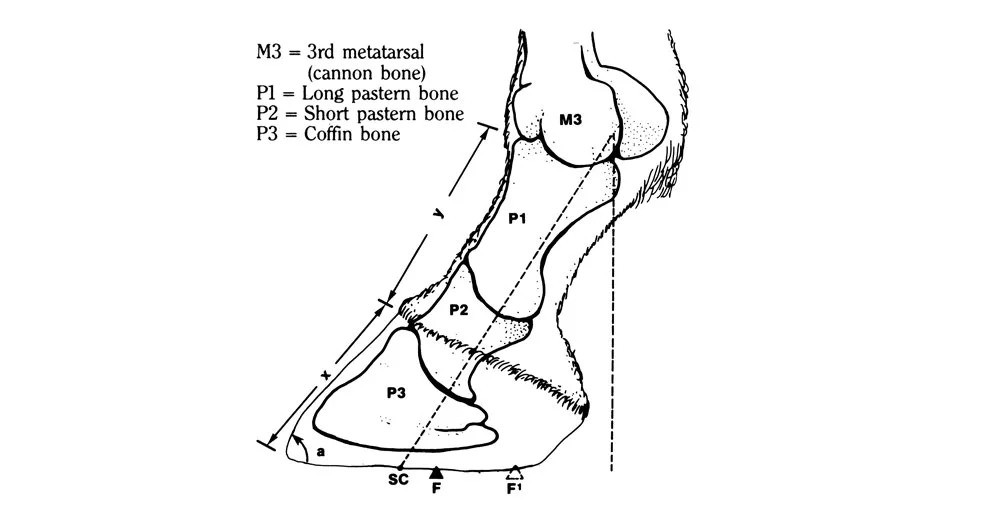
The hoof, if broken into quadrants, yields a lateral toe, a medial toe, a lateral heel and a medial heel. The point in the middle of the hoof where the quadrants meet is the center of the hoof (labeled SC in all figures). It is the center of the surface area of the hoof that bears weight and nothing more. It is impossible for this point to be the center of weight-bearing balance (labeled F in all figures). Concluding that this point is the true center of balance is closing the door to understanding the dynamics of the leg during the support phase of the stride.
“Center” has many meanings. The one referred to here is equidistant from the borders, in the middle, so to speak, the surface center (SC) of the hoof. “Balance” has many meanings, as well. The balance I am referring to here involves medial/lateral and anterior/posterior aspects, static/dynamic equilibrium, area and weight.
Balance, per this discussion, could be a point or a series of points that move in a predictable fashion as the conformation, angles, fulcrums and levers change during this consideration portion of the weight-bearing phase. This discussion pertains strictly to the horse during the weight-bearing phase of the stride, after all four quadrants of the hoof are on the ground and to midstance. For simplification, the left forefoot/leg is the only leg addressed.
It is physically impossible for the surface center of the hoof to be the center of balance in the horse’s hoof…

American Farriers Journal is the “hands-on” magazine for professional farriers, equine veterinarians and horse care product and service buyers.

American Farriers Journal is the “hands-on” magazine for professional farriers, equine veterinarians and horse care product and service buyers.
Download these helpful knowledge building tools


We are here to support you.
We stock a wide range of high-quality products from trusted brands to ensure durability, performance, and reliability in every job you undertake. Our extensive inventory of horseshoe products and farrier tools means you can find everything you need in one place, saving you time and effort. Your satisfaction is our top priority. We are committed to providing excellent customer service, prompt shipping, and hassle-free returns.
