
Though farriers are largely focused on the hoof, looking out for hoof health can also mean taking a holistic approach and accounting for other factors that influence hoof health. Many things are out of the farrier’s control and up to the day-to-day management of the owner, including weight management. However, a recent study found that horse owners are not always educated on how a healthy horse looks and some aren’t willing to change their beliefs.
Post-doctoral scholar Megan Ross of the University of Guelph, along with Dr. Katrina Merkies, shed some light on the attitudes and beliefs owners have when managing obese horses in an article by the University of Guelph. The study revealed that cultural norms and show-ring standards often favor “plump” horses. Because overweight horses have been normalized, lean and athletic horses can be perceived as underweight.
Even proper tools to assess weight like the equine body condition score weren’t reliable for owners (Mills et al. 2025). Participants misjudged fat as muscle, leading to lower scores than were appropriate.
Other owners are not ignorant of a healthy body condition score but emotionally blind to it.
“Owners often felt torn — knowing a leaner horse is healthier, yet struggling with the discomfort of seeing their horse look thin. Many keep horses on the heavier side as a sign of good care, and media images that reward overweight horses only reinforce this perception,” says Ross (Ross et al. 2024).
When explaining why horses are overweight, study participants cite time constraints, cost and facility limitations, while boarding managers expressed difficulty in tailoring feed for individual horses in large groups. Others were honest about their preference for a slightly overweight horse going into winter, assuming that the horse would lose any excess weight by spring due to harsh conditions.
Methods to mitigate weight gain like grazing muzzles and dry lots were mentioned frequently by owners in the study, but enrichment and welfare concerns remained. Other strategies like track systems and slow feeders were explored less commonly despite studies showing their efficacy.
What Are The Risks?
Overweight horses are at higher risk of laminitis than horses with an ideal body condition score, and horses that are overweight are more likely to have metabolic issues — such as PPID — which can also cause laminitis.
“Adipose (fat) tissue is an inflammatory organ and produces numerous compounds that lead to inflammation in several parts of the body, most notably the hoof,” says Dr. Shannon Pratt-Phillips, an equine nutritionist. “In addition to the hoof, problems also occur with reproduction, heat dissipation, digestion (due to lipomas that are fatty masses in the intestines that can cause blockages) and an intolerance for exercise in obese horses.
“It is also extremely likely that excessive weight has a negative impact on overall hoof health. As an example, proper blood circulation is partly attributed to the compression and expansion of the digital cushion within the hoof. If a horse is carrying excess weight, the digital cushion’s function may be compromised, resulting in poor blood circulation and laminitis.
“In addition to laminitis, excess body weight likely causes regular strain on the hoof wall as it expands with each step in order to absorb normal shock and concussion. This can be further strained with extensive exercise since even more force is applied as the hoof hits the ground. Over time, obesity may disrupt the integrity of the hoof wall, resulting in cracking or crumbling hooves. In addition, the extra strain on the joints is of great concern, particularly for athletic horses.”
What Can Farriers Do?
Advising horse owners on accurate body condition scoring and explaining potential health concerns may help owners with obese horses make management changes. Emphasizing quality of life and the vet and farrier expenses that come with laminitis can be good motivators.
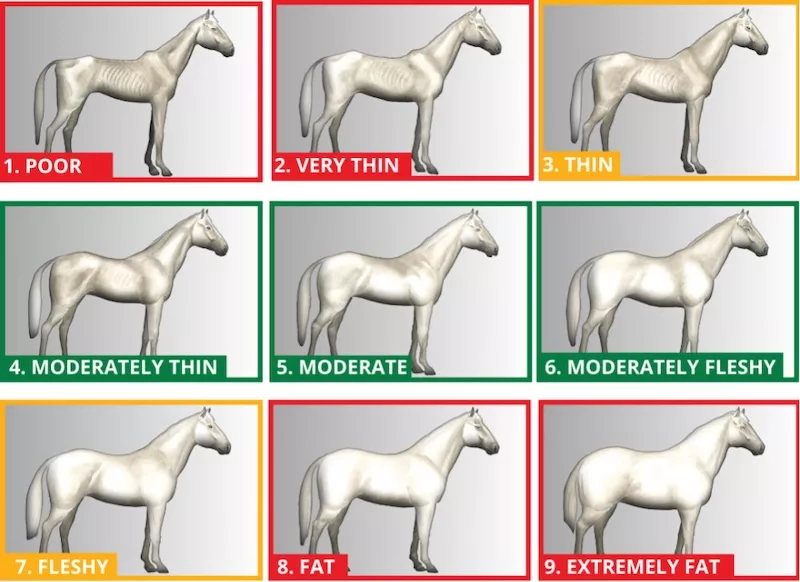
Lydia Gray, an equine health consultant and former staff veterinarian at SmartEquine, describes body condition scoring as a numerical-based standardized system of assessing fat cover in a horse. It ranges from 1 to 9 with 1 being extremely emaciated, 5 being ideal and 9 being obese. Each number on the scale represents about 50 pounds.
Standardizing body condition helps equine professionals stay on the same page when it comes to weight management and overall health. It’s also helpful in tracking weight-loss progress.
There are six areas of the horse that should be assessed with measuring fat cover, including along the neck, behind the shoulders, along the withers, across the ribs, down the back or loin and along the tailhead. Each area should get a number and those numbers averaged to get an overall score. See the image above for a general picture of how each body condition score looks.
“One of the biggest challenges is that horses thrive on social turnout and grazing, but lush pastures can lead to obesity,” says Ross. “Owners may struggle with the trade-off between keeping horses happy and keeping them healthy.”
However, there are ways to do both, such as with track systems, slow feeders and enrichment activities. Challenging an owner’s belief with proven strategies and wellness facts can save farriers and owners health stress down the road.