Takeaways

  • Low, weak heels can cause extensive pain and damage in the hoof, limb and into a horse’s frame.
  • Long toes act as a lever, putting extreme pressure on the coffin joint and the supporting structures.
  • The horse should naturally break over from heel to toe. If the toe is so long it slows and impedes the breakover, the stress dissipates to the rear of the hoof and limb.

Low, weak heels can cause significant issues for both performance horses and the pleasure horse.

The issues relating to low, weak heels do not isolate themselves to only the hoof. They also can cause extensive pain and damage up the horse’s limb and into the frame of the horse’s body that, in turn, affects its ability to perform to the best of its ability. Early intervention is always advisable, but farriers often inherit the issues and must try to remedy it for the horse as best as they can.

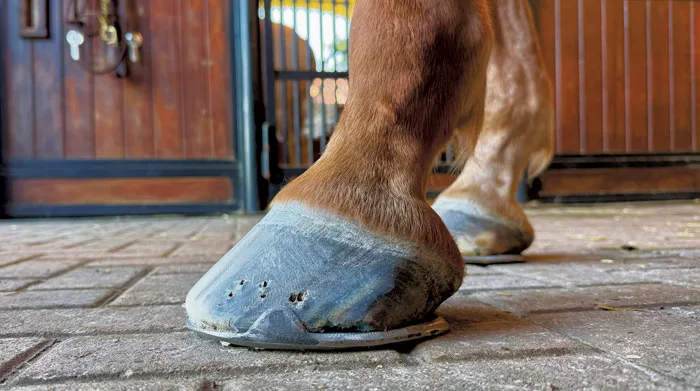
Toes that are kept too long exacerbate the problem of low, weak heels. The long toe acts as a lever, putting extreme pressure on the coffin joint and the supporting structures, which then travels up the limb. The horse should naturally break over from heel to toe. If the toe is too long, it slows and impedes the breakover, and the stress dissipates to the rear of the hoof and limb.

There are a multitude of approaches to assist a horse with low, weak heels. It’s important to note, each horse is individual, and what works for one might not be the solution for another.

Many raise the heel to correct the angle, which seems logical. However, the fetlock or the hock will drop, which puts even more pressure on the heels. Seeing this in action, the heels will crush even more in most cases. Some might suggest egg bar shoes. Although they serve a purpose in some cases, I find they provide too much support behind the hoof and again crush the heels.

Back Up the Toe

The approach I take, assuming it’s not contraindicated to the horse I’m presented with, draws on my decades of experience and observation. I prefer to concentrate on the toes by bringing them back and slightly narrowing the quarters.

When toes are too long and wide, it pushes all the weight back to the heels, which leads to crushing. A horse such as this that’s worked on a soft surface will not sink, which puts pressure toward the heels and causes more strain.

Managing Heels

Managing-Low-Weak-Heels-in-Performance-Horses.jpg

Early intervention for low, weak heels is always advisable, but farriers often inherit issues and must remedy it the best they can. Neal Tredinnick

Neal Tredinnick of Florida Sports Horse Farriery offers the following advice to his customers with performance horses with compromised heels.

  1. The Wellington, Fla., farrier advises minimal trail riding on hard, rocky surfaces to avoid crushing heels.
  2. Remove studs as soon as possible following competition. Do not allow the horse to stand for lengthy periods of time in a stall or trailer with them in.
  3. Adhere to a regular shoeing schedule of 3-4 weeks. Do not allow them to exceed the time frame as the toes will grow long and place too much pressure on the heels.
  4. Apply a waterproof hoof oil when paddocks are wet to prevent water from penetrating hooves. By contrast, when the ground is extremely dry, avoid hoof cracking by using a hoof moisturizer. Hooves should be somewhere in the middle — not too dry and not too wet.

I’ve had the most success with flat feet by bringing the toe back, bring in the toe quarters and applying a well-

fitted wide-web shoe to offer heel support. I like to grind the toe off the shoe to improve breakover. Shoe the heels as wide as possible to minimize heel sinkage. However, heel crushing can occur when the shoe is too far out the back of the foot.

I’ve also had success using a frog pad, which consists of a flat pad with a raise portion that places pressure on the frog and removes it from the heels. The frog is a shock absorber and all too often the frog can be compromised on a horse with neglected low, weak heels. It’s important that the frog can dissipate shock as nature intended. If the frog isn’t contacting the ground, there will be negative shock absorption occurring elsewhere in the hoof, which can cause severe injury and trauma. It’s important to acknowledge that we want the hoof to perform as near to natural as possible and not inhibit what nature designed.

I have shod Olympic-level horses that have had exceptionally low, flat heels using the techniques described in this article. Having a horse with this type of conformation doesn’t necessarily mean it will not reach its potential. With continuity of farrier and veterinary care, along with careful management, these types of horses certainly can go on to perform at the highest levels.