

Farrier Takeaways
- Employing a systematic approach in your overall assessment can help interpret the case and determine how to managing potential problems.
- Static and dynamic assessments coupled with external examination can help determine the effectiveness of the current prescription.
- Determining where the toe length is originating will offer a sense of direction when removing foot, based around the center of articulation.
See Stuart Muir in-person at the upcoming International Hoof-Care Summit on January 26-29 in Covington, Ky. He will be presenting on Vascular Pathways and Physiological Factors that Affect the Distal Limb. See his full video overview here.

The practical art of shoeing horses is often a combination of necessity and the desire to provide therapeutic or athletic advantage to the horse. Hoof capsule variances can provide untold obstacles and challenges that might need addressing during the life of a horse.
Identification of contradicting pathology or diseases can make a shoeing prescription challenging. It also might make certain approaches either infeasible or unsustainable for a particular horse over an extended period of time. An example of this could be internal pathology coupled with exterior environmental diseases of the hoof capsule.
It can be useful to approach each limb as an individual case to maximize both the horse’s and farrier’s chances for success. Therefore, having an evaluation protocol can be useful.
Assessing Conformation
Employing a systematic approach in the overall assessment can help the hoof-care provider interpret the case and aid in deciding the best approach to managing any potential problems. Once the hoof-care provider has identified the need for change within a shoeing prescription, creativeness and adaptability can come into play.
Assessment of limb conformation is a good place to start when preparing to shoe a horse (Figure 1).
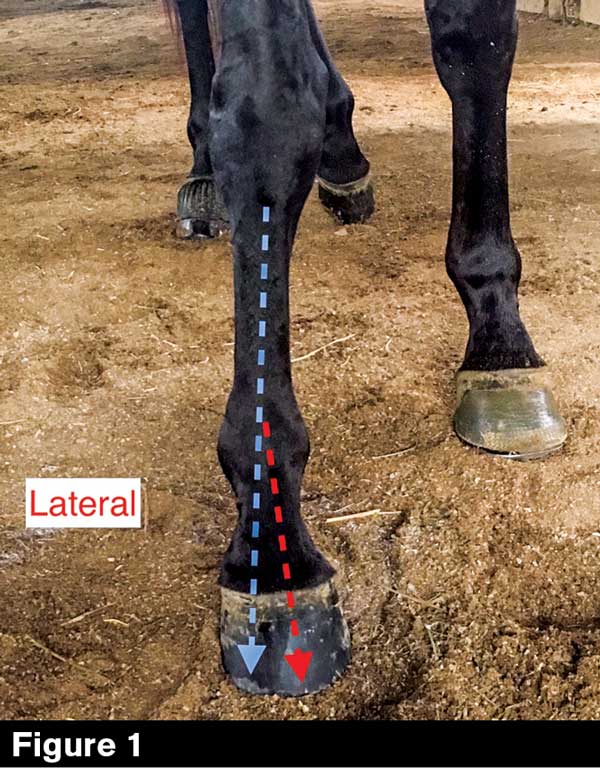
Limb conformation will affect the loading forces dissipated onto the hoof capsule. The loading effects of limb conformation often can be seen when hoof-care providers start interpreting the hoof capsule health, contour and shape.
Hoof capsules that are showing signs of being overloaded in certain areas can be a normal response from proximal limb alignment. Horses that have deviations in the bone column will direct the forces caused through static and dynamic loading to different quadrants of the hoof capsule than a horse with more ideal conformation.1
Often, if the horse has pathology or hoof distortion, the origin of lameness can manifest in relation to loading force (Figure 2). Externally, this can be seen in terms of quarter cracks, flares and a steeper vertical wall structure. Vertical deviation of structure is generally an indication of the quadrant of the hoof capsule that is dissipating the most significant amount of load.1
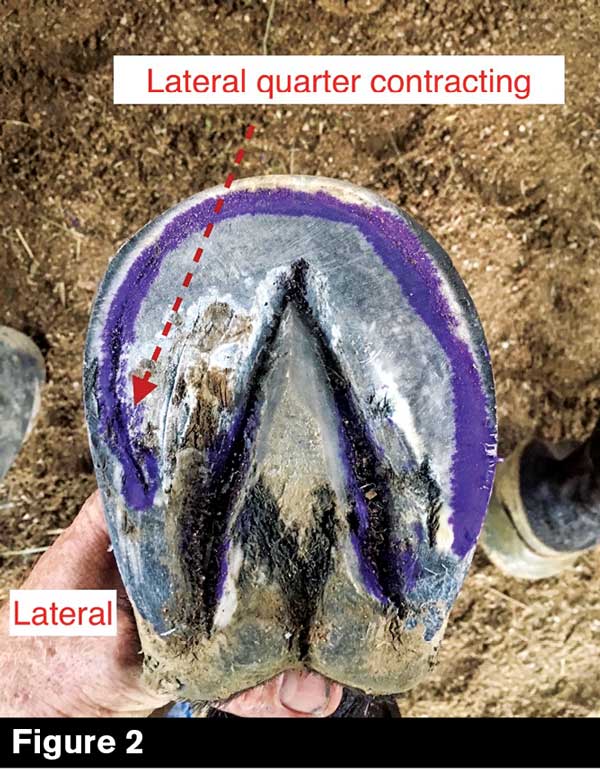
Hoof quality can be taken into consideration in the examination process. The wall has three components — the internum stratum, medium stratum and externum stratum. The most superficial layers of hoof wall are typically the hardest and offer protection to the underlying sensitive structures.
Environmental factors can play a significant role in the way that the hoof-care provider manages distorted feet. Humidity and high saturation levels can leave a horse’s wall structure more pliable under load. Removing too much integrity from the wall often only weakens the structure further. Therefore, adapting alternative trimming methods can help manage weak or highly saturated feet.2
Neutralizing saturation levels can lead to a more robust hoof capsule. The horse’s location and environment can be taken into consideration when suggesting treatments that either dehydrate the feet or soften them.2 Wall and sole health is going to be fundamental to shoe selection, as well as deciding whether it is safe to nail or whether the option of glue-on shoes is needed.
External Forces
Although identifying limb alignment and hoof capsule distortion can be an important element of hoof capsule rehabilitation, it can also be important to note the effect of external force on the internal structures of the hoof capsule. External forces can be the cause of contracted heels or other distortions that create compression within the hoof capsule. These might also affect the function of the shock-absorbing structures in the foot.
Static and dynamic assessments coupled with external examination can help the provider to assess the effectiveness of the horse’s current hoof-care prescription. Watching the horse move prior to shoeing can offer the practitioners valuable insight into any lameness, and help them to identify how the horse is traveling in relation to limb alignment before the next shoeing takes place.
If lameness is detected during the dynamic evaluation, palpation of the digital pulse, located at the fetlock, can quickly give an indication of which leg has inflammation-based pain. Generally, the digital pulse will become enlarged in cases when inflammation is found within the hoof capsule.
A thorough examination of the external structures can help identify any areas of soreness or inflammation in the distal limb.
Hoof testers can be used to manually palpate areas of interest. Hoof testers can be used to evaluate how pliable the structures are and also assess how much hoof mass the horse has. Evaluating hoof mass or integrity can be done by depressing the hoof testers on the area of interest to see how much pressure it takes to displace the structure.
Hoof mass is a key component of a healthy hoof capsule. The horse’s ability to dissipate energy before it transfers to the coffin bone is one of the most basic functions of the hoof capsule. In cases when a horse is suffering from a lack of sole mass, often the solar corium can be affected to the point where it isn’t capable of excreting the horn needed to recuperate. This is possibly due to inflammation that is associated with the growth centers that provide nourishment to the sole region.
Offering Support
Using a pragmatic approach to hoof care can be one of the quickest routes to rehabilitation.
When horses’ hooves are in a distorted position or condition, the hoof-care provider can also consider using hoof-care strategies that will artificially support internal and external structures that are not positioned in their original location. In cases when the wall structure is weak, the hoof-care provider can choose to be cautious about removing too much integrity from the hoof capsule. Removing hoof capsule integrity in lieu of a cosmetic finish might only further diminish the concussion-dampening characteristics that the hoof wall provides.
Limb conformation will affect the loading forces dissipated onto the hoof capsule …
Heel position and wall health is an important element to consider when putting together a shoeing prescription. When a horse’s hoof capsule is showing signs of being overloaded, the hoof-care provider might consider that the internal structures that lay in close proximity are also compromised.3
Heel structure, which is in a distorted position, can be one of the first indications that the hoof capsule is not managing load adequately.3 When the hoof capsule is migrating dorsally, the hoof-care provider can consider the use of artificial break-over principles such as rocker toes or shoes that have mechanics already artificially manufactured into them. The same could be done for horses whose heel structure is not in its original position. Offering the horse extra length of shoe can help support the heel structure that is compromised.
The functionality of the internal structures’ ability to generate new healthy growth often can be the determining factor in the horse’s ability to recover from distortion-based lameness.
Sole Depth
Further examination of the feet could include identification of the solar architecture.
While sole depth is important, determining where the toe length is originating will give the practitioner a sense of direction when removing foot, based around the center of articulation.4
The hoof capsule can have a tendency to elongate and this can be seen radiographically. Finding the live apex of the frog can lead the hoof-care provider to visually survey whether the horse has vertical depth of foot or hoof mass that has stretched forward in a horizontal plane.
The digital breakover is considered the distance between the dorso-distal aspect of the coffin bone, to the most anterior/distal aspect of the exterior hoof wall. An extended digital breakover measurement is often found in feet with a long toe and very shallow vertical depth of foot.5
Horses with shallow vertical depth of foot can be difficult to trim. Depending on the approach, sole and wall integrity can be lost through excessive rasping in an effort to bring the toe back into a “normal” parameter.
The frog’s composition has an estimated moisture content of 50%. Therefore, the soft, pliable nature of this structure is often one of the early warning signs that the central aspect of the hoof is overloaded.
Ideally, the trimmed frog would mirror the sensitive frog shape and form.6 Shoe selection can greatly benefit horses that are showing signs of the solar region being overloaded. Stock dimension can reduce the strain from proximal related force or load alone.
Reducing the amount of distance between the foot and ground surface can help engage the caudal and central structures of the hoof capsule. This also can stimulate the internal anatomy that is proximal to them.
Load Sharing
Horses that have poor wall and sole quality might need the added benefit of incorporating other structures into a load-sharing capacity. Load sharing is a term that acknowledges incorporating other structures into a load-bearing role.
Traditionally, the hoof capsule’s solar region was thought to be unable to take any significant weight caused through load bearing. Historically, solar support was generally offered through bar shoes and plastic or leather pads. While this might be true for chronically thin-soled horses, other foot types can do well with the assistance of solar support.
Owners, trainers and riders competing at a high level often need traction. Depending on shoe selection, therapeutic horseshoes can be difficult to introduce into a horse’s shoeing prescription of this caliber, since they can decrease the amount of traction depending on the composition of the substrate they are competing on.
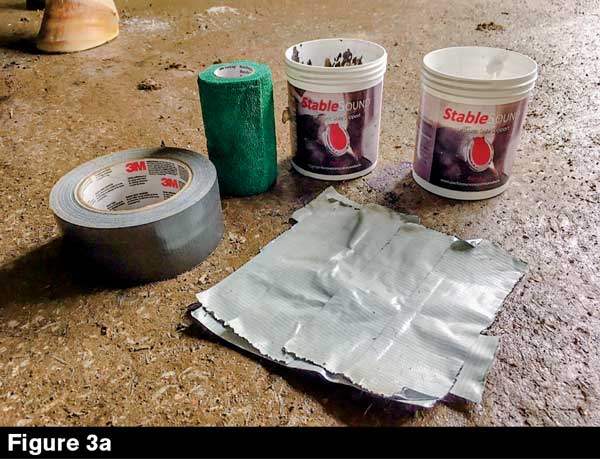
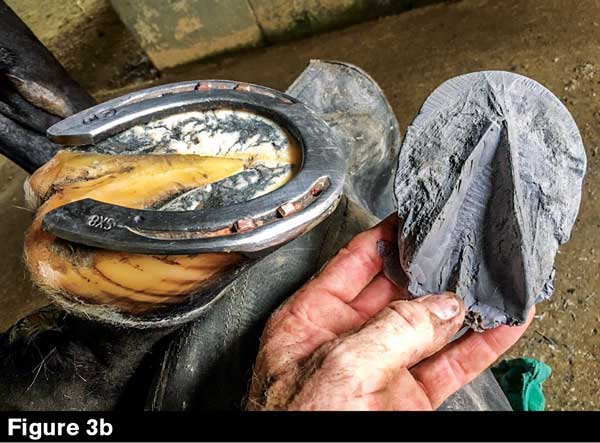
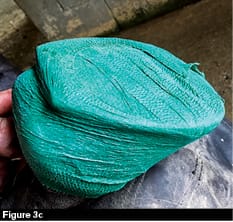
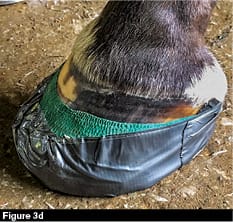
Solar support can come in numerous options — impression material, pour-in orthotics and frog support pads can all be used to help horses suffering from lack of solar arch or concussion-related issues.
The use of temporary orthotics (Figures 3a-d), made from impression material, can offer the benefit of sole support while being easily removable when the horse is competing. The temporary orthotics can be applied using a basic foot packing method, while they are needed.1
Identification of infection residing on the sole, frog, white line and wall can enable the hoof-care provider to make a judgment on which topical treatment to use either before or after shoeing. Areas of superficial infection on the hoof that are compromised can be treated topically with numerous over-the-counter solutions.
Managing external diseases of the hoof capsule is important to the overall health of the hoof. Depending on environment and location of the horse, topical solutions and shoeing can play a pivotal role in successful management. When dealing with infections that penetrate into the hoof capsule, identifying the affected layers is important. If the infection is bordering dermal structure, the use of non-caustic solutions is necessary to stop possible chemical burning of the underlying live sensitive structure.
Care must be taken when trying to cornify the external wall or sole structure too quickly, as this can lead to the base of the infection not healing from the deepest juncture of the wound, or infection site. This could predispose the hoof capsule to reinfection at a later date.
Depending on the infection, the use of copper sulfate pastes and detergents designed for equines are a great addition to a shoeing prescription. Areas of compromised tissue encompassing the white line region can be treated before the shoes are applied to ensure the area is passively medicated while the shoe lies over the site of infection.
Treating infections on the solar surface can be easier to manage with the use of treatment plates or foot packing. Keratinaphillic diseases such as white line and seedy toe can be effectively treated with topical chlorines and, in severe cases, debridement.
Managing internal pathology can be as challenging as managing external hoof capsule distortion. Once the origin of pathology is identified and an external examination is done, a shoeing prescription can be determined.
In certain cases, intervention with veterinary sports medicine may speed up the effectiveness of the shoeing prescription. Veterinary diagnostics can enable hoof-care providers to focus on the surveyed pathology. This element can play a fundamental role in the rehabilitation of the horse, as the shoeing can become very detailed to that particular site of pathology.
Managing pathology can be a dynamic situation because pathology can be progressive in nature. Depending on the lameness, forces applied to the hoof capsule through shoeing might change with the movement of the center of pressure. This is often seen when altering the hoof capsule angle with the use of graduated or wedge shoes.
While therapeutic shoeing can be a successful method of supporting and relieving pathology, the sustainability of the shoeing might need continual monitoring to ensure the hoof capsule integrity isn’t being compromised.
It might be important to re-evaluate the shoeing periodically and make any changes that are indicated through hoof capsule change or progressive pathological change.
Having a systematic approach for evaluating a horse for shoeing can be one of the fastest routes to equine soundness
References
- Morrison S. (2013). The Thoroughbred Racehorse Foot: Evaluation and Management of Common Problems. Lexington, Ky.: Rood and Riddle Equine Hospital.
- Ramey P. (2011). Care and Rehabilitation of the Equine Foot, Georgia: Hoof Rehabilitation Publishing LLC.
- Morrison S. Understanding Ground Impact and Heel Pain
- Duckett D. (2008). The External Reference Points of the Equine Hoof. The American Association of Equine Practitioners, 54th Annual Convention. San Diego, Calif.: Presentation.
- Redden R.F. (2006) When and How to Use the Full Rocker Motion Shoe.
- Bowker R. (2003). Contrasting Structural Morphologies of “Good” and “Bad” Footed Horses. East Lansing, Mich.: Department of Pathology and Diagnostic Investigation, Michigan State University.
- Colhan P., Leach D. and Muir, G. (1991). Centre of Pressure Location of the Hoof with and without Hoof Wedges. Gainesville, Fla.: Department of Large Animal Services, University of Florida.