
Farrier Takeaways
- Consider whether the horse is sound and when it will compete before deciding to make significant changes to the foot.
- Use caution when trimming sole. Using a wire brush to brighten the sole and conservative knife work will benefit the horse.
- It’s important to relieve heel stack because it creates more pressure on the suspensory.
- Providing a thumb’s width between the apex of the frog and the inside of the shoe’s toe is a good, general guide.
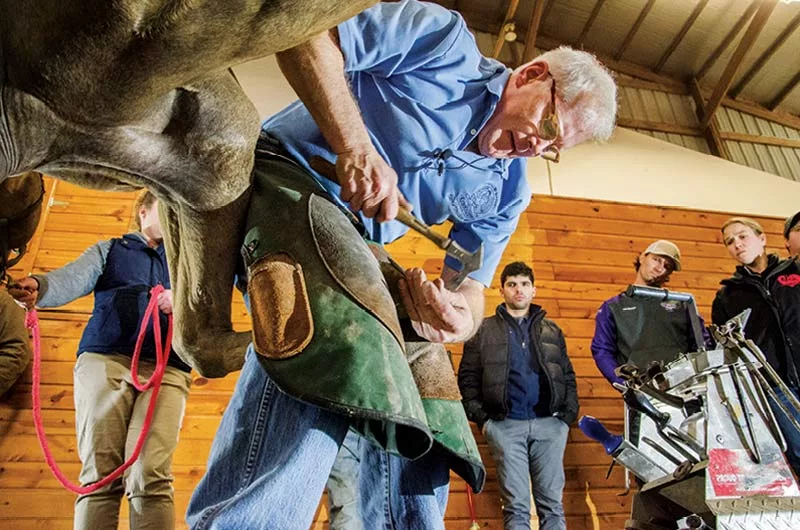
Shoeing performance horses don’t require bells and whistles. Quite the contrary, says Lexington, Ky., farrier Bobby Menker.
“Just keep it simple,” he told attendees at the Wisconsin Equine Clinic & Hospital in Oconomowoc, Wis. “We start at the coronary band and then try to build a base all the way down. This is what I like to build for.”
It’s the shoeing philosophy that he follows each day, regardless of the horse’s experience or value. Menker shared some cases involving heel problems during the mid-February clinic.
Heel Relief
Menker and his son Austin were introduced to a horse that is just weeks away from the All-American Quarter Horse Congress, which takes place much of October.
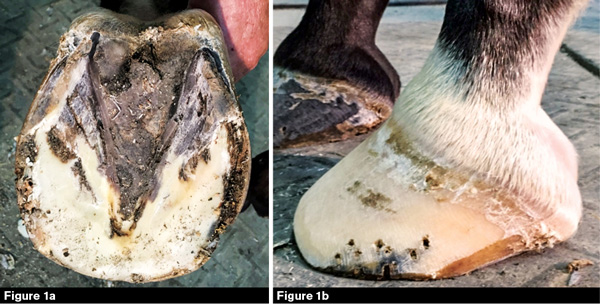
“There’s a lot of pressure going on in the back half of this left front foot (Figures 1a and 1b),” says the elder Menker, noting the horse had on rail shoes before Austin pulled them and lightly prepped the feet. “Both heels are crushed. We didn’t have any sole left on the front. It wasn’t like it was giving, but you could just feel that we were right there. If we took out any more sole, we were going to be in trouble. We really didn’t have any walls. Everything was blown out.”
When trimming any sole, Menker draws upon the influence of Somerset, Mass., farrier Myron McLane.
“Myron explained a long time ago that he likes to brighten his soles,” he says. “I used to really love to use my knife a lot. We get in trouble real quick with using our knives too much. That got me thinking. Now, I use a lot of wire brushing and I just lightly brighten my soles. As soon as the sole starts getting waxy a little bit, I quit.”
The older horse will be competing in multiple events at the Congress, and it’s sound.
“I don’t want to make any big changes, but I want to get some relief off those heels,” he says. “He’s a little bit offset in the knee and everything ties to the outside. The inside view on this horse really rolls under and everything moves to the outside of the leg.”
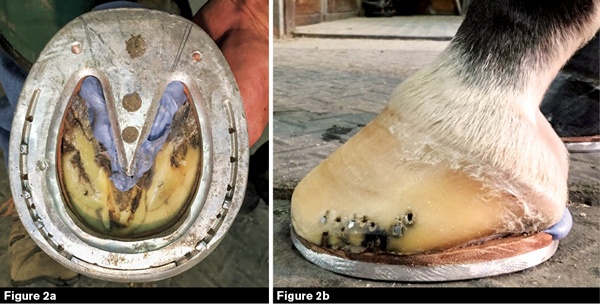
Menker applied a leather wedge rim pad that didn’t cover the frog and chose a heart bar (Figures 2a and 2b).
“A lot of times I’ll use leather on the frog, but I didn’t want anything that rigid on there,” he says. “I put dental impression material in because while he wasn’t sore, he was already compressed.
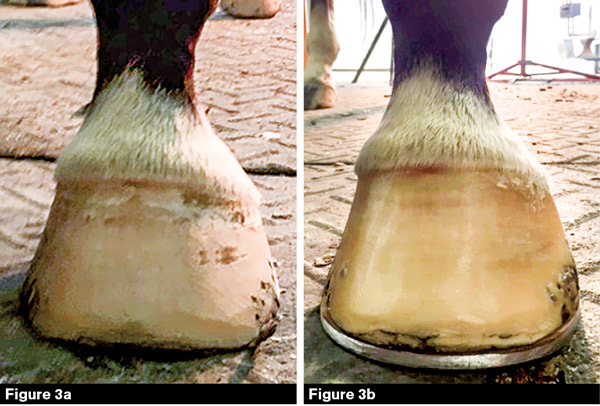
“In this before and after (Figures 3a and 3b), I was trying to get the center of his hoof capsule over and underneath the center of his leg a little bit more.”
The horse not only became comfortable, it performed without issue and placed second at the Congress. The Menkers took the horse out of the heart bars 6 months later and applied an aluminum Kerckhaert Comfort shoe (Figures 4a and 4b).
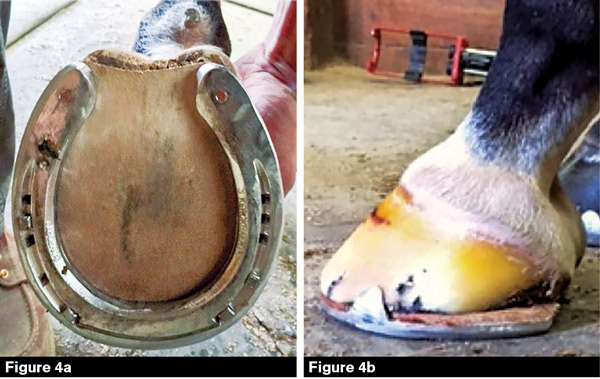
“I use them kind of like a Morrison shoe,” Menker says. “They have a wider toe, which offers more protection for these flat-footed horses that don’t have a lot of sole depth. I can put a really big bevel in them. Then I use the leather wedge or whatever so it gives me a little lift and also a nice breakover.”
In this case, he prefers to use reverse bevels to broaden the branches, he says.
“I widen the inside branch as much as I can so that I have support underneath the hoof capsule, but I’ve got it in the center of his leg,” Menker explains. “You can see that the angle is getting better and the hoof capsule is more pulled together.”
Heel stack is as big of a problem as being flat-footed because it puts more pressure on the suspensory …
When Menker looks at front feet, he recalls a method of assessing hoof wall angles that he learned from Edgewood, N.M., farrier Craig Trnka.
“He talks about two fingers from the coronary band as the true angle of the hoof wall,” he says. “I started looking at it that way myself. It plays true because when you put two fingers down, you’ll start seeing the distortion happening on the hoof capsule. That’s just some of the little things that we take into consideration.”
Menker decided to use a full leather wedge pad this time.
“A lot of times, we’ll use either Equi-Pak — the CS or the Soft — or RATE Hoof Packing,” he says. “I’ve had really good luck with using the RATE Plus underneath some of these feet, and I don’t get the sweat underneath them like we do with some of the other packings.”
Stacked Heels
Sticking with the theme of heels, Menker moved toward a different type of problem with a young Paint.
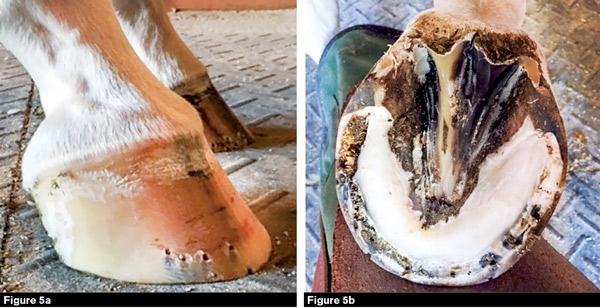
“The first thing I noticed is how steep this thing was, how stacked up his heels were (Figures 5a),” he says. “This thing is just loading like crazy. As you can see on the foot surface (Figure 5b), look how far forward and how much separation is in those heels.”
Heel stack is as big a problem as being flat-footed because it puts more pressure on the suspensory, Menker says.
“If you watch a horse with a lot of heel stack, they’ll hit the ground and fall off the back side of that foot,” he says. “The toe will come off the ground. You can’t tell me that’s not putting more pressure on the back of those legs.”
After just one trimming, everything started to relax.
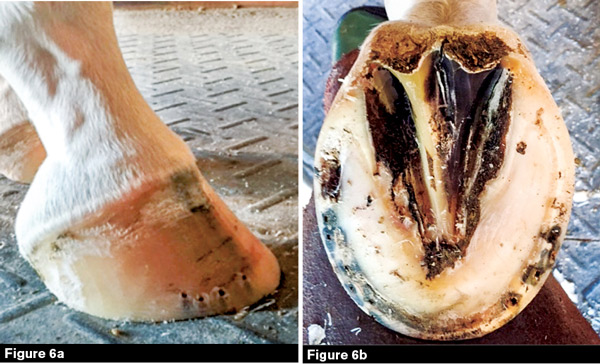
“Look at the difference in the suspensory branches (Figures 6a and 6b),” Menker says. “I haven’t even dressed the front. The widest portions of the frog are farther back now. After I look at this picture, I keep asking myself why I didn’t pull this heel back even a little bit farther. But there was something about it at the time that made me not do it.”
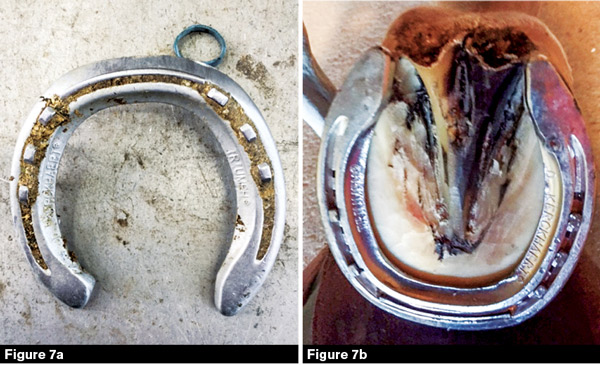
The 00-size shoe they pulled off the Paint (Figure 7a) had a chopped off heel and large nails, he says. Menker went up a shoe size and provided more support in the heels by applying an aluminum Kerckhaert Triumph (Figure 7b).
“I left the medial branch a little fuller and got the heel in the center of the stock,” he says. “I’m supporting the inside branch of his leg with it that way. I put a nice big blunt toe. I came back a little bit and have nice spacing between the toe and the apex of the frog. You can tell we got him pulled back and I got his foot underneath where it needs to be.”
The spacing between the toe and apex of the frog is a practice that hit home for Menker after spending a day with Goshen, Ky., farrier Conrad Trow.
“We got to talking about a Thoroughbred shoer who takes his thumb and puts it at the end of the frog and he wants that to be touching the inside edge of the shoe,” Menker recalls. “That’s his general guide. On a bigger horse, there might be a little bit more space.”
A short time later, he read about the same practice in an article. The more he thought about it, the more it dawned on him that he had been placing shoes with the same distance between the toe and apex of the frog all along.
LEARN MORE
Gain more insight from Menker by watching, “Traction Considerations To Enhance Performance,” by visiting
americanfarriers.com/0518
“I didn’t realize I was doing it,” Menker says. “There are some times that I catch myself when the shoe is a little bit more forward and I have a little bit more distance between the toe and apex of the frog. But, I’ve found that a nice thumb distance between the end of my frog and the inside edge of my shoe is a good practice.”
Keeping it simple when shoeing performance horses — or any horse — will help keep them sound and functioning to the best of their ability.


