
Adam Ellens
Our excellent farrier, Adam Ellens, saved the life of the paint pony Sunny Princess. Adam's extensive knowledge came largely from his teacher, Dr. Doug Butler, and from experience. Below, you can find excerpts from the article originally printed in Horse Sport, about Sunny's condition and treatment.
— Colleen Rutherford Archer
(Deep River, Ontario)
Saving Sunny
A journey through founder
Full article originally printed in the August 2012 issue of Horse Sport
By Colleen Archer
Christmas preparations were already underway last December when I looked out the window and saw our sweet 14-year-old paint pony Sunny Princess, who we had owned for a year and a half, with her left leg stuck out at an awkward angle. For days the weather had been terrible and the ground icy, and I thought with horror that Sunny must have had an accident and broken her leg.
...
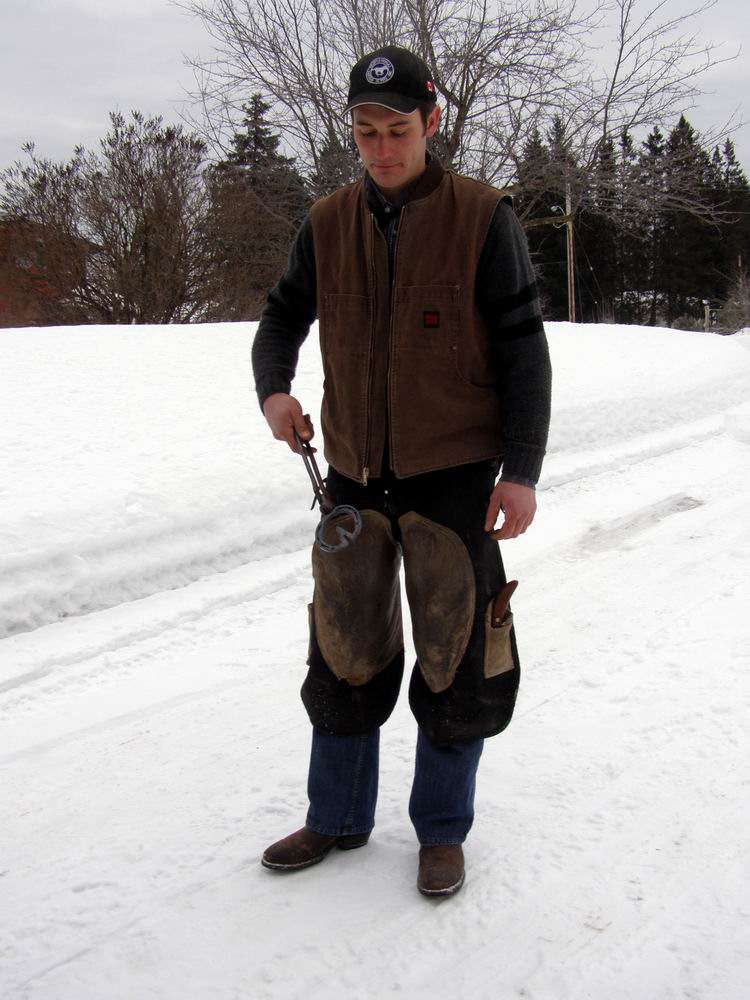
Adam Ellens |
Luckily our farrier, Adam Ellens CF (certified farrier), was coming soon to trim the horses’ hooves. While I assumed Sunny had pulled a muscle and that was why she was reluctant to move, Adam suspected she had laminitis and had probably iced up on the front hooves because of shifting her weight to the back. Both my veterinarian and Adam had mentioned she might have had mild laminitis in the past because of the characteristic rings on her hooves – wider at the heel than at the toe.
Adam suggested reducing her feed,
letting her rest in her stall, soaking her
front hooves in cold water, and inquiring
with my vet about anti-inflammatory medication. I had never dealt with laminitis in a horse or pony before and didn’t recognize the symptoms, and hate to think what would have happened to Sunny if Adam had not been there. X-rays were needed for a really accurate diagnosis, so I called the Ottawa Valley Large Animal Clinic. Meanwhile, Adam put heart bar shoes on Sunny’s front hooves to support the bone column.
It was a bitterly cold day when Dr. Larry Butler of OVLAC arrived to x-ray Sunny, but by employing a tiny heater and working quickly he managed to get the images. “We have a case of founder going on,” he confirmed. Sunny had a six-degree rotation of the coffin (pedal) bones, with areas of inflammation in both front hooves. Now at least we knew exactly what we were dealing with.
The recommended treatment for Sunny was bute, antihistamine, and soaking her hooves in hot water for half an hour three times a day. While in the initial stages of laminitis cold water is generally recommended to stop the swelling in the laminae (the tissues connecting the coffin bone to the hoof wall), as the condition progresses hot water is the norm. In extreme cases, resection is sometimes necessary – a procedure in which a section of the dorsal hoof wall is removed to relieve swelling, release pressure from the coronary band, and drain any abscesses.
In Sunny’s case, temperature changes were advised to help restore circulation, so I would put Sunny on snow for half an hour, then in hot water for half an hour, and then into her stall for two hours to rest. When Dr. Butler first suggested three half-hour soaks a day, I said in a shocked voice: “But that will make three hours a day of soaking!” A bemused Dr. Butler then pointed out how it is perfectly possible to soak both front hooves simultaneously.
...
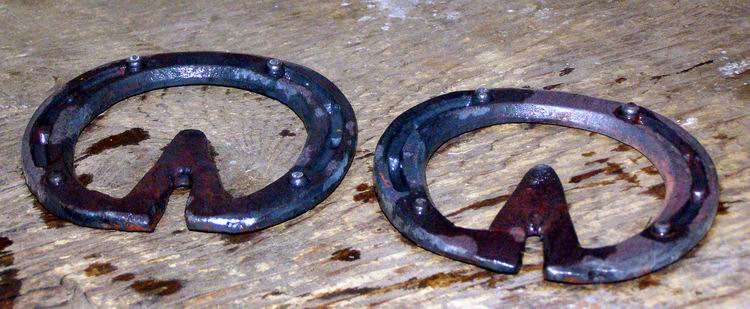
Photo orginally published in Horse Sport. The heart bar shoes used to help support the bone column in Sunny’s hooves while she recovered. |
An unused stall with a soft-stall floor became Sunny’s “treatment room.” As usual, despite the pain she was in, Sunny was a perfect patient and accepted everything with good grace. While her feet soaked in the hot water, I would make little whirlpools with my hand and do (Tellington) TTouch on her.
...
Other care included the endless cleaning of Sunny’s stall and the spreading of deep shavings, lots of grooming to give her some company, and the “Easter egg hunt” once she was able to be outside, in which I would divide her small flake of hay over a wide area of snow so she would get a bit of gentle exercise to relieve some of her boredom. For equine company she could visit “the boys” (our three geldings) over the fence.
In the course of two months I put in well over 150 hours nursing Sunny, and I’m extremely grateful to both my farrier and the veterinarians for their good advice. Without them I can’t imagine Sunny would ever have recovered.
...
According to Adam, it would take about a year for Sunny’s hooves to get fully adjusted to this new reality, but my hope is that with the continuing help of the farrier and veterinarians she will remain functional. Adam’s teacher, Dr. Doug Butler (no relation to Dr. Larry Butler), author of Laminitis and Founder, Prevention and Treatment for the Greatest Chance of Success, says this about treating founder:
“You are looking for a team that can work together with you to solve a very complex and potentially deadly problem. Farriers may understand the mechanical aspects of the problem, but not the medical aspects. Veterinarians may understand the medical aspects, but not the mechanical.
...
According to Dr. Butler, mismanagement due to overfeeding idle horses causes 70 to 80 per cent of laminitis cases, and I’m hoping that by reducing Sunny’s feed I will be able to prevent any future episodes.
...
Knowing what you’re feeding can be of particular importance for owners of equines with metabolic issues. Recent studies have shown that a large proportion of horses with laminitis also have an underlying endocrinological disease such as equine metabolic syndrome (EMS) or Cushing’s syndrome. Equine metabolic syndrome, which can strike horses of any age, is in fact characterized by obesity, insulin resistance, and susceptibility to laminitis.
As Adam, Dr. Larry Butler, and Dr. Doug Butler have all said, you can indeed “kill a horse with kindness”, and our two ponies are now on a very strict diet. It may be hard to deny your ponies and idle horses treats, grain and supplements while others are munching away, but if you’ve witnessed the excruciating pain suffered by a victim of laminitis or founder, then you’ll know that keeping a horse or pony at its proper weight is the kindest thing to do.